
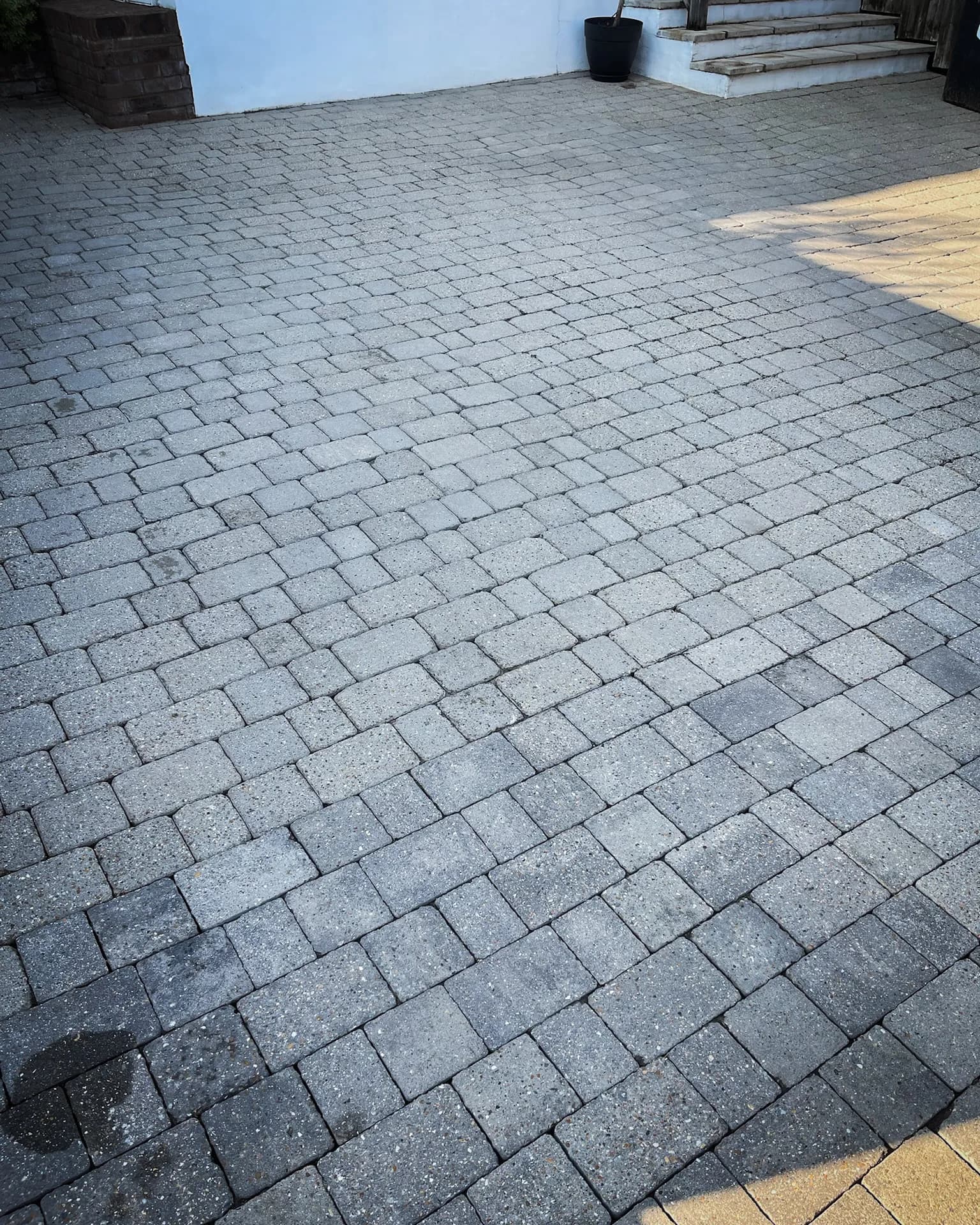
Block paving is one of the most practical driveway surfaces around. It is hard-wearing, repairable, attractive when it is properly maintained and capable of lasting for years. It is also one of the easiest surfaces to make look dramatically better with a pressure washer.
And that is where people can be fooled into thinking the job is finished.
A block paved driveway can go from tired and dirty to almost new-looking in a matter of hours. Years of algae and grime disappear, the original colour of the blocks starts to come back and the whole property suddenly looks sharper. It is extremely satisfying.
But with block paving, cleaning the surface is only part of the job. What happens to the joints afterwards matters just as much.
A block paved driveway is not simply a collection of individual blocks laid next to each other. It is an interlocking paving system, and the sand within the joints forms part of that system. When those joints are properly filled and consolidated, the individual blocks work together far more effectively as a surface.
The problem is that deep cleaning inevitably removes some of that jointing material. The stronger the clean and the older or looser the existing sand, the more likely it is that material will be washed out. That is perfectly normal, but it means that once the cleaning is finished, the driveway needs putting back together properly.
And that involves rather more than throwing some sand over it with a broom.
One of the most important parts of our block paving restoration process at Chiltern Surface Co is mechanical compaction. Once the driveway has been cleaned and allowed to dry appropriately, new jointing material is swept across the surface and worked into the joints. We then use a suitable plate compactor to vibrate the paving and help that material settle properly through the joint.
This is important because a joint can look full from the top without actually being full underneath. Loose sand can sit relatively high in the joint and give the impression that everything has been finished properly. Then the driveway goes back into normal use, the material settles further and suddenly the joints are noticeably lower than they were a few weeks earlier.
Mechanical compaction helps avoid that. The vibration encourages the jointing material to settle down into the available space, after which more can be added where necessary. In practice, it is often a process of filling, compacting, topping up and compacting again until the joints are properly consolidated.
It is not the most glamorous part of driveway cleaning. You are unlikely to see many dramatic slow-motion videos of a plate compactor on Instagram. But it is one of the parts that matters.
There is another reason for this. Block paving is designed to work as an interlocking system rather than as one solid slab. Properly filled joints help the blocks support one another and contribute to the overall stability of the paved surface.
That does not mean re-sanding can repair a badly constructed driveway. If there are underlying problems with the sub-base, settlement or installation, putting new sand into the joints is not going to perform some kind of structural miracle. But where the driveway itself is fundamentally sound, restoring the joints properly after deep cleaning is an important part of restoring the paving as a whole.
Why we often prefer polymeric sand
For many block paved driveways, we like to go one step further and use polymeric sand rather than conventional loose kiln-dried sand.
Polymeric sand is a specialist jointing material containing binding additives. It is installed dry into the joints and then activated with water in accordance with the manufacturer's instructions. Once correctly installed, it forms a more cohesive joint than ordinary loose sand.
We like it because it addresses some of the weaknesses people commonly associate with traditional block paving.
Anyone who has owned a block paved driveway for a while will probably recognise the routine. The driveway is cleaned and re-sanded, it looks fantastic, then gradually some of the sand starts disappearing. Rain moves a little. Traffic moves a little. Cleaning moves a little. Ants occasionally appear to launch a fairly substantial civil-engineering project.
Eventually there is more room in the joints for dirt, seeds and organic material to collect, and weeds begin appearing again.
Polymeric sand is designed to create a more stable joint and resist erosion better than conventional loose jointing sand. That makes it particularly attractive after a full driveway restoration, because if we have gone to the effort of cleaning the paving thoroughly and restoring the joints, we would rather use a material designed to remain stable for longer.
It can also help inhibit weed growth. The important word there is inhibit.
There is no sand on earth that can issue a legally binding instruction to nature never to produce another weed. Seeds can still land on the surface, organic material can still collect and, given enough time and the right conditions, something will inevitably attempt to grow.
But reducing the amount of loose, open jointing material and creating a more stable joint makes the environment considerably less inviting.
Polymeric sand still has to be installed properly
There is an important point here, because polymeric sand is sometimes talked about as though buying the right bag is the difficult part.
It is not.
Preparation and installation are crucial. The joints need to be clean, sufficiently dry and deep enough to accept the material properly. The sand needs to be worked down into the joint rather than simply sitting near the surface. Mechanical compaction remains important because the objective is to fill the available joint properly, not just create a hardened layer across the top.
Once the joints have been filled and compacted, excess material also needs to be removed carefully from the face of the paving before activation. The water application then needs to follow the product requirements. Too little, too much or poorly controlled activation can all affect the result.
In other words, polymeric sand is a very good product when it is used as part of a good process. It is not a shortcut.
Why do weeds grow between block paving?
This is one of the questions we hear regularly, and there is a common misconception that every weed growing between paving blocks must be pushing its way up from underneath the driveway.
Often, that is not what is happening at all.
Seeds and organic matter are constantly landing on outdoor surfaces. Over time they collect in the joints, particularly where the existing sand has become low or loose. Add moisture and a bit of sunlight and you have created a surprisingly comfortable little environment for weeds.
That is one reason maintaining the joints matters so much. Properly filled, stable joints leave less space for dirt and organic material to accumulate. Polymeric sand can help further by creating a more cohesive joint that is less easily disturbed.
Again, it will not make a driveway completely maintenance-free. Nothing outside really is. But it can make the paving considerably easier to live with.
Why compaction matters after pressure washing block paving
If there is one part of block paving restoration we think deserves more attention, it is this.
When a driveway is pressure washed or deep cleaned, some of the jointing sand will usually be removed. Replacing it is essential, but simply brushing new sand over the surface does not necessarily mean the joints have been properly restored.
Mechanical compaction helps settle that new jointing material down through the depth of the joint. More material can then be added where necessary until the paving is properly filled.
That is why we consider compaction part of the restoration rather than an optional extra. We are not simply trying to make a driveway look good on the day we leave. We want the joints to be properly rebuilt after the cleaning process.
A properly restored driveway is more than a clean driveway
This is really the difference in how we approach block paving at Chiltern Surface Co.
The pressure washing produces the obvious transformation. It removes years of dirt, algae and biological growth and restores the colour of the blocks. That is the bit everyone notices immediately.
But the less dramatic work afterwards is just as important. The paving needs time to dry. The joints need to be refilled. The material needs to be mechanically compacted. The joints need topping up where necessary. And, where the driveway is suitable, polymeric sand can provide a more stable long-term finish.
It takes longer than simply washing the driveway and sweeping ordinary sand across it afterwards. But that is rather the point.
A block paved driveway is a system, and when you clean it thoroughly you inevitably disturb part of that system. Our job is not simply to clean the blocks. It is to put the driveway back together properly.
And that is why, when it comes to block paving, cleaning is only half the job.