
Moss on a roof rarely arrives dramatically. It tends to creep in slowly. A little appears on the shaded side, then a bit more around the tiles, and eventually you look up and realise the roof has become considerably greener than you remember.
That is extremely common in the UK, particularly on roofs surrounded by trees, north-facing elevations and areas that stay damp for longer after rain. A little moss is not automatically a disaster, but once it becomes heavily established there are sensible reasons to remove it. It can hold moisture, collect organic material, find its way into gutters, valleys and gullies, and generally make it harder for water and debris to move away from the roof as freely as they should. There is also the rather simpler issue that a heavily moss-covered roof can make an otherwise beautifully maintained house look surprisingly tired.
The interesting question, though, is not really whether roof moss should be removed. It is how it should be removed. That is where we think roof moss removal is often made far too simple.
Search online for the best way to remove moss from roof tiles and you will find plenty of certainty. Some people will tell you that every roof should be scraped manually. Others will insist that roofs should be cleaned. Others will tell you that one particular approach is always wrong. The problem with all of those arguments is that roofs are not all the same.
At Chiltern Surface Co, we do not start with a predetermined roof cleaning method. We start with the roof itself. The roofing material matters, as does its age and condition. The pitch and shape of the roof matter. The amount and type of moss growth matter. And access matters enormously. A modern concrete-tiled roof in good condition with straightforward access is a very different proposition from an older roof with fragile areas, previous repairs, dormers, valleys and limited access. Both may be described as "roof moss removal", but they are not really the same job.
That is why inspection is such an important part of professional roof moss removal. Before recommending a method, we want to understand what is actually there. What are the tiles made from? What condition are they in? Is the moss spread evenly or concentrated in damp, shaded areas? Are there valleys or gullies holding debris? Are there signs of previous repairs? Are extensions, conservatories, trees or solar panels going to affect access?
Where useful, we also use drone inspection to get a much closer look. From the ground you can usually establish that a roof has moss on it. From above you can see considerably more. Ridges, hips, valleys, junctions and hidden areas become much easier to assess, and that helps us decide which approach is actually suitable. The drone is not there because drones are exciting. It is there because better information generally produces better decisions.
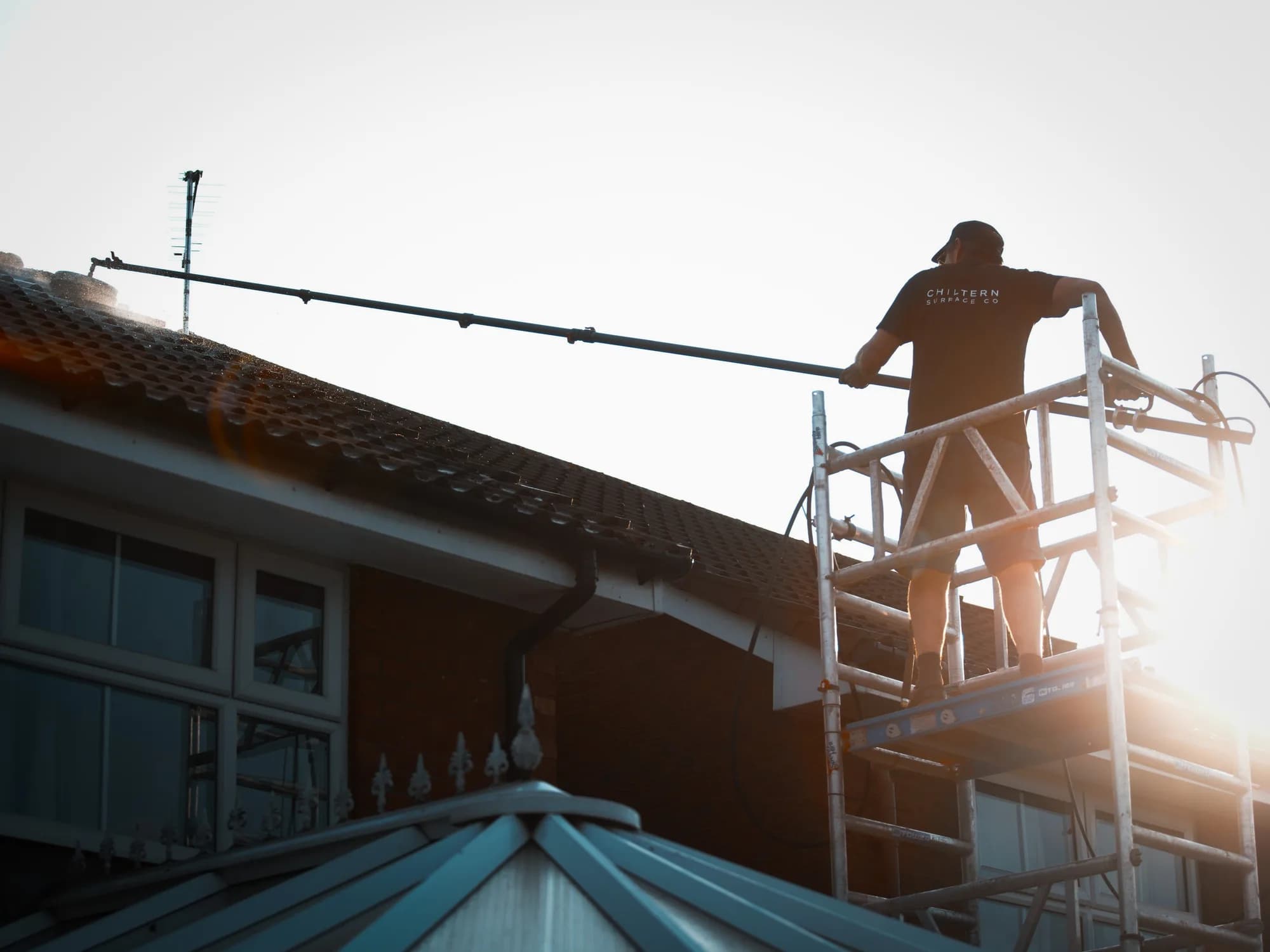
Access has just as much influence on the job. The closer we can safely position ourselves to the roof, the more controlled the work can be. Depending on the property, that can mean specialist powered access such as a cherry picker or tracked platform. Good access lets us work close to the
surface, see what we are doing properly and deal with individual areas in detail. It also means we do not have to ask the cleaning equipment to compensate for being too far away.
That matters because we are not trying to use the maximum amount of pressure possible. Where controlled low-pressure cleaning is appropriate, the objective is to use the lowest pressure required to achieve the right result. Professional equipment can produce considerably more pressure than many roof surfaces need. Knowing how much pressure a machine can produce is easy. Knowing how little you actually need is rather more useful.
On some roofs, careful manual moss removal will be the better approach. The main growth can be physically removed using tools suited to the profile of the tiles, giving the operative a high level of control. On another roof, a controlled low-pressure clean may make more sense. Quite often, the best answer is a combination of methods. Heavy accumulations may need removing manually, other areas may respond better to controlled cleaning, and valleys, gullies and gutters may all need separate attention.
That is why we are slightly wary of anyone claiming there is one "best" roof moss removal method. The best method is the one that suits the particular roof.
There is another important side to roof cleaning as well. Moss, algae and lichen are biological growths; they are not simply dirt sitting on the tiles. Removing the visible growth is an important part of the job, but it does not necessarily mean that every trace of biological contamination has been dealt with.
Once the bulk of the moss has been removed and the roof prepared appropriately, a professional biocide treatment can be used to address remaining biological growth and help inhibit regrowth. At Chiltern Surface Co, this is where Chiltern EverGuardTM can form part of the treatment process. The distinction is fairly simple: the cleaning stage deals with what is there now, while the treatment is concerned with what happens afterwards.
Gutters, valleys and gullies also matter. Remove a significant amount of moss from a roof and some of it is inevitably going to travel downwards. A proper roof moss removal job therefore needs to consider the drainage system as well as the tiles themselves. Cleaning a roof beautifully while leaving the gutters or a valley full of moss would rather defeat the object.
People also often ask whether moss damages roof tiles. The sensible answer is a little more nuanced than some of the information online might suggest. A small amount of moss does not automatically mean a roof is damaged, and there is rarely any reason to panic because you have spotted a green patch. However, allowing heavy moss growth to remain indefinitely is not especially useful either. It can retain moisture, accumulate debris and obscure areas of the roof that would otherwise be easier to inspect.
In fact, one of the benefits of removing heavy moss is simply being able to see the roof properly again. Once the growth has gone, previous repairs, worn areas or defects can sometimes become much easier to identify. The moss has not necessarily caused those problems; it may just have done a very good job of hiding them.
So when somebody asks us, "What is the best way to remove moss from my roof?", our answer is usually: it depends on the roof. That is not avoiding the question. It is the important part of the
answer.
Professional roof moss removal is really a matter of judgement. It is knowing when manual removal is preferable, when controlled low-pressure cleaning is suitable, when biological treatment should form part of the process and, just as importantly, when better access is needed before the work should begin.
At Chiltern Surface Co, that is how we approach it. We inspect the roof, understand the material and its condition, assess the moss and the access, and then recommend the process that makes sense for that particular property.
There is no prize for using the biggest machine, the quickest method or having one answer for every roof.
The roof tells us what to do.
And when you are working on one of the most important and delicate exterior surfaces of a property, that seems like a very sensible place to start.