
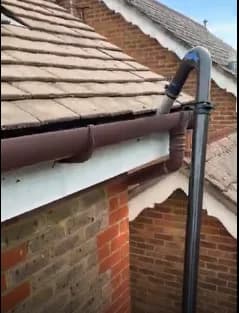
Gutter guards can reduce the amount of leaves and larger debris entering your gutters, but they are not a guarantee of maintenance-free guttering. Whether gutter guards are worth it depends on the property, surrounding trees, type of debris, gutter condition and the amount of maintenance currently required.
What Are Gutter Guards?
Gutter guards are protective covers or inserts designed to sit over or inside guttering. Their purpose is to allow rainwater into the gutter while reducing the amount of larger debris that enters it.
The principle sounds straightforward. Leaves, twigs and other material are kept away from the main gutter channel, while rainwater continues towards the downpipe.
However, gutter protection does not create a completely sealed system. Different designs handle different types of debris, and the conditions around the property can affect how well they perform.
For example, large leaves behave differently from small seeds, moss or fine organic material. A property beneath mature trees may also place greater demands on a gutter protection system than a home in an open area.
This is why it is better to consider the whole drainage system before deciding whether protection is appropriate.
Are Gutter Guards Worth It?
For some properties, gutter guards are worth it because they can reduce the amount of larger debris entering the gutter. This may mean less frequent heavy cleaning and fewer large pieces of vegetation reaching the downpipe.
However, that does not mean every property needs them.
If your gutters rarely collect significant debris, the practical benefit may be limited. On the other hand, a home surrounded by trees may have a much greater maintenance burden, making debris control more useful.
The key is to understand what problem you are trying to solve.
If leaves are regularly filling the gutters, protection may help reduce the amount entering the system. If the actual problem is damaged guttering, poor drainage or a restricted outlet, adding a guard will not address the underlying cause.
So the most useful answer is not simply “yes” or “no”.
Gutter guards can be worthwhile when they are suited to the property and used as part of a wider maintenance approach.
How Do Gutter Guards Work?
Most gutter protection systems work by creating a barrier between the gutter and larger debris.
Rainwater is directed through the protective surface, while leaves and other larger material are prevented from entering the main gutter channel.
The exact way this happens depends on the design. Some systems use mesh, while others use perforated surfaces, brushes or covers.
Each approach has different characteristics.
A system that works well with large leaves may not behave in exactly the same way when exposed to fine seeds or other small debris. Likewise, a guard can become covered by leaves on its upper surface, which may eventually affect how rainwater reaches the gutter.
Therefore, the protection should be considered alongside the property's environment.
The roof, gutter profile, nearby vegetation, rainfall and existing drainage arrangement all play a role in how the system performs.
What Are the Main Benefits of Gutter Protection?
The main benefit is simple: less large debris entering the gutter.
That can be particularly helpful for properties where leaves are a regular problem. Instead of allowing large quantities of vegetation to accumulate inside the gutter, the protection can reduce the amount reaching the channel.
This may also help reduce the amount of larger debris travelling towards downpipes.
Another benefit is convenience. If gutters are difficult to access, reducing the amount of material that enters them can make ongoing maintenance easier.
However, the value should always be judged against the property's actual needs.
A gutter protection system is not automatically an improvement simply because it has been installed. Its usefulness comes from solving a genuine maintenance problem.
That is why an assessment of the existing guttering should come before choosing a solution.
Do Gutter Guards Stop Gutter Cleaning?
No. This is one of the most important points to understand before installing gutter guards.
They can reduce the amount of debris entering the gutter, but they do not guarantee that the guttering will never need attention again.
Debris can collect on top of the protection. Fine material may also pass through depending on the system. Over time, this can still affect the condition and performance of the rainwater system.
The difference is that the type and amount of maintenance may change.
Instead of repeatedly removing large quantities of leaves from inside the gutter, maintenance may involve inspecting the protection and clearing material that has accumulated across its surface.
That can still be a useful improvement.
The realistic goal should therefore be reduced maintenance, rather than complete freedom from maintenance.
This is also why homeowners should be cautious about claims that suggest gutter protection will permanently eliminate gutter cleaning.
Are Gutter Guards Worth It If You Have Lots of Trees?
If your property is surrounded by trees, the answer may be more favourable.
Trees can introduce a large amount of material into roof drainage systems. Leaves, small branches, seeds and other organic debris can all find their way onto the roof and into the gutter.
During periods of heavy leaf fall, this can make gutter maintenance much more frequent.
A suitable protection system may reduce the amount of larger material entering the gutter. However, trees do not stop being a source of debris after installation.
Leaves can remain on top of the protection, and smaller material may still pass through.
The type of vegetation matters as well. A property dealing mainly with large leaves may have different requirements from one exposed to fine seeds or other small debris.
Therefore, if you have trees close to the property, the question should be:
What type of debris is reaching the gutter, and how much maintenance is it currently creating?
That provides a better basis for deciding whether protection is worthwhile.
What Happens to Leaves That Land on Gutter Guards?
Leaves that are prevented from entering the gutter do not simply disappear.
Some may be blown away by wind. Others may remain on the surface until rainfall or weather conditions move them.
If a large quantity accumulates, however, the protective surface can become covered.
This is important because rainwater still needs a clear route into the gutter.
A light covering may have little effect, while a heavy build-up of wet organic material can restrict the available surface.
Therefore, gutter protection changes the maintenance task rather than necessarily removing it.
This is not a reason to dismiss gutter guards. It is simply part of understanding what they are designed to do.
The system should be checked periodically, particularly where the property receives heavy seasonal leaf fall.
Can Gutter Guards Become Blocked?
Yes, the protection itself can become contaminated.
This is especially relevant where there is a large amount of surrounding vegetation.
The problem is not necessarily that the guard has stopped working. Rather, the environment is placing material onto the same surface that needs to remain open for rainwater.
Fine organic debris can also behave differently from large leaves.
Some material may remain above the protection, while smaller particles may pass through and gradually collect within the gutter.
For this reason, the condition of the gutter should still be monitored after protection is installed.
If the system is difficult to access, that should also be considered when deciding whether a particular design is appropriate.
Can Gutter Guards Cause Water to Overflow?
A gutter guard does not automatically cause overflowing gutters.
However, water still needs to enter the gutter efficiently.
If a protective surface becomes heavily covered with debris, the available openings may become restricted. Poor fitting or an unsuitable system can also affect how rainwater reaches the gutter.
Heavy rainfall may reveal problems that are not obvious during light showers.
However, it would be misleading to blame every overflow on gutter protection.
An overflowing gutter can have many possible causes, including a blocked outlet, damaged guttering, incorrect fall or a restriction further along the drainage system.
This is why the complete system should be considered before deciding that the guard is responsible.
Can Fine Debris Still Get Into the Gutter?
Yes.
Large leaves are usually the easiest type of debris for a protection system to manage. Smaller material is more difficult.
Seeds, fine organic matter, silt and other small particles may pass through some protection systems.
Over time, this material can accumulate within the gutter.
This is one reason the phrase “maintenance-free guttering” can be misleading.
Gutter protection is intended to reduce certain types of debris entering the system. It is not intended to create an absolute barrier against every particle.
The performance of the system should therefore be judged by how effectively it manages the particular debris found around your property.
Are Gutter Guards Worth It If Your Gutters Are Already Professionally Cleaned?
This depends on the reason your gutters need cleaning.
If professional cleaning is required frequently because large amounts of leaves enter the gutters, reducing that debris may provide a practical benefit.
However, if your gutters only need occasional attention and are easy to access, the financial value may be less obvious.
Access is an important part of the decision.
A homeowner with difficult-to-reach guttering may place greater value on reducing debris than someone with an easily accessible system.
It is also worth considering what happens between cleaning visits.
If the guttering regularly becomes heavily contaminated soon after it has been cleaned, reducing the amount of debris entering the system may be useful.
The decision should therefore be based on the actual maintenance pattern of the property.
Which Type of Gutter Guard Is Best?
There is no single type of gutter guard that is automatically best for every home.
Different systems use different designs, including mesh, perforated covers and brush-style inserts.
The important question is not which design sounds best in general.
It is which approach is suitable for the property.
Consider the type of debris entering the gutter, the amount of surrounding vegetation and the design and condition of the existing guttering.
The installation also matters. A protection system needs to work with the existing gutter rather than interfere with its ability to collect and direct rainwater.
For this reason, choosing a gutter guard based only on price or a general product claim may not give the best result.
Are Gutter Guards Suitable for Older Guttering?
Existing guttering should be considered before any protection system is added.
If the gutter is damaged, poorly aligned or already struggling to drain water correctly, a guard will not fix the underlying problem.
The same applies to restricted outlets or other drainage issues.
Adding another component to an existing problem can make it harder to understand what is actually happening.
A better approach is to establish whether the guttering is functioning properly first.
If the main issue is simply excessive debris, protection may be worth considering.
If the gutter itself has a problem, that should be addressed before relying on a guard to improve performance.
When Are Gutter Guards Most Worth Considering?
Gutter protection may be worth considering when a property has a clear and recurring debris problem.
Homes surrounded by mature trees are an obvious example. Properties with difficult-to-access gutters may also benefit from reducing the amount of larger debris entering the system.
They can also be useful for homeowners who want to reduce the frequency of heavy gutter maintenance.
However, the decision should still begin with the existing system.
If the guttering is already functioning well and rarely collects debris, there may be little reason to add protection.
The goal is not to install another product simply because it is available.
It is to solve a genuine maintenance issue in a practical way.
When Might Gutter Guards Not Be Worth It?
There are situations where protection may offer limited benefit.
If the gutters rarely become contaminated, the reduction in maintenance may not justify the investment.
Likewise, if the main problem is a damaged gutter, blocked outlet or drainage restriction, a guard will not resolve it.
It may also be unsuitable if the homeowner expects the system to remove every future maintenance requirement.
That expectation can lead to disappointment.
A more realistic approach is to see gutter protection as one possible part of gutter maintenance.
Where it solves a genuine problem and is appropriate for the property, it can be useful. Where it does not address the cause of the problem, another approach may be more suitable.
Do Gutter Guards Need Maintenance?
Yes.
Even when protection is working as intended, it should be checked.
The amount of maintenance required will vary according to the property's surroundings.
A home surrounded by trees may need more frequent attention than one with little vegetation nearby. Seasonal leaf fall can also change the amount of material collecting across the system.
Inspection should not focus only on the top of the guard.
The gutter outlets and downpipes are also part of the same rainwater system.
A gutter can appear relatively clean while a restriction further along the drainage route affects water flow.
Regular inspection therefore helps confirm that the entire system is still working as intended.
What Should You Check Before Installing Gutter Guards?
Before deciding whether gutter guards are worth it, identify the problem you want them to solve.
Start with the amount of debris currently entering the gutter.
Then consider the surrounding environment. Are there mature trees nearby? Does the property receive heavy seasonal leaf fall? Is the material mainly large leaves, or is there also fine organic debris?
Next, look at the gutter itself.
Is it in good condition? Does water currently flow towards the outlets? Are the downpipes clear? Are there recurring drainage problems?
Finally, consider access and maintenance.
If the protection will be difficult to inspect or clean, that should form part of the decision.
The best solution is not necessarily the one that promises the least maintenance. It is the one that is appropriate for the property's actual conditions.
Should You Clean the Gutters Before Installing Protection?
The existing guttering should be assessed before protection is installed.
If the gutter already contains leaves, silt or other accumulated debris, covering it does not remove that material.
A clean starting point also makes it easier to identify any existing problems with the gutter or drainage system.
This is particularly important if the property has recurring blockages.
If the outlet is already restricted, for example, installing a guard does not solve the restriction.
The aim should be to understand the existing condition first, then decide whether protection is an appropriate improvement.
How to Decide If Gutter Protection Is Right for Your Property
There is no need to make the decision based on a generic claim that gutter guards are either excellent or useless.
Instead, look at the conditions around your home.
Think about how often the gutters need attention, how much debris they collect and how difficult they are to access.
Then consider whether the current problem is actually caused by debris.
If it is, reducing the amount entering the gutter may be a sensible step.
If the problem is caused by the guttering, outlet or wider rainwater drainage system, that issue needs to be understood first.
This assessment-based approach is important because exterior maintenance is rarely one-size-fits-all.
The same protection system can perform differently on two properties because the surrounding conditions are different.
Frequently asked questions
Are gutter guards really worth it?
They can be worthwhile when a property has a recurring problem with leaves and larger debris entering the gutters. Their main value is reducing maintenance, not eliminating it completely. The condition of the guttering and the surrounding environment should be considered before installation.
Do gutter guards eliminate gutter cleaning?
No. They can reduce the amount of larger debris entering the gutter, but material can still collect on the protection or pass through it. Periodic inspection and maintenance remain important.
Do gutter guards work with lots of trees?
They can help reduce the amount of larger leaf debris entering the gutter, which may be useful on tree-lined properties. However, leaves can still collect on the protection, and smaller debris may require additional attention.
Can gutter guards cause gutters to overflow?
They do not automatically cause overflow. However, heavy debris accumulation, unsuitable protection or an existing drainage problem can affect water flow. An overflowing gutter should be assessed as a complete system rather than blaming the guard alone.
Do gutter guards need maintenance?
Yes. The amount required depends on the property, surrounding vegetation and type of protection. Checking the guard, gutter outlets and downpipes helps confirm that rainwater can continue to move through the system properly.
Conclusion
So, are gutter guards worth it? They can be a practical option when leaves and larger debris create a genuine and recurring gutter maintenance problem. They may reduce the amount of material entering the gutter and, in turn, reduce the need for frequent heavy cleaning. However, they are not a replacement for proper gutter maintenance. Leaves can collect on top, fine debris can still enter some systems, and existing problems with guttering or drainage will not automatically disappear after protection is installed. At Chiltern Surface, the approach is based on understanding the condition of the property before recommending a particular method. Different exterior surfaces and drainage situations require different solutions, and unnecessary work should not be recommended simply because it is available. If you are unsure whether gutter guards are worth it for your property, a Free Site Assessment can help you understand the current condition of your guttering and whether gutter protection would provide a genuine practical benefit.