
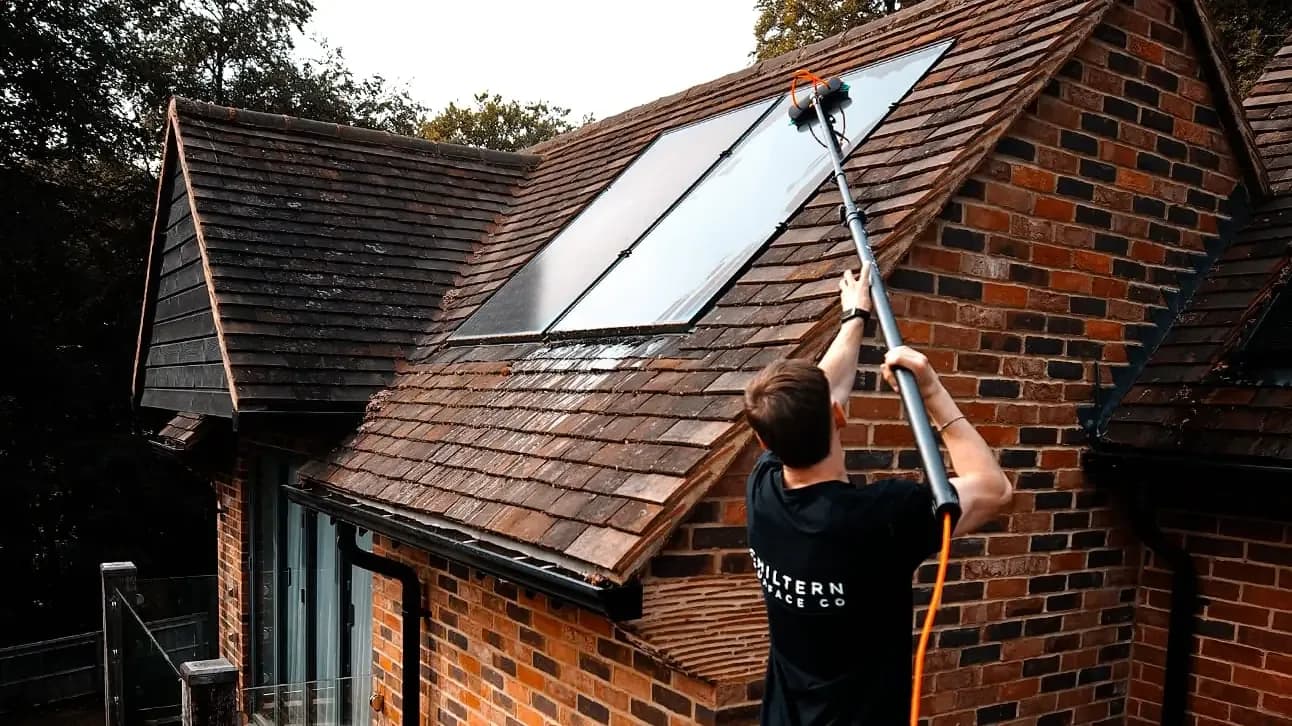
The best way to clean solar panels is to use a soft, non-abrasive brush with a gentle flow of clean water, working from the ground wherever possible. For the cleanest finish, de-ionised water is particularly useful because it dries without leaving the mineral spotting that tap water can create.
What you should not do is just as important. Solar panels do not need high-pressure washing, abrasive scrubbing or strong household chemicals. They also should not be treated as a surface to stand or walk on.
For many UK homes, rainfall removes most loose dust naturally. Cleaning becomes more useful when bird droppings, pollen film, tree sap, grime or moss around the lower frame remain on the glass after rain.
The Short Answer: Soft Brush, Gentle Water, Safe Access
For a typical domestic array, the safest cleaning method is simple:
- Check the panel manufacturer or installer guidance before cleaning.
- Choose a cool part of the day rather than working on very hot panels.
- Inspect from the ground for broken glass, loose components or damaged cabling.
- Use a soft, non-abrasive brush or purpose-made solar-panel cleaning head.
- Wet stubborn contamination before brushing it.
- Use light, overlapping passes rather than heavy scrubbing.
- Rinse gently with clean water.
- Work from the ground wherever practical and avoid standing on the array.
That method is enough for most ordinary contamination. The cleaning does not need to be aggressive to be effective.
First Decide Whether the Panels Actually Need Cleaning
Solar panels are low-maintenance surfaces. A slightly dusty appearance does not automatically mean they need professional cleaning.
Tilted roof-mounted panels benefit from regular rainfall, which removes much of the loose dust and light debris. If the glass looks broadly clear after rain and the system is performing normally, there may be little reason to intervene.
Cleaning is more worthwhile when you can see:
- Bird droppings that remain after rainfall.
- A visible pollen or grime film across the glass.
- Tree sap or sticky organic deposits.
- Moss and debris collecting along the bottom frame.
- Heavy dust from nearby roads, farmland or building work.
- Low-angle panels that hold dirt rather than shedding it.
The aim is condition-led maintenance: clean when persistent contamination is present, not simply because a calendar date has arrived.
What Equipment Should You Use?
A soft-bristle brush
The brush should be soft enough to lift dirt without scratching the glass or damaging any surface coating. A purpose-made solar or water-fed cleaning brush is a better choice than a stiff deck brush, scouring pad or general workshop broom.
A telescopic or water-fed pole
A long pole allows many roof-mounted arrays to be reached from stable ground. This is often preferable to taking cleaning equipment onto the roof.
The pole still needs to be controllable at full extension. If it becomes too heavy, flexible or awkward to guide safely, professional access is the better option.
A gentle water supply
Solar panels do not need a pressure washer. A normal controlled rinse is enough to wet the glass, loosen contamination and carry it away after brushing.
De-ionised water where practical
Tap water contains dissolved minerals. In hard-water areas, those minerals can remain as spots or streaks after the water dries.
De-ionised water contains very little dissolved mineral content, so it can be used to wash and rinse the glass and then left to dry naturally without leaving detergent residue.
This is the method used by Chiltern Surface Co for professional solar panel cleaning: de-ionised water, soft-bristle brushes and a water-fed pole, worked from the ground wherever access allows.
Step-by-Step: The Best Way to Clean Solar Panels
1. Check the system and access before you start
Before cleaning, look at the array from the ground. Check for obvious broken glass, damaged cabling, loose-looking components or anything else that should be inspected by the installer rather than a cleaner.
Follow the manufacturer or installer's instructions for isolating the system if they require it before cleaning. Do not improvise with electrical equipment you are unfamiliar with.
2. Choose cool conditions
Early morning, later in the day or a cool overcast period is usually easier than cleaning in strong midday sun.
Water evaporates more quickly from hot glass, which can make cleaning harder and leave marks before the panel has been rinsed properly.
3. Wet the panels first
A gentle pre-rinse loosens ordinary dirt and softens dried bird droppings. Let stubborn material soak briefly rather than trying to scrape it from dry glass.
4. Brush lightly
Use the soft brush in overlapping passes. You need enough contact to loosen the contamination, not enough force to flex the pole or press heavily into the panel.
Pay particular attention to visible bird mess, pollen film and the lower edge where moss or debris may collect.
5. Rinse the glass thoroughly
Once the contamination has been loosened, rinse it away rather than allowing dirty water to dry back onto the surface.
With de-ionised water, the panel can usually be left to air dry. There is no need to rub a towel across the glass.
6. Clear the frames and lower edges
A panel can look clean in the centre while moss and organic material remain gathered along the lower frame.
Clear reachable debris gently without forcing tools into seals, fixings or cable routes.
7. Carry out a final visual check
Look for missed deposits and confirm that the glass is clear. If you noticed cracked glass, damaged seals or cabling concerns, pass those observations to the installer or a suitably qualified solar professional.
What Is the Best Water for Cleaning Solar Panels?
Clean water is the starting point. For occasional DIY maintenance, ordinary water may be enough if your local supply does not leave significant mineral spotting and the panels are rinsed well.
For a professional clean, de-ionised water has clear practical advantages. It reduces the risk of mineral residue, avoids detergent film and allows the glass to dry naturally.
It also keeps the process simple. There is no need to add a strong cleaner when the contamination can be removed with soft mechanical action and pure water.
Should You Use Soap or Detergent?
Avoid treating solar panels like ordinary household glass.
Washing-up liquid can leave a film if it is not completely rinsed away, and household cleaners may contain ingredients that are unnecessary on a solar module.
If a panel manufacturer specifically permits a cleaning product, follow that guidance. Otherwise, a soft brush and clean water are a sensible starting point.
Chiltern Surface Co uses no detergents and no chemicals on the panels. The glass is washed and rinsed with de-ionised water only.
Can You Pressure Wash Solar Panels?
No high-pressure washer is needed for normal solar panel cleaning.
A concentrated jet introduces unnecessary force around the frames, seals and electrical parts of the installation. It can also encourage the operator to treat the panel like paving rather than a precision exterior surface.
If ordinary grime is stubborn, the answer is usually more soak time and gentle brushing, not more pressure.
Can Rain Clean Solar Panels for You?
Rain does much of the routine work on a pitched UK array.
Loose dust, pollen particles and light surface debris can wash away naturally, particularly on panels installed at a reasonable angle.
Rain is less reliable against dried bird droppings, sticky pollen film, tree sap and moss around the panel edges. Those are the types of contamination that make a manual clean worthwhile.
This is why there is no benefit in repeatedly cleaning an array that rain is already keeping clear.
How Often Should Solar Panels Be Cleaned?
There is no single interval that suits every property.
As a broad maintenance guide, many domestic arrays may benefit from checking or cleaning around every 12 to 18 months, but local conditions matter more than the calendar.
You may need cleaning more often if:
- Your home is close to mature trees.
- Bird activity regularly leaves droppings on the array.
- The property is near farmland, dusty roads or construction.
- The panels are mounted at a low angle.
- Moss and debris repeatedly gather along the lower frame.
If the panels stay visibly clear and rainfall is doing the work, there is no reason to clean them simply to meet a fixed schedule.
Should You Clean Solar Panels From a Ladder?
Only if the access can be managed safely and the work does not require you to overreach.
In practice, the better option for many homes is to avoid ladder-based cleaning altogether. A water-fed pole from stable ground allows the operator to reach the panels without standing on the roof or handling a hose at height.
If the array sits above a conservatory, extension, steep bank or other difficult access point, the safest decision may be to have the work assessed professionally rather than trying to extend a DIY method beyond its limits.
What About Ground-Mounted Solar Panels?
Ground-mounted arrays are generally easier to maintain because the panels can be reached without roof access.
They may, however, become dirty more quickly because they sit closer to soil, splash, vegetation and dust. The same cleaning principles still apply: soft brushes, gentle rinsing, no abrasive tools and no unnecessary pressure.
Common Solar Panel Cleaning Mistakes
Using a stiff brush
A stubborn mark should be softened with water rather than attacked with an abrasive tool.
Using washing-up liquid without checking guidance
Household detergent can leave residue and is often unnecessary. Keep the process as simple as the panel manufacturer allows.
Cleaning in strong midday heat
Hot glass causes water to evaporate quickly, making an even clean harder to achieve.
Standing or walking on the panels
Solar modules are not a working platform. Plan the access around the array, not across it.
Using a pressure washer
High pressure does not improve a properly planned solar-panel clean. It simply adds avoidable force around sensitive components.
Cleaning when nothing is actually dirty
A slightly dusty appearance after a dry spell is not always a reason for intervention. Let rainfall handle loose contamination where it can.
When Professional Solar Panel Cleaning Makes Sense
Professional cleaning is most useful when the panels are visibly soiled but difficult to reach safely.
It is worth considering when:
- Roof height or pitch makes ground-level DIY reach difficult.
- A conservatory, extension or restricted access blocks the cleaning angle.
- Bird fouling or organic build-up is extensive.
- You want the frames and lower edges cleaned as well as the glass.
- You are unsure about system isolation or visible cabling.
- The array is large enough that even cleaning is difficult to achieve yourself.
Chiltern Surface Co follows an assessment-first approach. The array, pitch, access, frames and seals are checked before the cleaning method is confirmed.
What a Professional Solar Panel Clean Should Include
| Stage | What should happen | Why it matters |
|---|---|---|
| Assessment | Check array, pitch, access, frames and visible condition | Confirms the safest practical method |
| Gentle clean | Soft brush with controlled water flow | Removes grime without abrasive force |
| Pure-water rinse | Rinse with de-ionised water | Reduces spotting and detergent residue |
| Frames and edges | Clear accessible moss and debris | Finishes the whole visible array |
| Final check | Review the panels and flag visible issues | Separates cleaning from any repair or electrical work |
Frequently asked questions
What is the best thing to use to clean solar panels?
A soft, non-abrasive brush with a gentle flow of clean water is the safest starting point. De-ionised water is particularly useful because it dries with very little mineral residue.
Can I clean solar panels with tap water?
Yes, for light DIY maintenance it may be adequate, but hard tap water can leave mineral spotting. A de-ionised final rinse gives a cleaner finish.
Can I use washing-up liquid on solar panels?
It is better to avoid it unless the panel manufacturer specifically permits it. Washing-up liquid can leave a film if it is not rinsed completely.
Can I use a pressure washer on solar panels?
No high-pressure washer is needed. Use gentle rinsing and a soft brush instead, especially around the frames, seals and electrical components.
Should solar panels be cleaned from the ground?
Where possible, yes. A water-fed pole can reach many domestic arrays without anyone standing on the roof or panels.
How often should solar panels be cleaned?
A broad starting point is around every 12 to 18 months, but the actual need depends on rainfall, trees, birds, panel angle and visible contamination.
Does rain clean solar panels?
Rain removes much of the loose dust from tilted panels, but it may leave behind dried bird droppings, sticky pollen, tree sap and moss at the edges.
How does Chiltern Surface Co clean solar panels?
With de-ionised water and a soft-bristle brush on a water-fed pole, worked from the ground wherever access allows. No detergents, chemicals or high pressure are used on the array. If your solar panels are visibly soiled, difficult to reach, or you are unsure whether they need cleaning at all, arrange a Free Site Assessment with Chiltern Surface Co. We can inspect the array, explain whether cleaning is genuinely worthwhile and provide a clear Free Quotation before any work begins. Our solar panel cleaning service is available across Buckinghamshire, Berkshire and Oxfordshire, with no pressure to book work your panels do not need.