
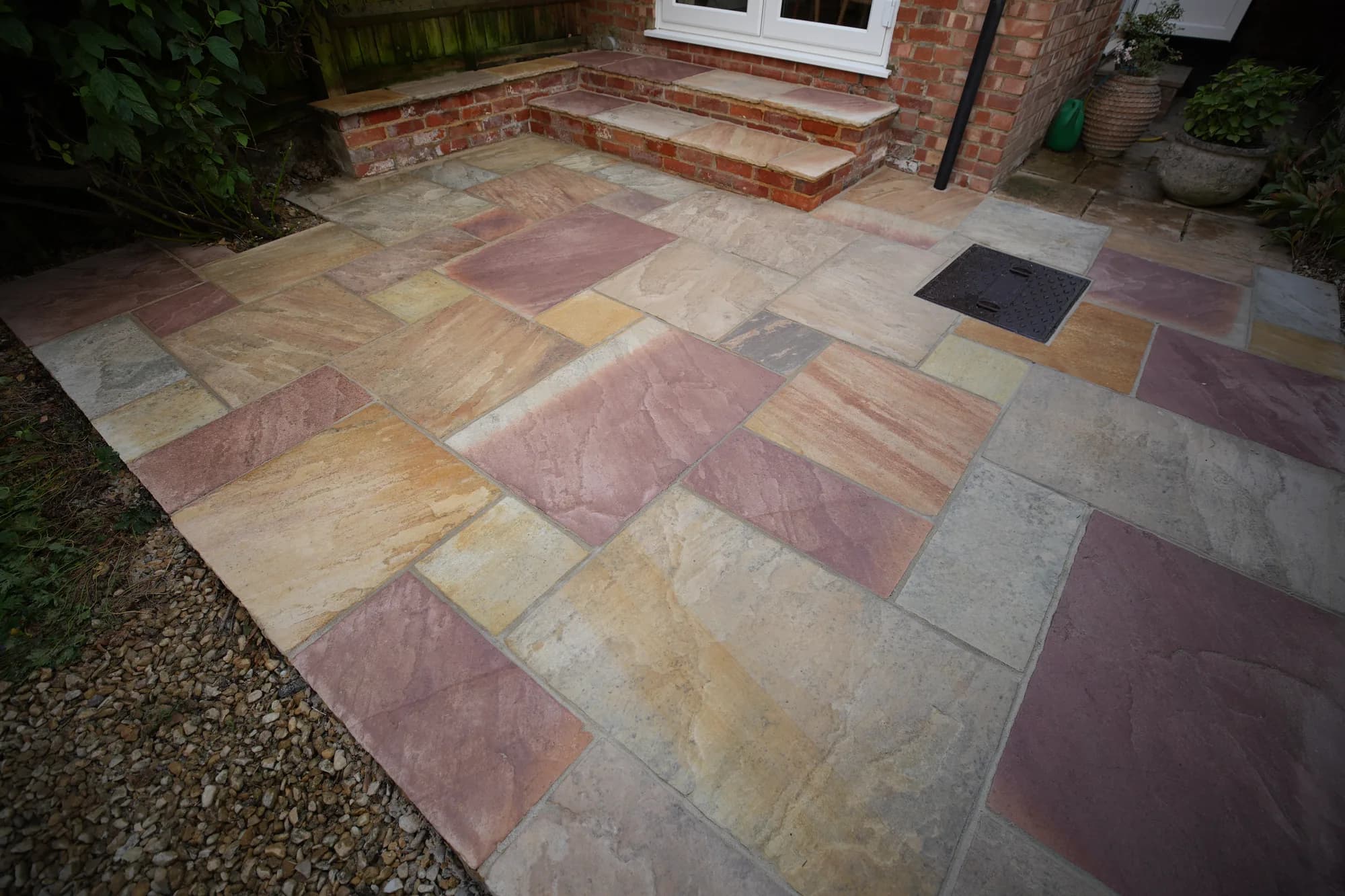
Black spot looks like dirt, which is precisely why it is so often treated like dirt. The trouble is that established lichen on porous sandstone is a biological problem, not simply a dirty surface.
The aim isn't to make old sandstone look new. It's to make it look like sandstone again.
There is a particular moment that anyone who has tried to clean an old sandstone patio will recognise. You have spent several hours with a pressure washer, you are wet, the windows are wet, several plants that had absolutely nothing to do with the exercise are wet, but the patio looks fantastic. Years of grime and green growth have disappeared, the original colours of the sandstone are coming back and you are feeling pretty pleased with yourself.
Then it dries, and there they are: hundreds of little black marks, apparently completely unimpressed by everything you have just done. This is what most people call black spot, and it is one of the most common problems we encounter when restoring sandstone patios, particularly Indian sandstone and other porous natural stone.
Black spot hasn't just landed. It has moved in.
Sandstone may look solid, but at a microscopic level it contains pores, capillaries and tiny irregularities. Those characteristics are part of the stone's natural character and influence how it absorbs water and weathers. They can also provide somewhere for biological growth to establish itself. Lichen is particularly good at this: its fungal component develops microscopic filaments called hyphae, allowing it to interact with pores and irregularities in the surface.
That is the crucial point. The little black mark you can see isn't necessarily the whole problem. Once lichen has established itself, simply trying to wash the visible mark away can become a battle with the sandstone underneath.
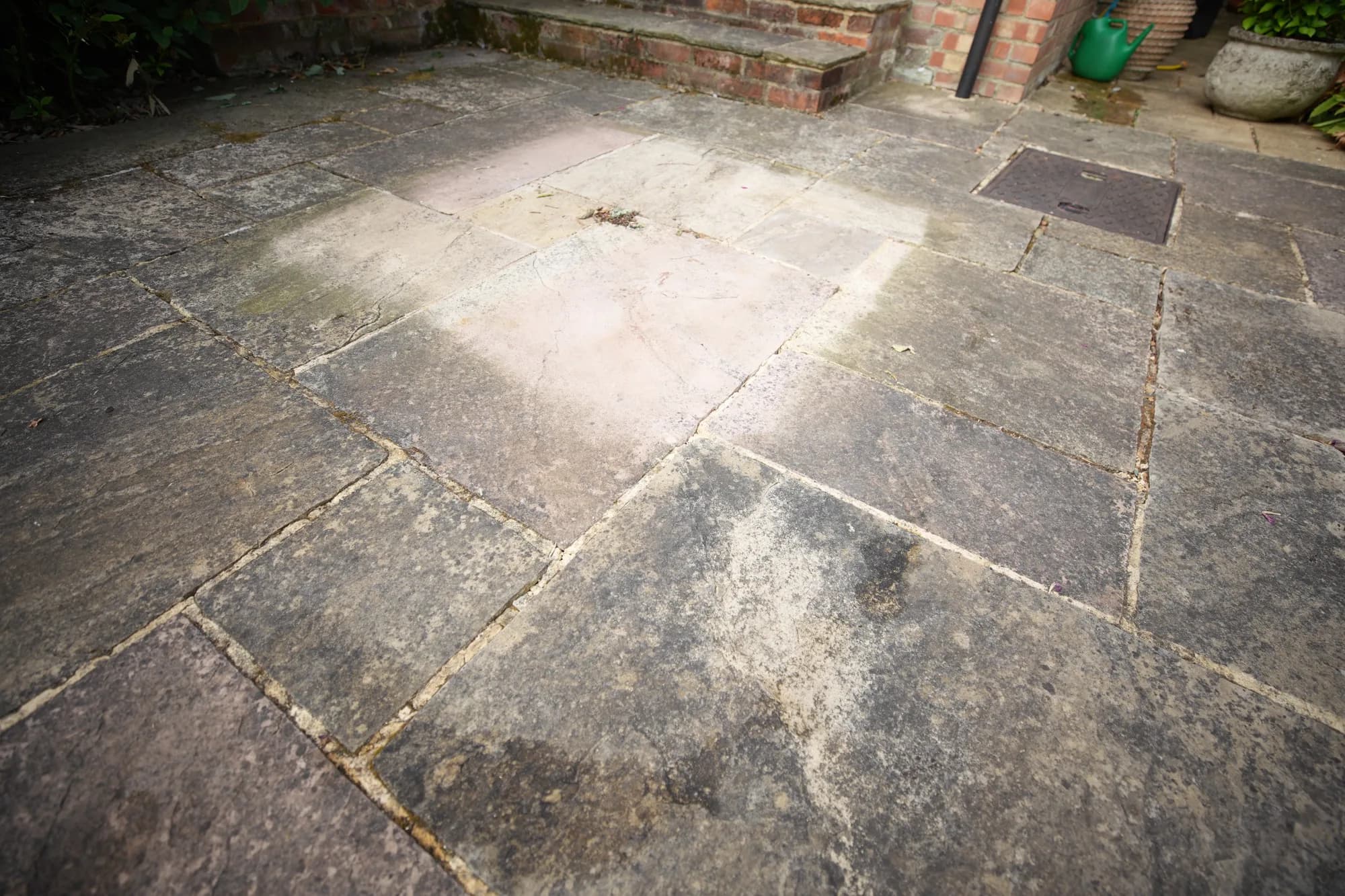
Established contamination across the sandstone before restoration. The visible marks are only part of what makes black spot difficult to treat.
Why more pressure isn't the answer
Pressure washing is excellent at removing contamination that is on a surface: dirt, algae, loose organic material and years of general grime can disappear incredibly effectively. The difficulty begins when we expect water pressure to solve a biological problem that has become established within a porous material.
The familiar response is to move the lance closer and keep working the stubborn marks. Eventually something starts disappearing; the important question is whether it is the lichen or the sandstone. Natural sandstone isn't indestructible. Excessive, concentrated pressure can roughen its texture and disturb surrounding jointing. You can technically remove a black mark by gradually removing the surface it is
attached to, but that is a little like removing a stain from a wooden table with a belt sander. The stain has gone. Whether we should call that cleaning is another matter.
The tape measure says two patios are the same job. The stone says otherwise. We tend to listen to the stone.
The part people rarely talk about
There is another reason we don't like relying on pressure alone. Sandstone is porous, so pressure cleaning doesn't simply move water across the face of the paving; it introduces a considerable amount of moisture into the stone's pore structure. That is perfectly normal during a controlled restoration. The problem is stopping there.
If the visible contamination is removed but the underlying biological problem is left untreated, you have made the patio look beautifully clean while thoroughly wetting the porous environment in which the remaining contamination exists. We sometimes describe this to customers as feeding the black spot. Not literally - lichen isn't waiting for somebody to arrive with a pressure washer and lunch - but moisture is fundamental to biological growth, and repeatedly flushing porous sandstone without properly treating the biology is not much of a long-term strategy.
That is how people fall into the clean-regrow-clean cycle: the patio develops black spot, gets pressure washed, looks dramatically better, and then the black spot returns. So it gets cleaned again, often more aggressively. Eventually sandstone gets the blame, when the real problem may be that it has repeatedly been cleaned but never properly treated.
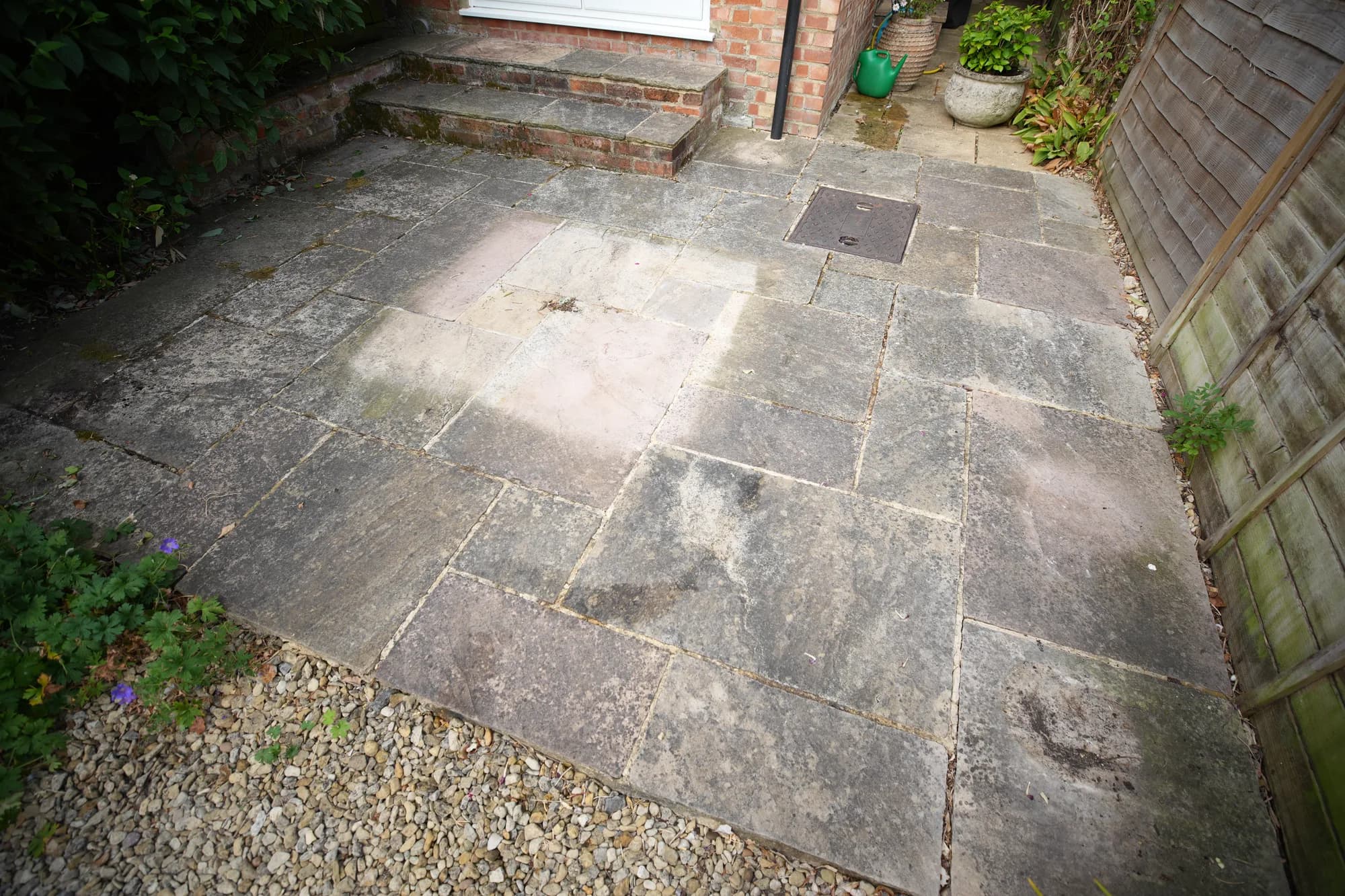
The same patio before restoration. Years of biological contamination had muted much of the natural colour and variation in the sandstone.
Treat the biology, not just the appearance
That distinction is central to the way we approach sandstone patio restoration at Chiltern Surface Co. We use pressure cleaning for what pressure cleaning is good at: removing surface contamination, restoring the appearance of the stone and preparing it for treatment. We then use specialist chemistry to address the biological problem that pressure alone cannot properly deal with.
On a relatively well-maintained patio, that can be straightforward. On old Indian sandstone that has spent fifteen years beneath mature trees with very little direct sunlight, established black lichen may require targeted treatment, appropriate dwell time and sometimes several applications. Two patios can both measure 80 square metres and yet be completely different restoration jobs.
The garden leaves clues
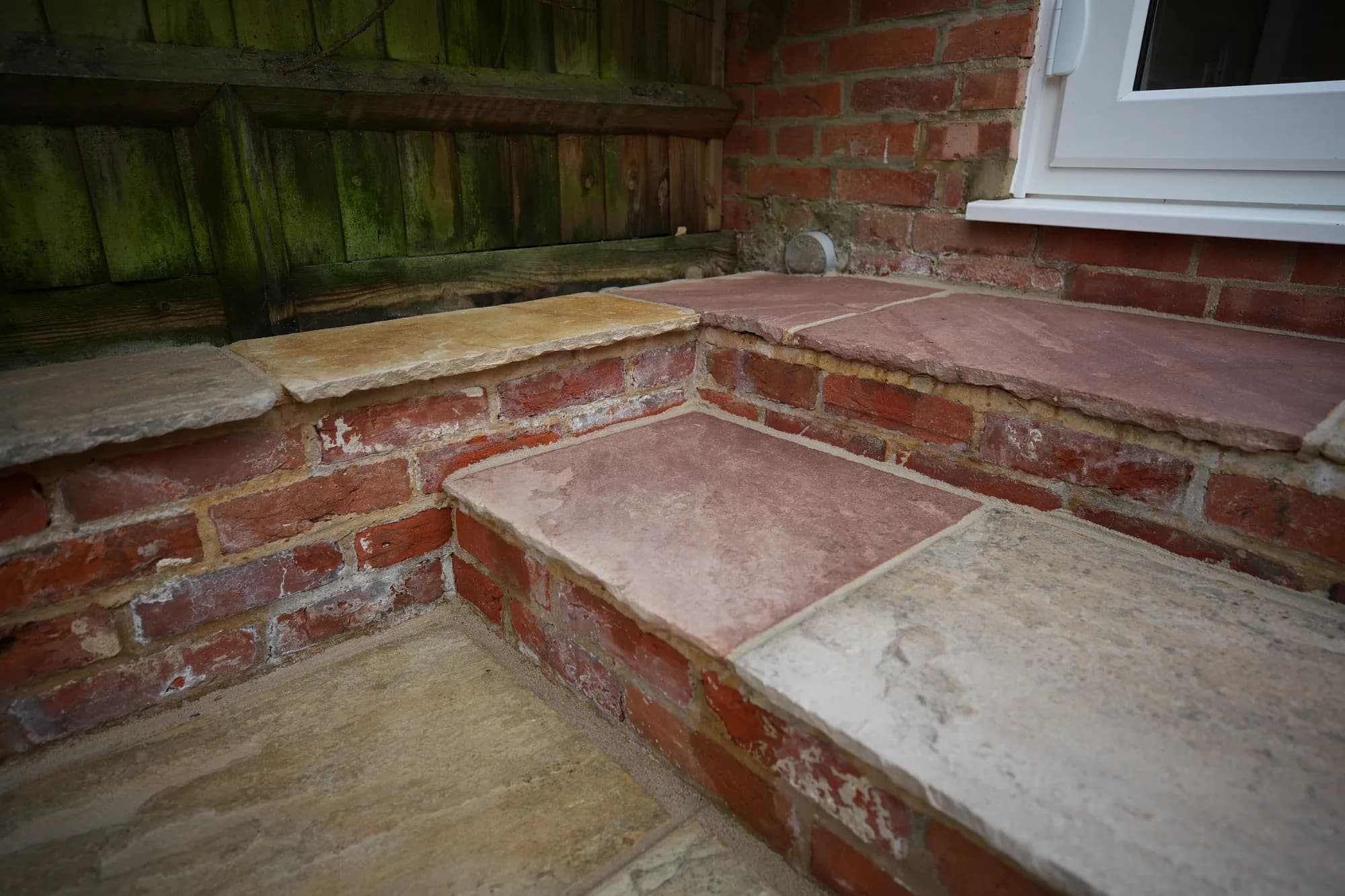
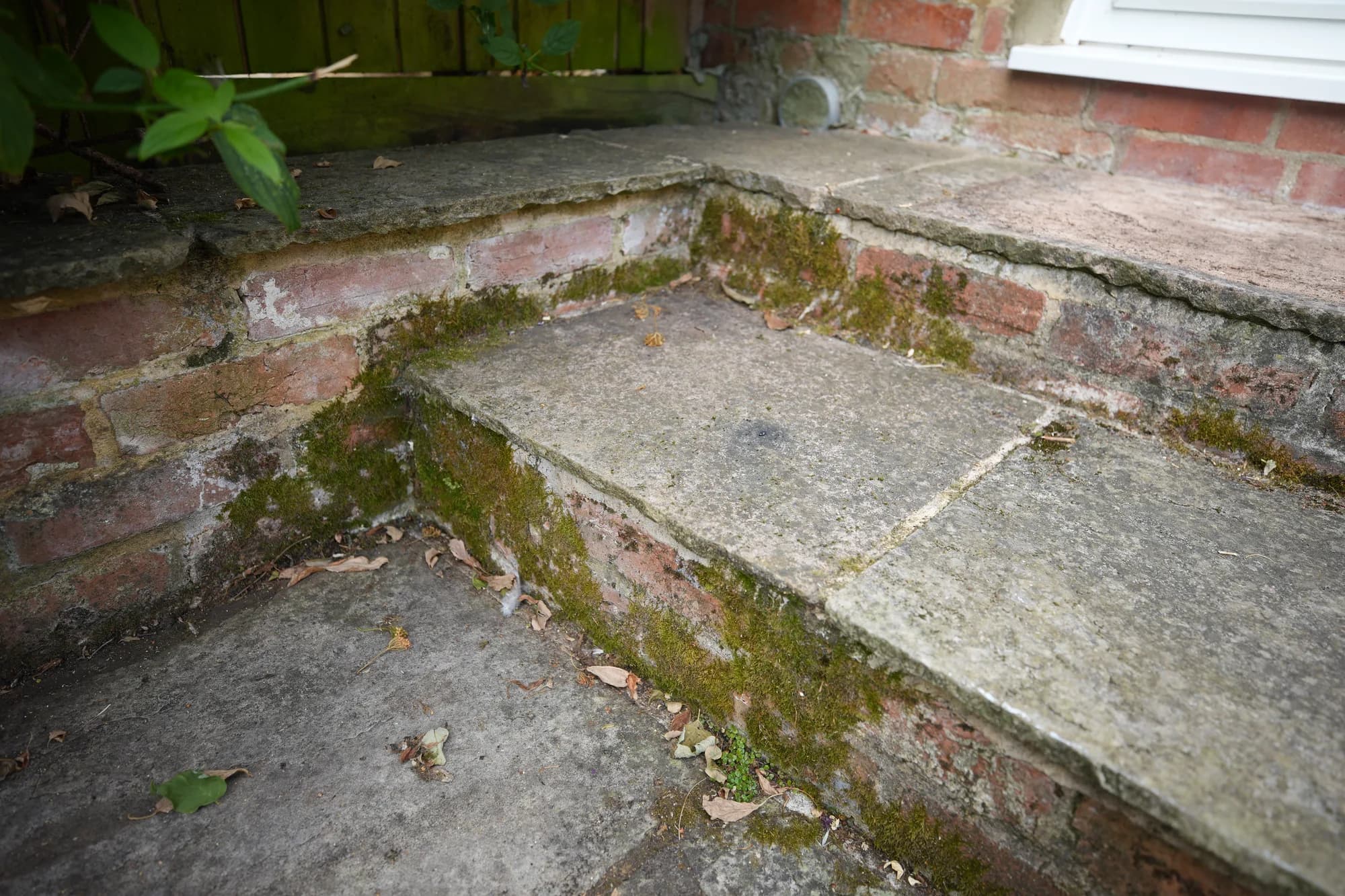
Black spot thrives where conditions favour it, which means you can often read the environment of a garden simply by looking at the paving. The sunny, exposed section may be relatively clean, while slabs beneath trees, beside a north-facing wall or surrounded by dense planting can be heavily colonised. The patio is effectively showing you where it stays damp.
Google Drive original Google Drive original
The shaded steps before and after restoration. The surrounding environment helps explain why biological growth was so established here.
Cleaning doesn't change where the patio lives. We can restore the sandstone, but we cannot move the sun or persuade the British weather to become Mediterranean. That is why we think about black spot as a long-term surface-care issue rather than something permanently solved by one heroic afternoon with a pressure washer.
Once the sandstone has been deep cleaned and the established black spot treated, Chiltern EverGuard™ forms an important final part of our process. It is our specialist biological treatment, used to address remaining biological contamination and help inhibit the return of algae, lichen, moss and black spot. The deep clean restores the stone, the targeted treatment tackles the established problem, and Chiltern EverGuard™ is about helping protect what happens afterwards.
Restoration, not perfection at any cost
Can every last black spot always be removed? Sometimes the results are extraordinary, but natural stone requires judgement. Very mature lichen can be stubborn and individual slabs can respond differently, so our objective is always to achieve the best possible result without damaging the stone in pursuit of perfection. Sometimes another treatment and more time are preferable to simply becoming more aggressive.
One of the strange things about an old sandstone patio is that you often don't realise how much it has changed. Biological growth develops gradually, so the stone gets a little darker every year and eventually that simply becomes what you think the patio looks like. Then a section is properly restored and suddenly the original pinks, buffs, creams and warm yellows appear again. They haven't been added. They were there all along.
The aim isn't to make old sandstone look new. It's to make it look like sandstone again.
That, really, is the difference between pressure washing a patio and understanding how to restore one. From a distance, black spot looks like a simple cleaning problem. Once you understand what is happening inside porous sandstone, the question is no longer, "How much pressure will remove this?" It becomes, "What is growing here, how established is it, and what combination of cleaning and treatment will restore the stone without unnecessarily damaging it?"
At Chiltern Surface Co, that is how we approach black spot removal. The problem you can see on the surface doesn't necessarily stop at the surface. And sometimes the difference between cleaning a patio and properly restoring one is simply understanding what you can't see.