
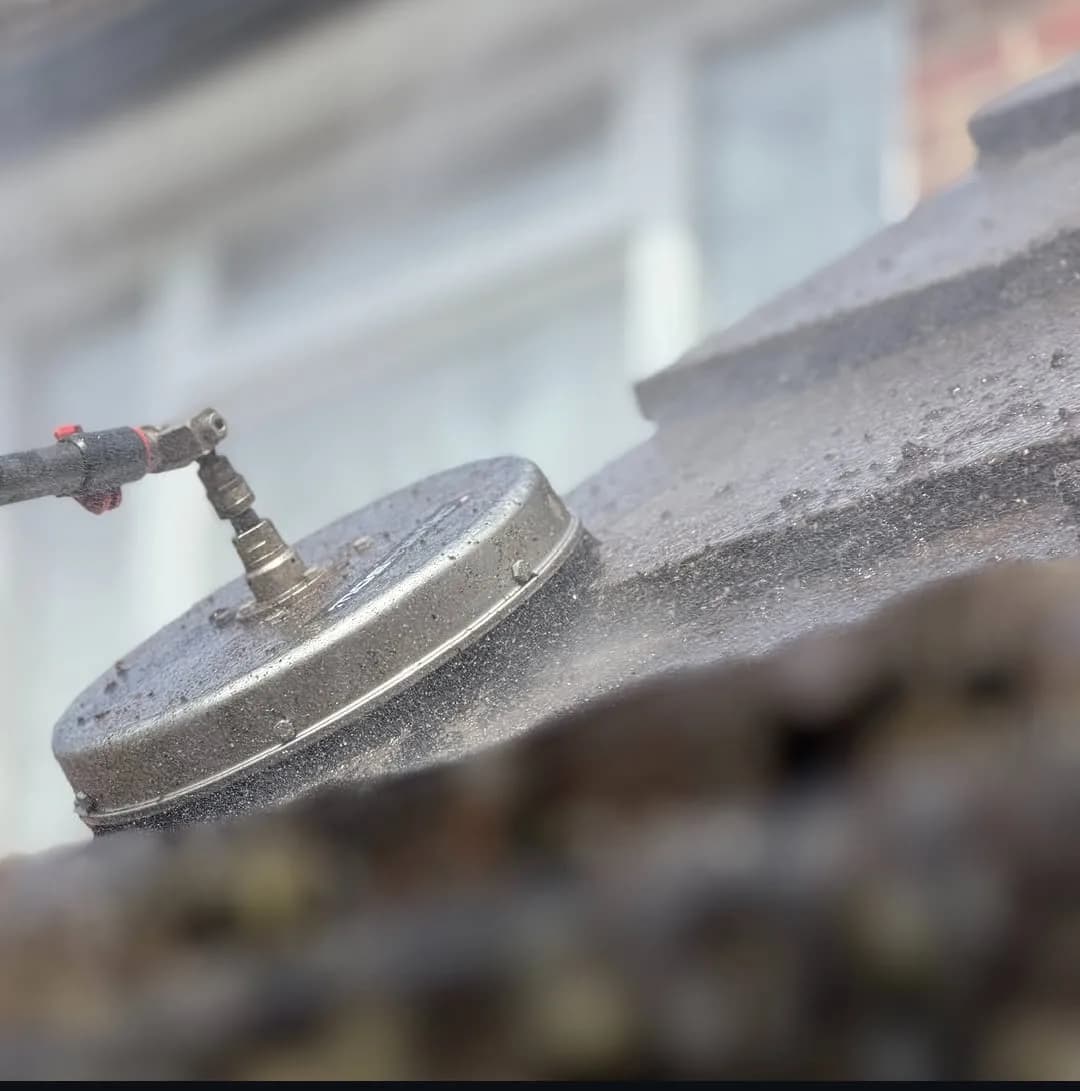
What Is Gutter Vacuum Cleaning?
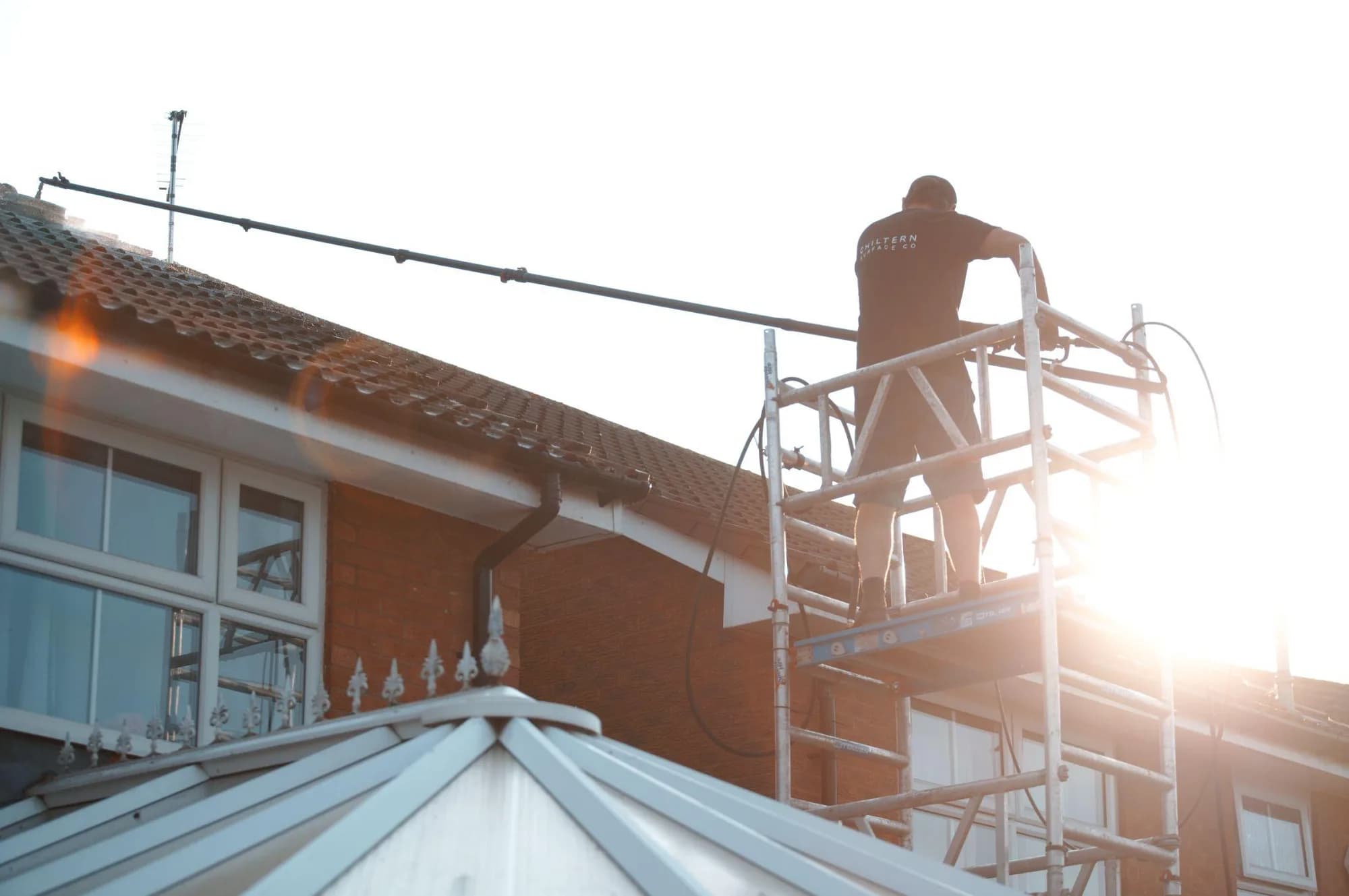
Gutter vacuum cleaning is a method of removing debris from gutters using controlled suction and high-reach equipment.
Instead of manually reaching into the gutter, an operator uses a long pole and suitable cleaning head to access the gutter from below. The vacuum then removes leaves, moss, sludge and other loose material.
Some professional systems also use an inspection camera. This can help the operator see areas that are difficult to inspect from the ground.
However, the vacuum itself is not the most important part of the process.
For effective gutter cleaning, the property, gutter design, access and type of contamination all need to be considered first. Different conditions may require different methods.
This is particularly important for older or poorly maintained gutters. A large amount of compacted material may not respond in the same way as loose leaves.
The goal should therefore be more than simply removing visible debris. A good cleaning process should also consider whether water can flow correctly towards the outlets and whether there are signs of damage or other drainage problems.
How Does Gutter Vacuum Cleaning Work?
The process usually begins with an assessment.
The operator considers the height of the gutter, the available access, the type of guard or covering present and the condition of the debris.
A suitable vacuum head is then positioned inside or over the gutter. Long-reach poles allow the operator to work from a safe position where the property permits it.
The vacuum draws debris through the cleaning system rather than allowing it to fall around the building.
This can be particularly useful where gutters are above conservatories, extensions, garages or other areas where traditional access is awkward.
The process should be controlled rather than rushed.
An experienced operator needs to work through the gutter carefully, checking whether material has been removed and whether any sections need further attention.
Where an inspection camera is available, it can provide another layer of information. It may help confirm the condition of the gutter and identify areas where debris remains.
The equipment supports the process, but the operator's assessment and technique remain important.
Can Gutter Vacuum Cleaning Be Done From the Ground?
In many situations, yes.
One of the main reasons homeowners consider vacuum gutter cleaning is the ability to reach gutters without standing on the roof.
High-reach poles can allow an operator to access many gutters while remaining at ground level.
This can be useful for properties where traditional ladder access would be difficult or where reaching the gutter from the roof would be unnecessary.
However, ground-based cleaning is not automatically suitable for every property.
The height of the building, gutter design, surrounding structures and access available around the property all matter.
A narrow side passage may create a different challenge from a completely open garden. A conservatory roof may restrict the position from which equipment can be used. Complex rooflines can also make some sections difficult to reach.
Therefore, a professional should assess the property before deciding whether a ground-based method is appropriate.
The aim is not to use a particular piece of equipment at all costs. It is to select the method that gives the best balance of access, effectiveness and care.
What Can a Gutter Vacuum Remove?
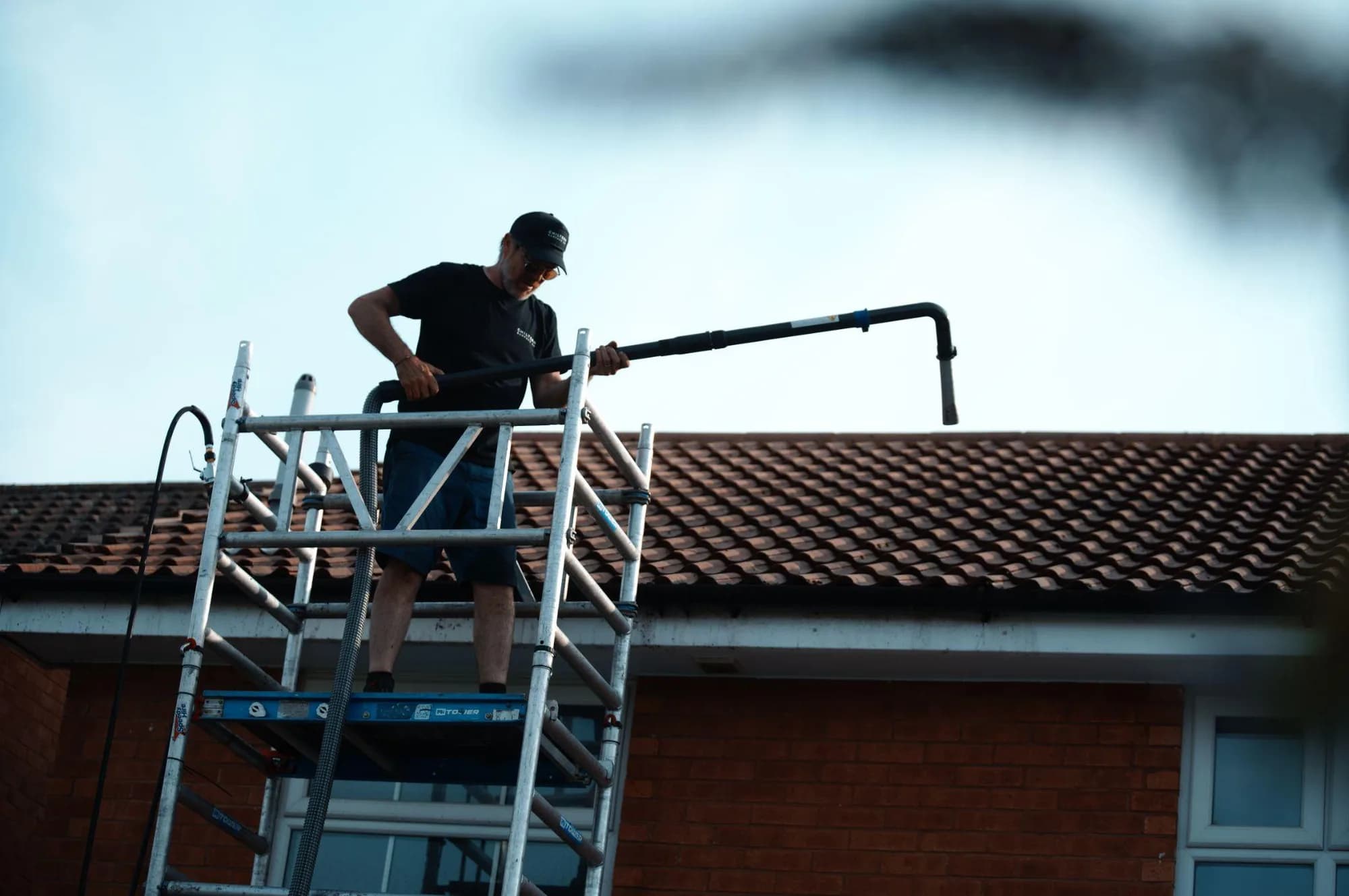
A suitable gutter vacuum system can remove many common types of gutter debris.
Loose leaves are usually straightforward. Small twigs, seeds and other dry organic material can also be collected.
Damp leaves and some heavier material can often be removed with suitable equipment, although wet debris may behave differently from dry debris.
Moss and sludge can be more difficult when they have become compacted over time.
This is where realistic expectations matter.
A vacuum is not a guarantee that every piece of material will immediately disappear. The condition of the gutter affects how easily debris can be removed.
If contamination has formed a dense layer, additional cleaning methods may be appropriate.
That is why Chiltern Surface focuses on assessment rather than treating every gutter in exactly the same way.
The right method depends on the surface, contamination and surrounding risks.
Can a Gutter Vacuum Remove Wet Leaves and Sludge?
Suitable vacuum equipment can handle many forms of damp debris, but wet material is generally heavier and more difficult to move than dry leaves.
This does not mean that gutter vacuum cleaning is unsuitable after wet weather.
It means the condition of the debris should be considered.
Freshly fallen leaves may be relatively easy to remove. Older leaves can become compressed, break down and mix with moisture to form sludge.
In some cases, this material may require additional agitation before it can be removed effectively.
A professional should therefore avoid promising that a single vacuum pass will remove every type of buildup.
The better approach is to inspect the gutter, identify the contamination and choose the most appropriate cleaning method.
That may involve vacuuming, careful manual work or a combination of suitable techniques.
Can Gutter Vacuum Cleaning Unblock Downpipes?
This is an important distinction.
Cleaning the gutter does not necessarily mean that the entire drainage system is clear.
A vacuum can remove material from the gutter and may help with debris around an accessible outlet. However, a blockage further inside a downpipe or underground drainage connection may require a different method.
If water continues to back up after the gutter has been cleaned, the downpipe should not automatically be assumed to be clear.
The outlet is an important part of the inspection.
A gutter that looks clean but continues to overflow may have a restriction beyond the visible section.
This is why effective gutter maintenance should consider the complete water path.
Rainwater needs to move from the roof into the gutter, towards the outlet and through the downpipe. A problem anywhere along that route can affect drainage.
Is Gutter Vacuum Cleaning Safer Than Using a Ladder?
One of the biggest advantages of high-reach cleaning is that it can reduce the need for ladder or roof access in suitable situations.
Working from ground level can make it easier to clean certain high gutters without placing an operator directly on the roof.
However, it would be misleading to describe the method as completely risk-free.
Long poles need to be controlled correctly. The operator needs sufficient space and a suitable position to work from. The surrounding property also needs to be considered.
For homeowners, this is one reason professional cleaning can be preferable to attempting high-level gutter work themselves.
A ladder is not always the best solution simply because it is available.
Where a high-reach method can achieve the required result without unnecessary access to the roof, it may be a more appropriate approach.
Can High-Reach Vacuum Cleaning Reach Two-Storey Gutters?
Many high-reach systems are designed for elevated gutters, making them useful for properties where ordinary ground-level access is not enough.
Two-storey homes can present particular challenges because gutters may be well beyond comfortable ladder height.
The same applies to sections above extensions or conservatories.
However, reach alone is not enough.
The operator needs to be able to position the cleaning head correctly and see or assess what is happening inside the gutter.
This is why inspection and technique are as important as the length of the pole.
A professional assessment can establish whether the gutter can be cleaned effectively from the available position or whether another method is needed.
What About Gutters Above Conservatories and Extensions?
Gutters above conservatories can be awkward to reach.
A ladder may not have a suitable position, and walking across a roof simply to access a gutter may create unnecessary risk.
A high-reach vacuum can provide an alternative in many cases.
The operator can work from a suitable position beside the property and guide the cleaning head towards the gutter.
However, the conservatory or extension still needs to be considered during the assessment.
The available working space, roofline and gutter position can affect which method is appropriate.
This is another example of why professional gutter cleaning should be based on the property rather than a fixed process.
What If There Is Very Little Space Around the Gutter?
Access problems are not always caused by height.
Some homes have narrow side passages, extensions or other structures that leave very little room around the gutter.
In these situations, conventional access may be difficult.
High-reach equipment can sometimes help because the operator does not need to position a ladder directly beneath every section.
However, the equipment still needs room to be controlled safely.
If the operator cannot position the poles correctly or cannot see the area being cleaned, another approach may be necessary.
The important point is that restricted access should be assessed before work begins.
Does a Camera Make Gutter Vacuum Cleaning Better?
A camera can be a useful part of a professional gutter vacuum cleaning process.
The main benefit is visibility.
Some gutters are difficult to inspect from ground level. A camera attached to suitable equipment can provide a view inside the gutter while the cleaning work is taking place.
This can help the operator identify remaining debris and inspect areas around difficult sections.
It can also provide useful information when a homeowner reports a drainage problem.
For example, if the gutter appears clean but continues to overflow, visual inspection may help determine whether debris remains or whether the issue could be related to the gutter's condition.
The camera should support the assessment rather than become a marketing feature.
What matters is what the inspection tells the operator and how that information affects the cleaning method.
Gutter Vacuum Cleaning vs Traditional Gutter Cleaning
Neither method is automatically better for every property.
Traditional cleaning can be appropriate where gutters are easily accessible and the debris can be safely removed by hand.
Vacuum cleaning becomes particularly useful where access is difficult or where ground-based cleaning can achieve the required result.
The type of debris also matters.
Loose leaves may be easily removed by either method. Heavy, compacted material may require more careful treatment.
The gutter's condition is another factor. Old or damaged sections should be handled carefully regardless of the cleaning method.
For this reason, the best approach is not to choose a method based only on equipment.
A specialist should first consider the problem, then select the appropriate process.
That approach reflects a simple principle: different properties require different methods.
Is a Gutter Vacuum Worth Buying?
For homeowners who clean one property occasionally, buying professional equipment may not be the most practical choice.
A specialist gutter vacuum system can represent a significant investment. There is also the question of storage, maintenance, attachments, poles and learning how to use the equipment effectively.
Professional equipment can make more sense for someone managing multiple properties or carrying out frequent gutter maintenance.
For the average homeowner, hiring a specialist may be simpler.
You are not only paying for equipment. You are paying for assessment, experience, appropriate methods and the ability to identify problems that may not be obvious from the ground.
This is particularly important if the gutter is high or difficult to access.
How Often Should Gutters Be Vacuum Cleaned?
There is no universal schedule.
The right frequency depends on the property and its surroundings.
Homes beneath mature trees may collect leaves and organic debris more quickly than properties with little vegetation nearby.
Roof design also affects how material moves into the gutter.
Rather than cleaning simply because a certain number of months have passed, regular visual checks can help determine when attention is actually needed.
After periods of heavy leaf fall, it is sensible to inspect the gutters.
The same applies after severe weather if you notice debris, overflow or changes in drainage.
Regular maintenance can help identify problems before they become more difficult to address.
What Happens During Professional Gutter Vacuum Cleaning?
A professional service should begin with an assessment rather than immediately starting the vacuum.
The gutter height, access, contamination and surrounding property are considered first.
The appropriate equipment and cleaning method can then be selected.
During the work, debris is removed carefully while the operator monitors the condition of the gutter.
Where appropriate, inspection equipment can help check areas that are difficult to see.
Once cleaning is complete, the system should be assessed for obvious remaining debris and signs of drainage problems.
The expected outcome should also be realistic.
The purpose is to achieve a significant improvement in cleanliness and support proper gutter function where the condition of the system allows.
If a separate problem is identified, such as a damaged gutter or suspected downpipe restriction, it should be explained rather than ignored.
That gives the homeowner a clearer understanding of what has been found and what action may be appropriate.
When Should You Hire a Professional?
Professional gutter vacuum cleaning is particularly useful when the gutters are high, difficult to access or positioned above structures that make conventional cleaning awkward.
It is also worth considering when you are unsure whether a gutter is simply dirty or has a wider drainage problem.
Persistent overflow, standing water or repeated blockages can indicate that cleaning alone may not be the complete answer.
A professional assessment can help separate these issues.
The recommendation should be based on the actual condition of the property. Sometimes cleaning is appropriate. In other cases, the gutter may need repair or another part of the drainage system may require attention.
Good advice includes knowing when not to recommend unnecessary work.
Frequently asked questions
Does gutter vacuum cleaning really work?
Yes, it can be an effective method for removing many common types of gutter debris, particularly where access is difficult. Its effectiveness depends on the type and condition of the material inside the gutter. Compact or heavily bonded debris may require additional methods.
Can a gutter vacuum clean gutters from the ground?
In many situations, yes. High-reach poles allow suitable equipment to access elevated gutters while the operator remains at ground level. However, the height, gutter design and surrounding property should be assessed first to determine whether ground-based cleaning is appropriate.
Can gutter vacuum cleaning unblock a downpipe?
It can remove debris from the gutter and may help with material around an accessible outlet, but it does not guarantee that a blockage deeper inside the downpipe has been cleared. Continued drainage problems may require separate investigation.
Is gutter vacuum cleaning better than using a ladder?
It can be a more practical option for many high or difficult-to-reach gutters because it may reduce the need for ladder or roof access. However, no single cleaning method is best for every property. The gutter condition and access should determine the approach.
Is it worth buying a gutter vacuum for your home?
For occasional domestic cleaning, hiring a professional may be more practical than purchasing and maintaining specialist equipment. A professional service also provides assessment and experience, which can be particularly valuable when gutters are high or drainage problems are suspected.
Conclusion
Gutter vacuum cleaning can be a practical solution for maintaining gutters, particularly where traditional access is difficult. High-reach equipment can allow many gutters to be cleaned from the ground, reducing the need for unnecessary ladder or roof access. However, the vacuum should not be viewed as the entire solution. The condition of the gutter, the type of debris, the available access and the wider drainage system all matter. Loose leaves may be straightforward to remove, while compacted sludge or other difficult contamination may require additional care. It is also important to remember that a clean gutter does not automatically mean a clear downpipe. If water continues to back up or overflow, the drainage route may need further assessment. At Chiltern Surface, the focus is on choosing the appropriate method after understanding the problem. Equipment supports the process, but careful assessment, preparation and workmanship remain central to achieving the right outcome. We do not believe every gutter needs the same treatment. The most suitable approach depends on the property, its condition and the risks involved. If you are unsure whether gutter vacuum cleaning is suitable for your property, arrange a Free Site Assessment with Chiltern Surface. We can assess the situation and recommend the most appropriate approach, helping you make an informed decision about your gutter maintenance.