
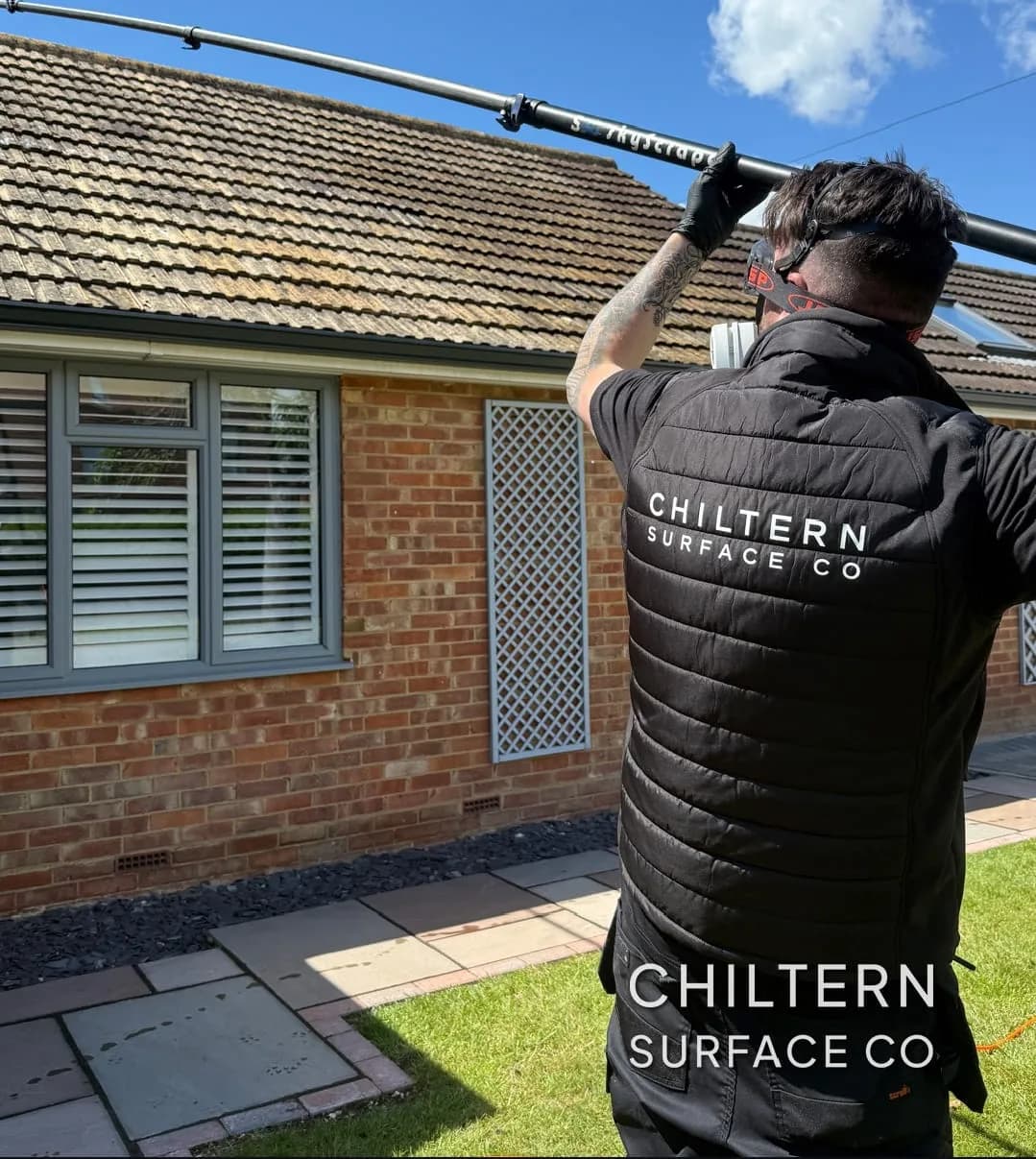
Cleaning gutters is an important part of exterior property maintenance, but reaching them is not always simple. High rooflines, two-storey properties, extensions and awkward access can make traditional gutter cleaning difficult.
The good news is that some gutters can be cleaned from ground level using suitable long-reach equipment. However, the right approach depends on the height, gutter design and type of debris present.
Why Do Gutters Need Cleaning?
Gutters have a simple but important job. They collect rainwater from the roof and direct it towards the drainage system.
Over time, leaves, moss, twigs, dirt and other organic debris can collect inside them. As this material builds up, it can restrict the flow of rainwater.
A partially blocked gutter may still appear to work during light rain. During heavier rainfall, however, water can begin to overflow.
This can leave the guttering under unnecessary strain and may cause water to run down areas of the property that were not designed to handle constant water flow.
Regular cleaning also gives you an opportunity to spot issues such as damaged sections, loose joints or areas where debris is building up unusually quickly.
Can You Clean Gutters from the Ground?
Yes, depending on the property.
If the gutters are reasonably accessible from ground level, long-reach equipment can sometimes remove leaves and other loose debris without requiring someone to climb onto the roof.
This is particularly useful for homeowners who have high gutters or who want to avoid unnecessary work at height.
However, how to clean gutters from the ground is not simply a question of finding the longest pole available.
The cleaning method needs to match the condition of the gutter.
Loose leaves are relatively straightforward. Compact, wet organic material is more difficult. A gutter containing a heavy build-up of moss may require a different approach again.
The height of the gutter also matters. A method that works well on a single-storey extension may not provide enough control or visibility on a two-storey property.
How to Clean Gutters from the Ground
There are several ground-level approaches that can be used for suitable properties.
Use a Telescopic Gutter Cleaning Tool
A telescopic pole can extend your reach while allowing you to remain on the ground.
Depending on the attachment, it may be possible to pull or loosen leaves and other loose material from inside the gutter.
This can be useful for routine maintenance where the contamination is light.
However, basic telescopic tools have limitations. They may struggle with wet leaves that have compacted over time or moss that has become firmly established.
Trying to force a tool through a heavy blockage is not necessarily the best solution. It can make the work harder and may put unnecessary pressure on the guttering.
Use a Long-Reach Gutter Vacuum
A specialist gutter vacuum can provide another ground-level solution.
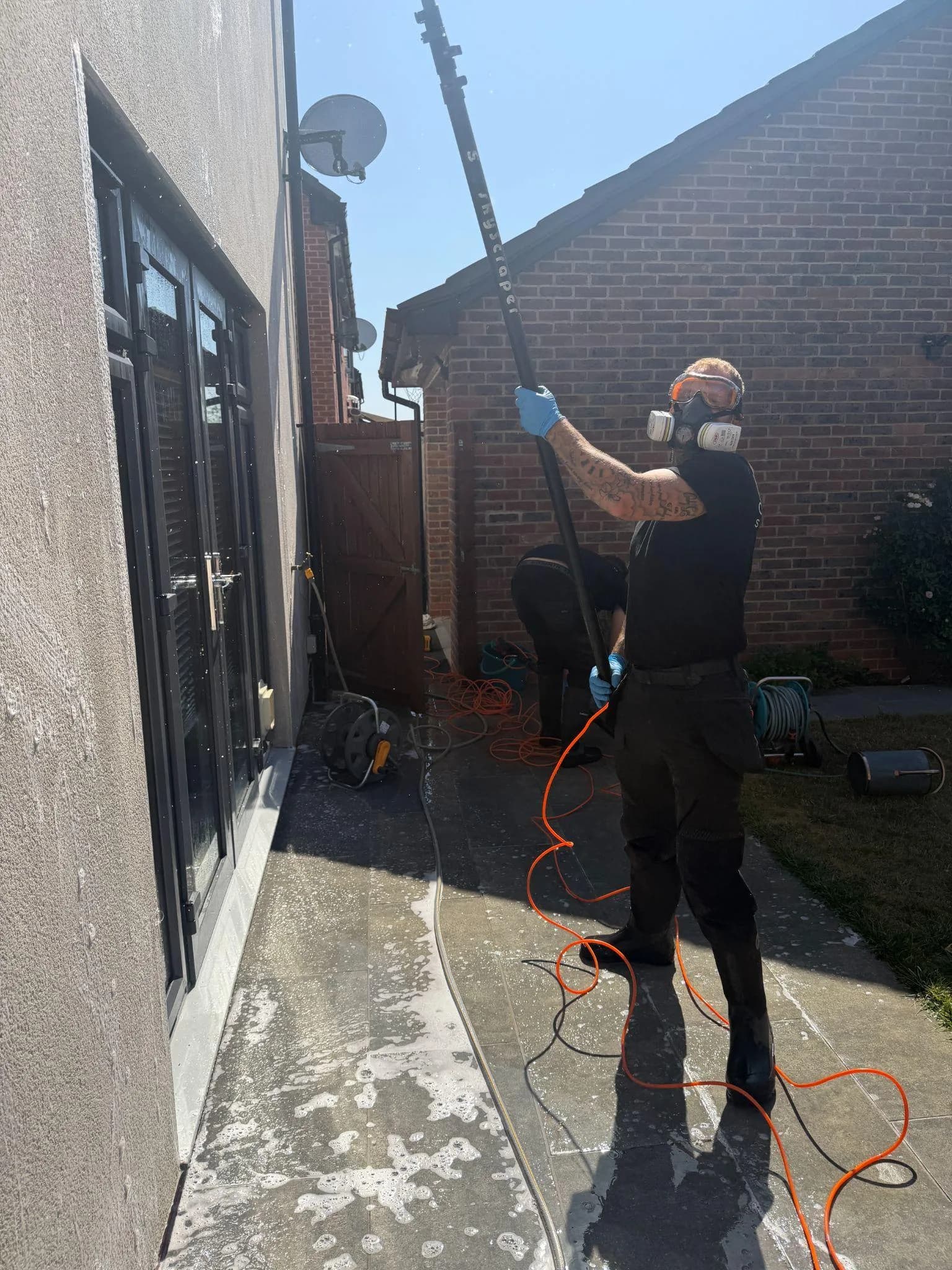
The long-reach system allows debris to be removed from the gutter while the operator remains below. This can be particularly useful where the gutter is too high for ordinary hand tools.
Vacuum cleaning can also help remove loose leaves, moss, sediment and other debris rather than simply pushing it towards another section of the gutter.
However, equipment should not be chosen simply because it is powerful or has greater reach.
The condition of the gutter and the type of contamination should determine the appropriate method. This assessment-led approach is central to professional exterior surface work.
How to Clean High Gutters Without a Ladder
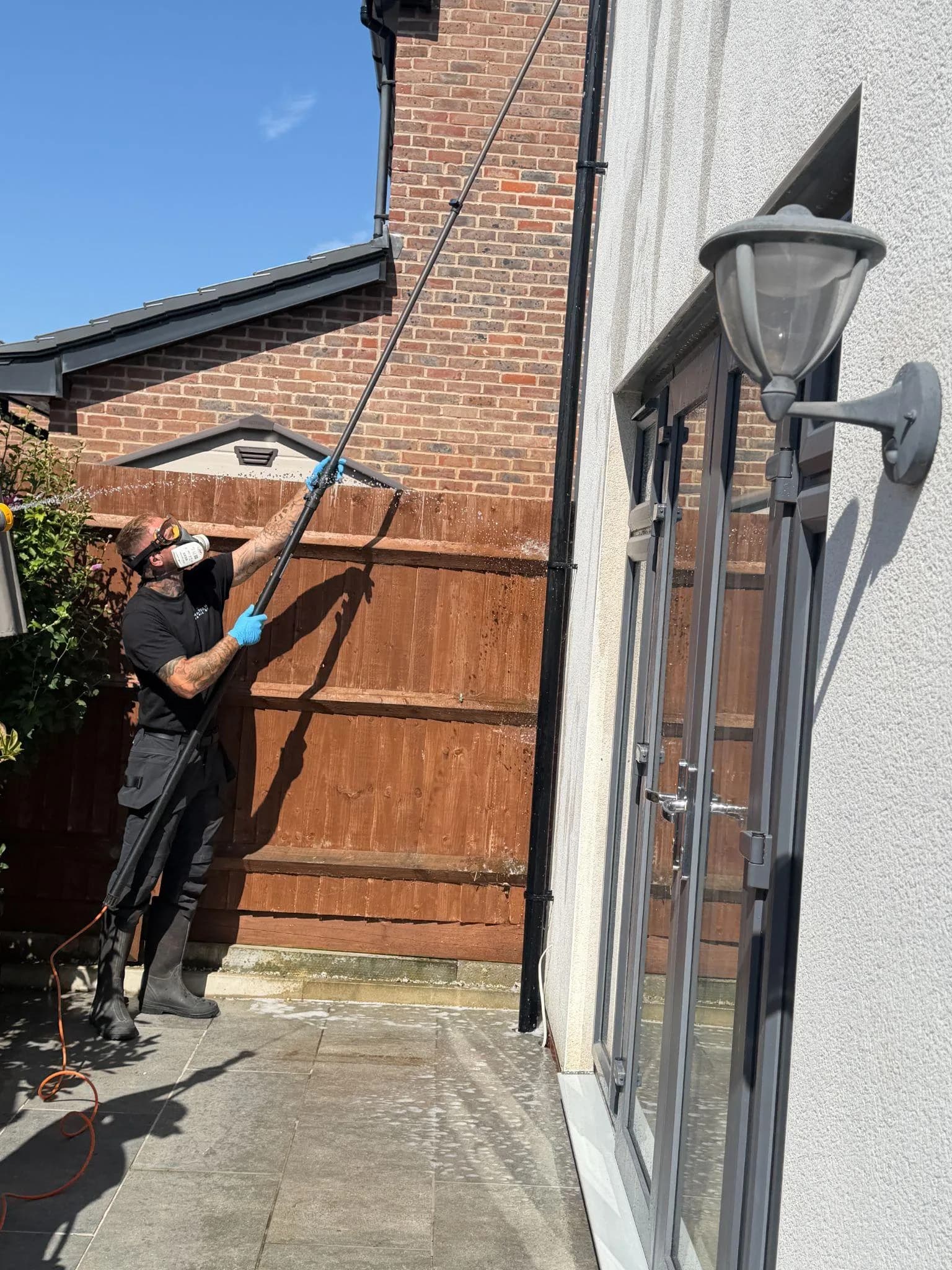
High gutters are one of the main reasons homeowners search for how to clean gutters from the ground.
A two-storey property can make ladder access awkward. Extensions, conservatories, narrow side passages and uneven ground can create further challenges.
Long-reach equipment can often make these areas more accessible from ground level.
However, reaching the gutter is only part of the job.
You also need to consider whether you can properly identify what is inside the gutter. Corners, joints and downpipe outlets can collect debris that is difficult to see from below.
For this reason, a professional approach should focus on both cleaning and assessment.
The goal is not simply to remove the most visible leaves. It is to ensure that the accessible gutter sections are properly considered and that potential drainage problems are not overlooked.
How to Clean Two-Storey Gutters from the Ground
Two-storey guttering presents a greater challenge than standard low-level guttering.
The additional height means that ordinary household equipment may not provide enough reach or control.
Specialist long-reach systems can be useful because they allow the work to be carried out from ground level.
The condition of the gutter should still be checked before deciding on the method.
For example, loose leaves may be relatively easy to remove. A thick layer of wet organic material may require more care. A suspected blockage around a downpipe outlet may also need separate attention.
This is why there is no single cleaning method that is suitable for every property.
Different surfaces and conditions require different methods, and professional recommendations should be based on the gutter, contamination and potential risks.
What If the Gutters Are Full of Wet Leaves?
Wet leaves can be much harder to remove than dry leaves.
As leaves remain in a gutter, rainwater can make them heavier. Over time, they can break down and mix with dirt, moss and other organic material.
The result can be a dense layer that does not move easily.
A simple telescopic brush may work for loose material, but it may be less effective against compacted debris.
A suitable long-reach vacuum system may be more appropriate where the material can be removed from ground level.
The important point is not to assume that more force is always better.
Gutters are part of a property's drainage system. Careful cleaning should aim to remove contamination without placing unnecessary stress on the guttering.
What About Moss in Gutters?
Moss is another common form of gutter contamination.
It may enter the gutter from the roof, particularly where the roof has existing organic growth. Once inside the gutter, moss can mix with leaves and sediment.
A small amount can often be removed during routine gutter cleaning. Heavier accumulation may be more difficult.
It is also worth considering the source.
If a roof has significant moss growth, cleaning the gutter alone does not address the roof contamination. The moss can continue to enter the gutter after the cleaning has been completed.
This is where a wider property assessment can be useful.
Rather than treating the visible debris as the entire problem, it can be helpful to consider why the contamination is occurring and whether another part of the property requires attention.
What Happens If a Gutter Is Blocked?
A blocked gutter cannot move rainwater as effectively as it should.
During heavy rainfall, water may overflow from the gutter rather than travelling towards the downpipe.
The location of the overflow can sometimes provide a clue about the problem.
For example, water overflowing near a downpipe may indicate an issue around the outlet or further inside the drainage system.
However, not every overflow means that the gutter itself is blocked.
Gutters can also suffer from poor alignment, damaged joints or other problems that affect drainage.
That is why cleaning should not automatically be treated as the complete solution to every gutter problem.
If the gutter continues to overflow after cleaning, the drainage system should be assessed rather than repeatedly cleaned without investigating the cause.
Don't Forget the Downpipes
The gutter and downpipe work together.
Even if the main gutter appears clean, a blocked downpipe can still prevent water from draining correctly.
Organic debris can collect around the downpipe opening or further inside the pipe.
If water remains in the gutter after cleaning, or if it drains unusually slowly, the downpipe may need attention.
This is particularly important before and during periods of heavy rainfall.
A professional assessment can help determine whether the issue is caused by debris, the gutter itself or another part of the drainage system.
Common Mistakes When Cleaning Gutters from the Ground
One of the most common mistakes is assuming that every gutter can be cleaned in exactly the same way.
A low gutter with loose leaves is a simple situation. A high gutter filled with compacted organic material is very different.
Another mistake is pushing debris towards the downpipe without checking whether the outlet is clear.
This can potentially move the problem rather than solve it.
Using water alone is another common assumption. Rinsing can help with loose dirt, but it may not remove compacted moss and organic debris.
It is also easy to concentrate on the most visible parts of the gutter and overlook corners, joints and less accessible areas.
Most importantly, working at height should not be underestimated. If a gutter cannot be safely reached or inspected from the ground, attempting to improvise with unsuitable equipment may create unnecessary risk.
When Should You Choose Professional Gutter Cleaning?
DIY cleaning may be suitable for some low, accessible gutters where the debris is light and easy to remove.
Professional cleaning becomes more appropriate when access is difficult or the contamination is significant.
Consider professional advice if:
- Your gutters are on a two-storey property.
- You have heavy moss or compacted debris.
- A downpipe appears to be blocked.
- Gutters continue to overflow after cleaning.
- You cannot properly inspect the gutter from ground level.
- The roofline has difficult or restricted access.
- You are unsure which cleaning method is suitable.
The benefit of professional work is not simply specialist equipment.
A proper approach begins with assessing the property, understanding the problem and selecting an appropriate method. This reflects Chiltern Surface focus on technical judgement, careful workmanship and suitable specialist methods rather than applying one process to every property.
How Often Should Gutters Be Cleaned?
There is no single cleaning schedule that suits every home.
A property surrounded by mature trees may collect leaves much faster than a property with little vegetation nearby.
Roof condition can also affect the amount of moss and organic material entering the gutter.
For this reason, regular inspection is often more useful than relying on a fixed date.
Autumn can be an important time to check gutters because falling leaves can quickly increase the amount of debris present. Properties with heavy tree coverage may need additional attention.
Cleaning before debris becomes heavily compacted can also make future maintenance simpler.
Frequently asked questions
Can I clean my gutters from the ground without a ladder?
Yes. Telescopic tools and specialist long-reach vacuum systems can allow suitable gutters to be cleaned from ground level. However, the height and condition of the gutter should be considered before choosing a method.
What is the best way to clean high gutters?
There is no universal method. Long-reach specialist equipment can be suitable for high gutters, especially where ladder access is difficult. The appropriate method depends on the type and amount of debris as well as the gutter design.
Can two-storey gutters be cleaned from the ground?
In many cases, yes. Specialist equipment can provide sufficient reach for two-storey guttering. However, difficult rooflines, extensions and restricted access may affect the cleaning approach.
Can a gutter vacuum remove moss and wet leaves?
A suitable gutter vacuum can remove many types of loose and semi-compacted organic debris. Heavily compacted material may require a more careful or specialist approach.
When should I call a professional gutter cleaner?
Professional help is worth considering when gutters are high, difficult to inspect, heavily contaminated or repeatedly overflowing. Chiltern Surface can arrange a Free Site Assessment to help determine the most appropriate approach for your property.
Conclusion
Learning how to clean gutters from the ground can make routine gutter maintenance more manageable, particularly for high and difficult-to-reach properties. Telescopic tools can be useful for light debris, while specialist long-reach vacuum systems may be better suited to more substantial build-up. However, the correct method depends on the gutter's condition, the type of contamination and the layout of the property. The key is to avoid treating every gutter in the same way. Loose leaves, compacted moss, blocked outlets and damaged guttering are different problems and may require different solutions. At Chiltern Surface , the focus is on assessment, appropriate specialist methods and careful workmanship. The aim is to help protect the condition and long-term performance of your property's exterior rather than simply remove visible debris. If you're unsure about the condition of your gutters or cannot safely reach them, arrange a Free Site Assessment with Chiltern Surface. You can get property-specific advice and understand the most appropriate next step without unnecessary pressure.