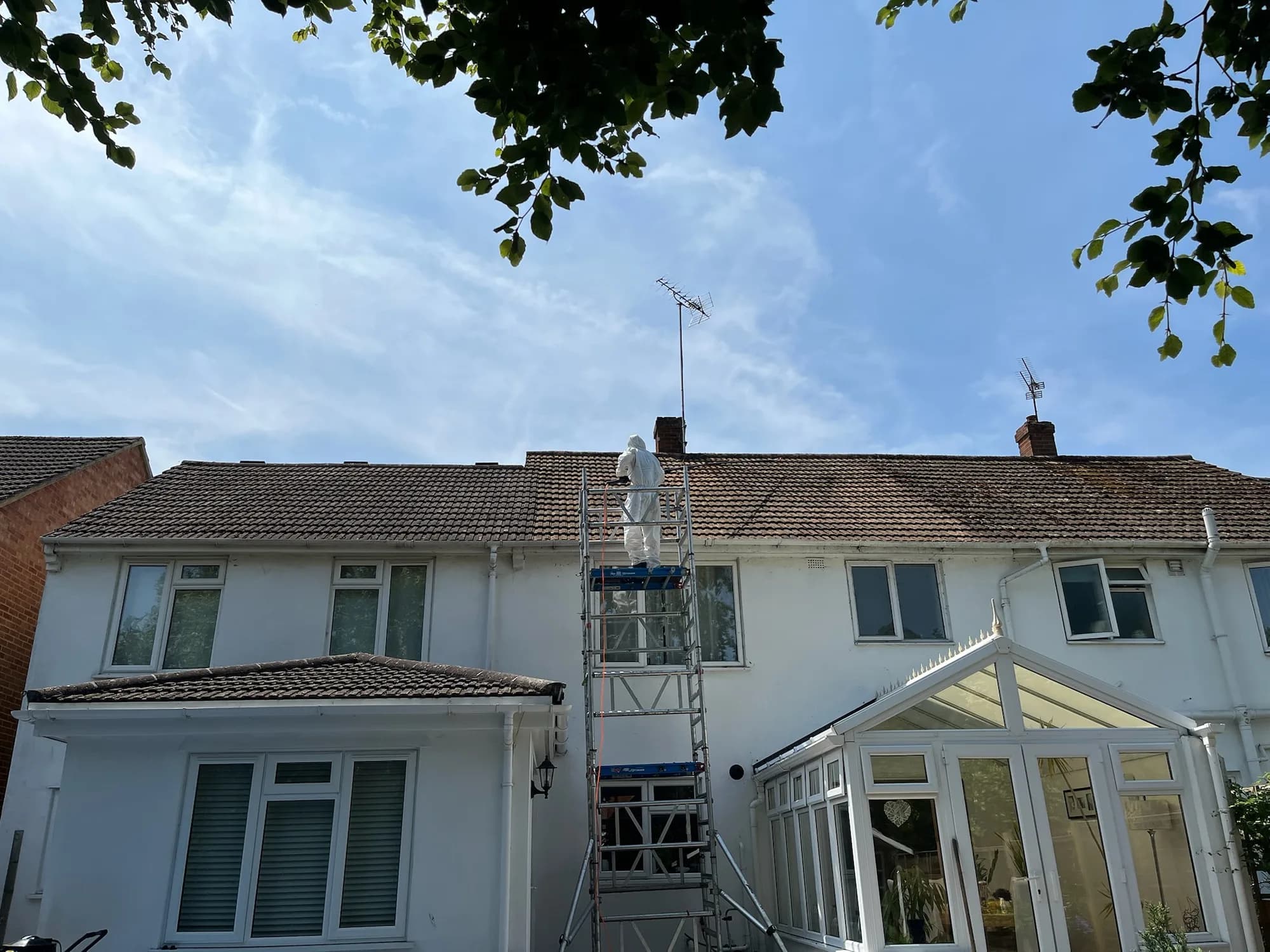
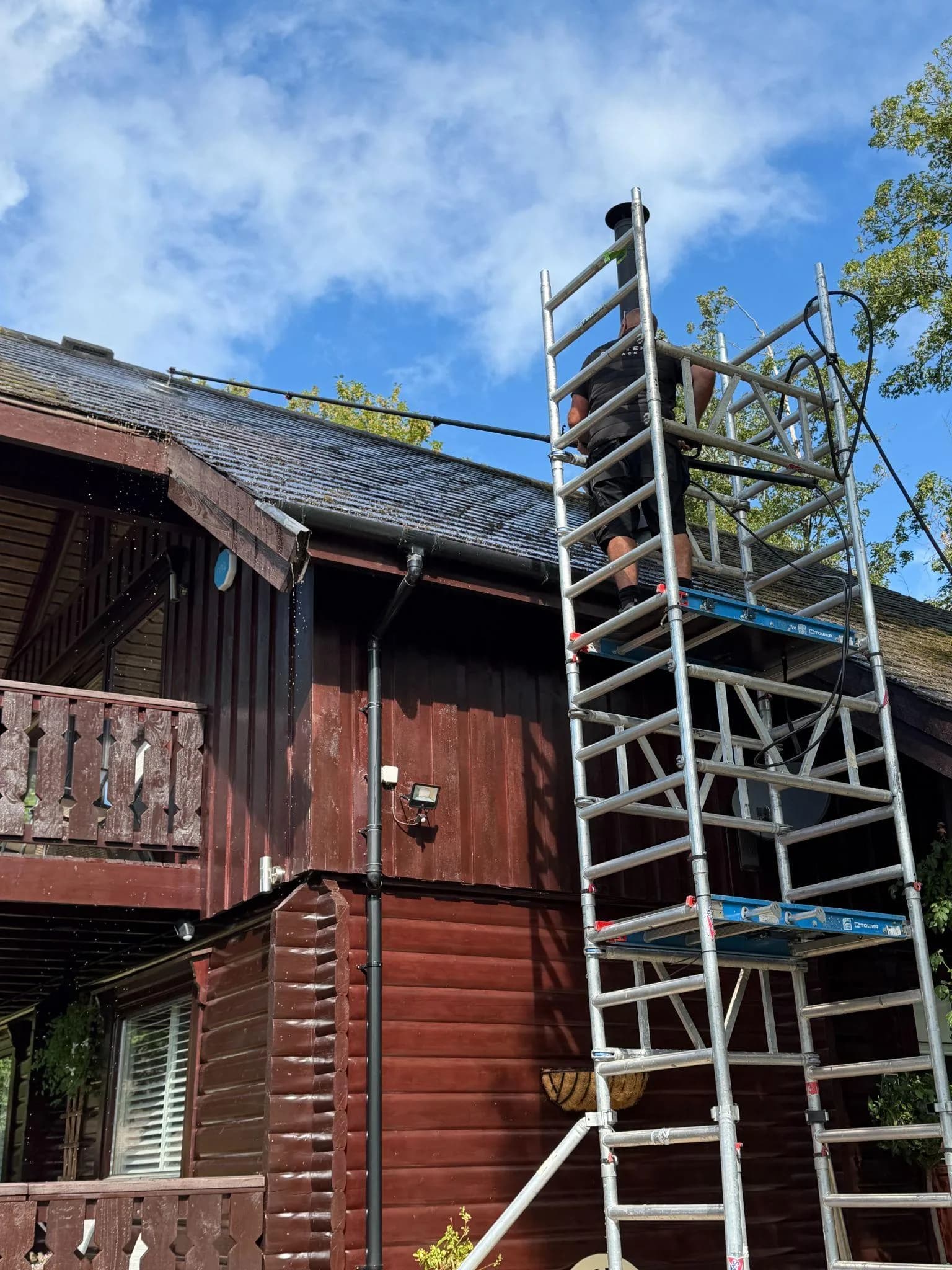
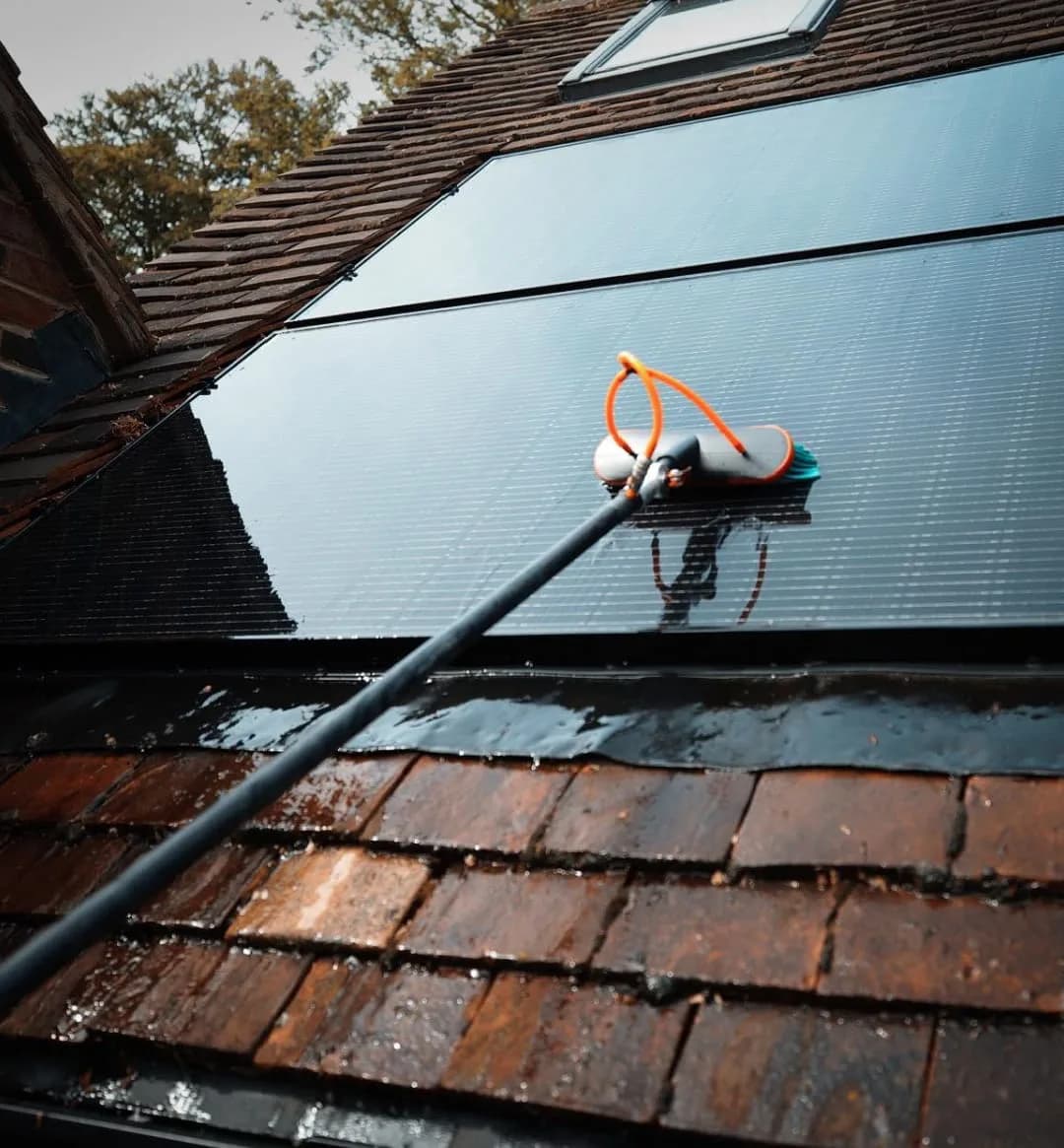
If you want to know how to clean solar panels from the ground, the safest approach is to avoid walking on the roof and use suitable long-reach equipment. A soft brush, telescopic pole and appropriate water can remove ordinary dirt while keeping you safely at ground level.
How to Clean Solar Panels From the Ground
Solar panels spend most of their lives exposed to the weather. Dust, pollen, bird droppings, leaves and other debris can settle on the glass over time.
Rain removes much of the loose dirt naturally. However, some contamination can remain and may eventually make the panels look visibly dirty.
The good news is that many solar panels can be cleaned without climbing onto the roof.
A suitable ground-based method uses long-reach equipment to reach the panel surface while the operator stays in a stable position on the ground. This can reduce the need for ladders and roof access.
However, how to clean solar panels from the ground is not simply a case of using the longest pole you can find.
The height of the building, roof pitch, position of the panels, surrounding structures and type of contamination all matter.
The aim should always be to choose a method that is safe, controlled and appropriate for the installation.
Why Clean Solar Panels From the Ground?
Roof-mounted solar panels can be awkward to reach.
A panel may be installed on a steep roof, above a conservatory or on a two-storey property. Even when the panels themselves are easy to see, reaching them safely can be a very different matter.
This is where ground-based cleaning can help.
Instead of standing on the roof, a telescopic pole can provide the reach needed to clean the glass. A suitable brush can loosen contamination, while water helps rinse the surface.
There is an important safety benefit here.
You are not creating unnecessary working-at-height risk simply to remove dust or bird droppings.
That does not mean ground cleaning is automatically suitable for every property. The equipment still needs to be controlled safely, and the operator needs enough space to work without leaning, stretching or losing balance.
If the panels cannot be reached safely from the ground, the right answer is not to improvise. A professional assessment is usually the better option.
Can All Solar Panels Be Cleaned From the Ground?
No. Many can, but not all.
A ground-based method depends on the relationship between the operator and the panels.
For example, panels on a low roof may be easy to reach. Panels on a taller building may require specialist long-reach equipment.
The position of the roof also matters.
A conservatory, extension, wall or garden structure can make it harder to position the pole correctly. Trees and overhead obstacles may create another challenge.
The goal is not simply to reach the panel.
You also need to be able to control the brush and water flow properly.
A pole that is technically long enough may still be difficult to handle if it becomes too heavy or flexible at full extension.
Therefore, before deciding how to clean solar panels from the ground, assess the property rather than assuming one setup will work everywhere.
What Equipment Do You Need?
Ground-based solar panel cleaning does not require a large collection of tools.
The main equipment should be selected according to the installation and the type of contamination.
Telescopic Cleaning Pole
A telescopic pole provides the reach needed to access elevated panels.
The correct length depends on the property.
A shorter pole may be enough for a bungalow or low roof. Taller properties may require longer equipment.
However, longer is not always better.
The longer a pole becomes, the more difficult it can be to control. Wind can also make an extended pole harder to handle.
Choose equipment that gives sufficient reach while remaining manageable.
Soft Cleaning Brush
The brush should be suitable for delicate glass surfaces.
Soft bristles can help loosen dust and other contamination without aggressive scrubbing.
Avoid hard, abrasive brushes or anything designed for heavy-duty surfaces such as paving or concrete.
Solar panels need a gentle approach.
Water-Fed Pole
A water-fed pole allows water to travel through the pole and reach the brush head.
This makes it possible to wet, brush and rinse the panels while remaining on the ground.
For professional cleaning, purified or deionised water may be used because it contains fewer minerals than ordinary hard water.
This can help reduce water spots as the surface dries.
Suitable Water Supply
Water quality is worth considering.
Tap water contains minerals. In hard-water areas, these can remain on glass after evaporation and leave marks.
Purified water can reduce this problem.
The best water choice will depend on the property, local water quality and cleaning system being used.
How to Clean Solar Panels From the Ground Step by Step
Once you have established that the panels can be reached safely, the cleaning process should remain controlled and gentle.
1. Inspect the Panels First
Start by looking at the panels from a safe position.
Check for visible dust, bird droppings, leaves, pollen and other debris.
Also look for anything that appears unusual, such as damaged glass, exposed wiring or loose components.
Do not climb onto the roof simply to inspect a panel.
If you notice possible electrical damage, stop and arrange appropriate professional assistance.
Cleaning should never take priority over safety.
2. Choose Suitable Weather
Avoid working on extremely hot panels in strong direct sunlight where possible.
A cooler, overcast period can make the work easier because water is less likely to evaporate immediately.
You also need reasonably calm conditions.
Wind can make a long telescopic pole harder to control, especially when it is fully extended.
Good conditions make the cleaning process more controlled and reduce unnecessary effort.
3. Remove Loose Debris
Before brushing, deal with loose leaves and larger debris.
Do not press a brush hard against a dry layer of dirt.
If there is a lot of loose material, gentle water can help loosen it first.
The idea is to avoid dragging dry particles aggressively across the glass.
4. Wet the Panel Surface
Apply suitable clean water across the panel.
This helps soften surface contamination and makes brushing easier.
There is no need for excessive water pressure.
Controlled water flow is preferable to forceful spraying.
5. Brush Gently
Use the soft brush to work across the surface.
Do not press heavily.
Let the brush and water do the work.
If a deposit does not come away easily, avoid increasing pressure. Instead, allow it to soften and try again gently.
Persistent contamination may require a different approach.
6. Rinse the Surface
Once the dirt has been loosened, rinse the panel thoroughly.
The aim is to leave the glass free from loose contamination and cleaning residue.
Where purified water is being used, the panels can generally be allowed to dry naturally.
7. Check the Finished Surface
Look over the panels again from the ground.
Check for remaining bird droppings, streaks or areas that still look contaminated.
If a small area needs another gentle pass, repeat the process rather than applying excessive pressure.
What Water Should You Use?
Water is an important part of solar panel cleaning.
For basic cleaning, ordinary tap water may remove loose dirt. However, minerals in the water can create spotting when the surface dries.
This can be particularly noticeable in hard-water areas.
Purified or deionised water is often preferred for professional ground-based cleaning because it contains fewer dissolved minerals.
The result can be a cleaner finish with less spotting.
The important point is that water quality should be considered alongside the cleaning method.
Simply using more water does not necessarily produce a better result.
Should You Use Soap on Solar Panels?
Usually, there is no reason to use household soap or glass cleaner automatically.
Solar panels do not need to be treated like ordinary windows.
A suitable brush and appropriate water may be enough to remove normal surface contamination.
Using unnecessary cleaning products can leave residue behind. Some products may also be unsuitable for particular panel surfaces or coatings.
Always consider the manufacturer's guidance before applying any cleaning chemical.
If there is no clear reason for a detergent, a simple cleaning method may be preferable.
Can You Use a Pressure Washer?
Pressure washing is not a suitable routine method for solar panel cleaning.
A pressure washer is designed to remove heavy contamination from robust surfaces. Solar panels require a more controlled approach.
High-pressure water can place unnecessary force around panel edges, seals and components.
There is also little reason to use extreme pressure when ordinary dirt can be removed with gentle water and brushing.
This is an important distinction between cleaning a solar panel and cleaning a driveway.
The strongest equipment is not necessarily the right equipment.
The correct method should be selected according to the surface, contamination and potential risks.
Can You Use a Garden Hose?
A garden hose can help rinse loose dirt from accessible panels.
However, it may not be enough to remove stubborn contamination.
There is also the issue of water quality. If your mains water is hard, allowing it to dry on the glass can leave mineral marks.
For occasional light rinsing, a hose may have a place. For thorough ground-based cleaning, a suitable water-fed pole system gives you much greater control and reach.
How Do You Remove Bird Droppings?
Bird droppings can be more difficult than ordinary dust.
Once they dry, they can stick firmly to the glass.
The first step is to soften the deposit with water.
Do not scrape it with a hard object or immediately apply heavy brush pressure.
Give the water time to loosen the material. Then use a soft brush gently.
If the deposit remains difficult to remove, repeat the process rather than becoming more aggressive.
For high or awkward panels, this is also a good example of when professional cleaning may be more sensible than taking a roof-access risk.
How Do You Remove Dust and Pollen?
Dust and pollen usually require a gentler approach.
Dry brushing can move fine particles across the glass. Wetting the surface first can help loosen the contamination.
A soft brush can then be used with controlled movements.
Once the material has been loosened, rinse the panels thoroughly.
In many cases, this is enough to restore a visibly cleaner surface.
However, if contamination has become sticky or has been mixed with other deposits, a more specialist method may be required.
How Do You Clean Solar Panels on a Steep Roof?
A steep roof is one of the strongest reasons to consider ground-based cleaning.
Walking on a roof to clean panels creates unnecessary risk for many homeowners.
A telescopic pole can allow the panels to be reached without standing on the roof.
However, the steeper or higher the installation, the more important pole control becomes.
The operator needs to maintain stable footing while controlling the brush at height.
The pole should not be pushed beyond a comfortable working position.
If you need to lean, stretch or move into an unstable position to reach one section, stop.
A professional assessment can determine whether the installation is suitable for ground-based cleaning or requires another access method.
Is a Ladder Better Than a Telescopic Pole?
A ladder may appear to make the panels easier to reach.
However, it can introduce its own problems.
You may need to lean sideways to reach the panel surface. You may also need to reposition the ladder repeatedly.
Cleaning while handling a long brush or pole can make maintaining a stable position even more difficult.
A telescopic pole allows the operator to remain on the ground where suitable.
That can reduce the need for direct roof access.
However, ground-level work still requires stable footing and adequate control of the equipment.
If you cannot work safely from the ground, do not force the method.
What If the Panels Are Too High to Reach?
Do not solve a reach problem by taking unnecessary risks.
Using an excessively long pole can make the equipment difficult to control.
Climbing onto the roof without proper access and safety measures is also not a sensible alternative.
Instead, the property should be assessed to determine the safest practical method.
Professional cleaners can consider the building height, roof design, panel position, access points and surrounding obstacles before choosing an approach.
This is an important part of professional solar panel cleaning.
The equipment supports the process. The assessment determines the process.
How Often Should You Clean Solar Panels From the Ground?
There is no fixed schedule that applies to every property.
Rain can remove a lot of loose dirt naturally, so some panels may need very little manual cleaning.
Others may become dirty more quickly because of nearby trees, birds, dust or pollen.
Panel angle also affects how effectively rainwater moves across the surface.
Instead of automatically cleaning every few months, inspect the panels from a safe position.
If they remain reasonably clean, there may be no need for immediate attention.
If visible contamination builds up and remains after rainfall, cleaning may be worthwhile.
This approach avoids unnecessary cleaning while still keeping the panels in a sensible condition.
When Should You Stop DIY Cleaning?
DIY cleaning may be reasonable when the panels are accessible and the contamination is light.
However, professional help is the better choice when:
- The panels cannot be reached safely from the ground.
- The roof is particularly high or steep.
- You cannot control the cleaning pole comfortably.
- Heavy contamination will not release with gentle cleaning.
- You notice damaged panels or exposed electrical components.
- Surrounding structures make access difficult.
- You are unsure whether your cleaning method is suitable.
The potential benefit of removing dirt should never outweigh the risk of injury or damage.
Why Professional Solar Panel Cleaning Can Be Safer
Professional cleaning is not simply about having better equipment.
It is about knowing which method suits the surface and the property.
For suitable installations, ground-based water-fed cleaning can provide access without requiring someone to walk across the roof.
The contamination can also be assessed before the cleaning method is chosen.
Light dust may require a simple treatment. Dried bird contamination may need more time and careful softening.
This approach reflects Chiltern Surface's wider philosophy: assess the surface, understand the contamination and select an appropriate method rather than applying the same process everywhere.
The result should be a significant improvement in surface cleanliness without making unrealistic promises about energy production or performance.
Frequently asked questions
Can you clean solar panels completely from the ground?
Yes, many solar installations can be cleaned from ground level using suitable telescopic equipment. However, the height, roof design, panel position and surrounding structures all affect whether this is practical. If the panels cannot be reached or controlled safely, professional assessment is recommended.
What is the best brush for cleaning solar panels from the ground?
A soft brush designed for delicate surfaces is preferable. The brush should loosen contamination without aggressive scrubbing. Hard or abrasive brushes should be avoided because the aim is careful surface cleaning rather than heavy-duty removal.
Can I use tap water to clean solar panels?
Tap water can remove dirt, but hard water may leave mineral spots when it dries. Purified or deionised water can reduce this problem and is often preferred for professional ground-based cleaning.
Can I clean solar panels from the ground with a hose?
A hose can rinse away loose dirt, but it may not remove stubborn contamination. A suitable water-fed pole gives better reach and allows the surface to be gently brushed and rinsed while the operator remains on the ground.
Is cleaning solar panels from the ground safer than cleaning them from the roof?
In many situations, yes. Ground-based cleaning can avoid the need to walk on a roof. However, the operator still needs stable footing, suitable reach and control of the equipment. If those conditions cannot be achieved, professional cleaning is the safer option.
Conclusion
Learning how to clean solar panels from the ground can help you maintain the surface without creating unnecessary roof-access risks. For suitable installations, the process is relatively straightforward. Inspect the panels from a safe position, select suitable equipment, wet the surface, use a soft brush gently and rinse away the loosened contamination. The details matter, though. A hard brush, excessive pressure, unsuitable chemicals or poor-quality water can create problems that a simple cleaning process does not need to cause. Likewise, the longest telescopic pole is not automatically the best choice. You need equipment that gives you enough reach while remaining safe and controllable. Most importantly, do not climb onto a roof simply because one section of a panel is difficult to reach. At Chiltern Surface, the approach is based on assessment, specialist methods and careful workmanship. The aim is to understand the surface and its condition first, then choose a suitable cleaning method rather than forcing every property into the same process. If you are unsure whether your panels can be safely cleaned from the ground, arrange a Free Site Assessment with Chiltern Surface. The team can assess the access, contamination and appropriate cleaning approach, helping you make an informed decision without unnecessary roof work.