
What Size Ladder for Gutter Cleaning?
The right ladder for gutter cleaning depends on the actual gutter height, not simply whether the house is described as one or two storeys. As a rough UK guide, gutters on a single-storey property are often around 3-3.5 metres high, while two-storey gutters are commonly around 5.5-6 metres.
That usually means looking at a ladder in roughly the 4-6 metre range for many single-storey gutters and around 7-8 metres for many two-storey gutters. Those are starting points, not universal recommendations. The ladder still has to be long enough when it is set at the correct angle, and you must be able to work without standing on the top three rungs or leaning sideways to gain extra reach.
The safest answer is therefore: measure the gutter height first, then choose a ladder whose stated working arrangement gives you enough reach without pushing you into an unsafe position.
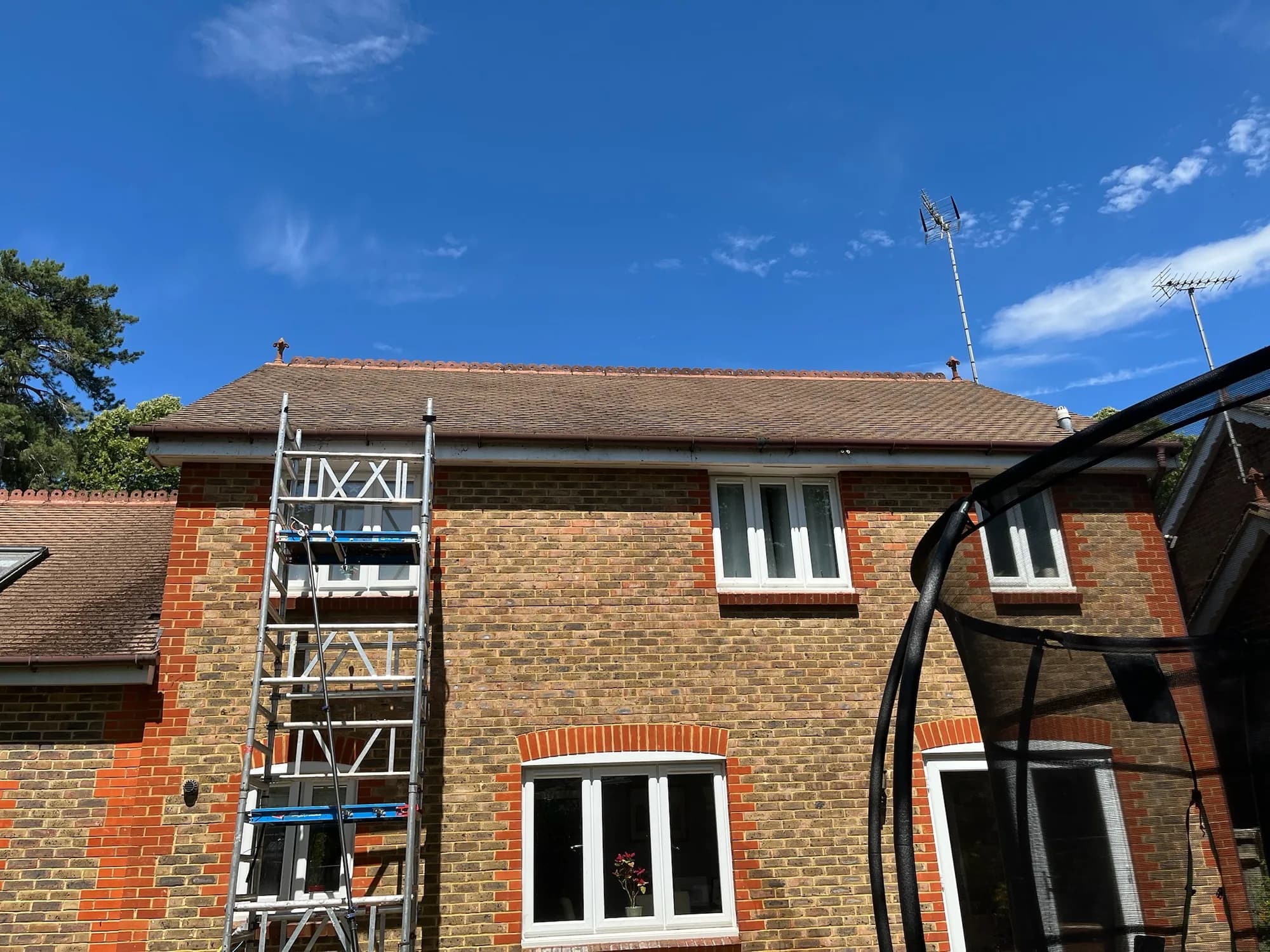
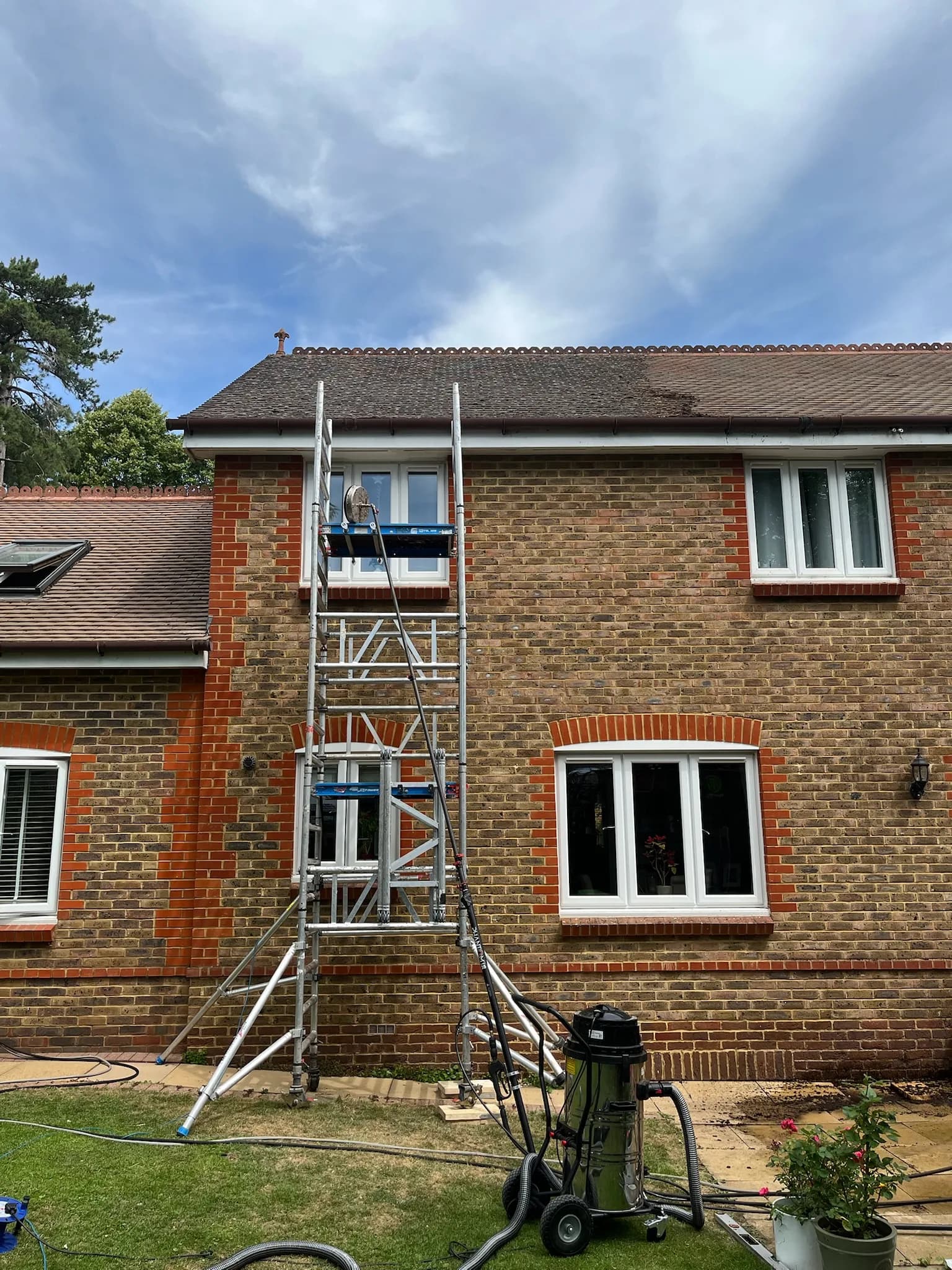
At Chiltern Surface Co, most domestic gutters are cleared with a pole-fed gutter vacuum from ground level where the property allows. Ladder access is used only where the layout makes it appropriate, because avoiding work at height is preferable when the same job can be completed effectively from the ground.
Quick Guide: What Size Ladder Do You Need?
The table below is a practical sizing guide based on typical UK gutter heights. Always check the ladder manufacturer's stated working height and setup instructions rather than relying on overall ladder length alone.
Property / gutter height
Typical gutter height
Rough ladder range
Important note
Low single-storey / garage
Around 2.5-3 m
Approx. 3.5-5 m
Measure first; a suitable stepladder or extension ladder may work depending on access.
Typical bungalow / single storey
Around 3-3.5 m
Approx. 4-6 m
Do not choose a ladder that only just reaches when vertical.
Typical two-storey home
Around 5.5-6 m
Approx. 7-8 m
Extension ladder is usually more appropriate than a stepladder.
Tall two-storey / sloping ground
6 m+
Often 8 m or more
Height and ground conditions need individual assessment.
Three storeys / difficult access
Varies significantly
Do not size by guesswork
Ground-based systems or professional access are often the better option.
These ranges reflect common trade guidance, but they are not a substitute for measuring the property. A house on sloping ground, a high Victorian property, a deep overhang or a raised rear elevation can make the gutter substantially higher than the front of a similar-looking house.
Why Ladder Length Is Not the Same as Gutter Height
A common mistake is to measure a 5.5-metre gutter and assume a 5.5-metre ladder is enough. A leaning ladder is not used vertically. It sits away from the wall, which reduces the vertical height reached by its full length.
The Health and Safety Executive recommends the 1-in-4 rule for leaning ladders: for every four units of vertical height, the base is approximately one unit out from the wall. That creates an angle of about 75 degrees.
You also need a usable working position. HSE guidance says not to work from the top three rungs of a leaning ladder. So a ladder that technically touches gutter height may still be too short for safe working.
For current UK ladder-safety guidance, see the Health and Safety Executive's safe use of ladders guidance.
How to Measure for a Gutter Cleaning Ladder
1. Measure from the ground to the gutter
Measure to the section you actually need to work beside. Do not assume the front and rear elevations are the same height. Sloping gardens and raised ground-floor levels can change the working height considerably.
2. Check where the ladder base can actually stand
The base needs firm, level, clean ground. Mossy paving, loose gravel, wet decking, soft borders and sloping ground all affect whether a leaning ladder can be used safely.
HSE guidance specifically advises using ladders only on firm, level ground and not improvising with bricks, timber or other packing to make a ladder level.
3. Allow for the ladder angle
A leaning ladder should not be positioned almost vertically to gain extra height. If the ladder is too short when placed at the correct angle, the answer is a longer ladder or a different access method, not a steeper setup.
4. Check the manufacturer's working-height information
Two ladders with similar overall lengths can have different usable heights because of section overlap, locking mechanisms and the way the manufacturer defines working height.
Use the ladder label and instructions as the final reference. Do not rely on a retailer's headline length alone.
What Type of Ladder Is Best for Cleaning Gutters?
Extension ladders
For many two-storey homes, a properly rated extension ladder is the most practical ladder type because it can reach the roofline while remaining in a normal leaning-ladder configuration.
Reddit discussions from homeowners and window cleaners repeatedly favour extension ladders for higher gutters, particularly when paired with stabilising or stand-off equipment. That is useful real-world feedback, but the ladder still needs to be suitable for the user's weight, the task and the manufacturer's instructions.
Stepladders
A stepladder may be suitable for some low single-storey gutters where the required working height falls within the ladder's designed range and the ground is level. It is generally not the right answer for ordinary two-storey gutter height.
Multi-position and telescopic ladders
Compact ladders are attractive because they are easier to store, but convenience does not make every model suitable for gutter work.
Several Reddit users specifically mention that large multi-position ladders become heavy or awkward when fully extended, while telescopic ladders require careful checking of every locking section. If using either type, the manufacturer's instructions and safety markings matter more than portability.
Do You Need a Ladder Standoff for Gutter Cleaning?
A stand-off, sometimes called a ladder stay, can be useful because it allows the upper contact point to rest against a stronger part of the building rather than directly on the gutter.
This matters for two reasons. First, plastic guttering is not designed to support the force of a leaning ladder. Second, a wider stand-off can give a more stable upper position and leave the gutter itself accessible.
HSE guidance says a ladder should have a strong upper resting point and specifically warns against resting it on weak surfaces such as glazing or plastic gutters.
A stand-off does not make an otherwise unsafe ladder setup safe. The ladder still needs firm ground, the correct angle, suitable length and appropriate securing.
What About a Ladder Stabiliser?
A stabiliser can widen the ladder's footprint and reduce movement, depending on the design. Many modern ladders include a stabiliser bar as part of the ladder itself, while other systems use approved accessories.
Homeowners in the Reddit discussions repeatedly describe stabilisers or stand-off arms as valuable when working around gutters, particularly because they reduce direct contact with the gutter and can improve confidence at the top of the ladder.
Use only accessories that are compatible with the ladder and follow the manufacturer's setup instructions. Improvised supports are not a substitute for a properly designed stability device.
Five Ladder Safety Rules That Matter More Than the Number on the Label
1. Use the 1-in-4 rule
For a leaning ladder, the base should be roughly one unit out for every four units of height, producing an angle of about 75 degrees.
2. Do not work from the top three rungs
If the only way to see into the gutter is to stand on the highest rungs, the ladder is too short for that working position.
3. Keep three points of contact wherever possible
HSE guidance recommends maintaining three points of contact when climbing and, wherever possible, while working.
This is an important limitation for gutter cleaning because scooping, bagging debris or handling tools can encourage people to use both hands. If the task requires prolonged hands-off work from a ladder, a ground-based method or other access equipment may be more appropriate.
4. Do not overreach
Gutter cleaning tempts people to stretch sideways because moving the ladder every few feet is inconvenient. That is exactly the habit to avoid. Keep your body centred between the ladder rails and reposition the ladder.
5. Secure the ladder
HSE guidance says ladders need to be prevented from slipping. Tying the ladder or using a suitable stability device is preferable; footing the ladder is a last resort where better securing methods cannot be used.
Should the Ladder Extend Above the Gutter?
It needs to extend high enough to give you a safe working position without using the top three rungs, but that does not mean the same rule applies as when a ladder is being used to access a roof or another level.
HSE's requirement for a ladder to extend at least one metre above a landing point applies when the ladder is being used as access to another level. For gutter cleaning, the key questions are whether the ladder provides a stable working position, whether the top rests on a suitable surface, and whether you can work without overreaching or standing too high.
What Size Ladder for a Single-Storey House?
For many UK bungalows and single-storey properties, gutters are around 3-3.5 metres high. Trade ladder guides commonly suggest something in the 4-6 metre range depending on the ladder type and working-height specification.
Do not automatically buy the longest ladder available. A larger ladder is heavier to move and can be less convenient around a low property. Measure the actual gutter, check the ground and choose the shortest ladder that still provides a safe working position within its manufacturer's limits.
What Size Ladder for a Two-Storey House?
For a typical two-storey UK home with gutters around 5.5-6 metres high, trade guidance commonly points towards a 7-8 metre extension ladder.
A 6-metre ladder may look close on paper but can lose useful vertical reach when it is set at the correct angle, and it may leave the user working too close to the highest rungs.
Again, this is a rough range rather than a purchase recommendation. Measure the property, check the ladder's stated extended and working heights, and consider whether the job should be done from a ladder at all.
What About Three-Storey Gutters?
Once gutter height moves into three-storey territory, the issue becomes less about buying a longer domestic ladder and more about choosing an appropriate access method.
The HSE's general working-at-height principle is to do as much work as possible from the ground. Longer ladders are heavier, harder to position and increase the consequences of a mistake.
For that reason, high or awkward gutters are often better suited to professional ground-based vacuum systems or other access equipment rather than routine DIY ladder cleaning.
Can You Clean Gutters Without a Ladder?
Yes. Ground-based gutter vacuum systems use lightweight poles to remove debris while the operator remains on the ground. Camera systems can also help confirm what is inside the gutter and whether the run has been cleared.
This is the preferred method on many Chiltern Surface jobs. Our gutter cleaning and clearing process uses a pole-fed vacuum from ground level wherever the run allows, with ladder access decided at the site visit rather than improvised on the day.
Ground-based equipment does not suit every property. Deep overhangs, conservatories, restricted rear access and mature planting can change the method. The point is to choose the safest effective approach rather than assume a ladder is always necessary.
Common Ladder Mistakes When Cleaning Gutters
- Choosing a ladder that only just reaches the gutter.
- Standing on the top rungs to gain the final few centimetres.
- Setting the ladder too upright because it is too short.
- Leaning the upper rails directly against plastic guttering.
- Using bricks, timber or loose objects to level the feet.
- Stretching sideways rather than moving the ladder.
- Working on wet, mossy or loose ground.
- Trying to carry buckets or tools while climbing.
- Using a ladder when a ground-based method would do the job more safely.
These are more important than the brand or style of ladder. A high-quality ladder used badly is still unsafe.
When Is Professional Gutter Cleaning the Better Option?
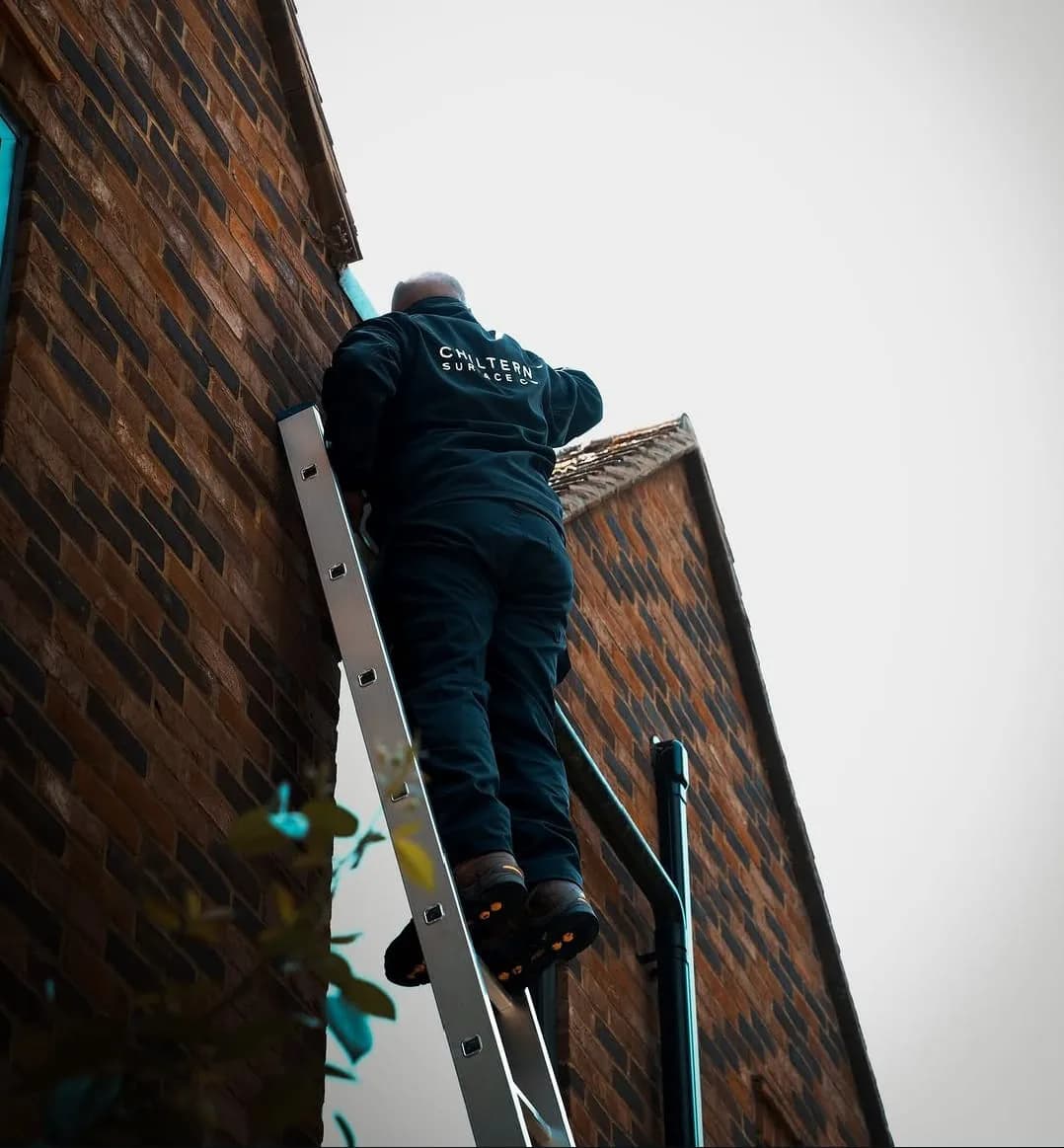
DIY gutter cleaning may be reasonable where the gutter is low, the ground is level, access is straightforward and the homeowner is competent and comfortable using the ladder.
Professional help becomes more sensible where:
- The gutters are two or three storeys high.
- Ground slopes away from the building.
- A conservatory, extension or porch blocks normal ladder access.
- The ladder would need to rest near glazing or weak roofline components.
- The user would need to work from the highest rungs.
- The job requires repeated two-handed work at height.
- There are overhead power lines or other significant hazards.
- The person using the ladder is not confident moving and securing it safely.
Chiltern Surface's wider assessment-first approach applies here as well: choose the method after looking at the property, not because one tool is always assumed to be the answer.
The Bottom Line
For many single-storey gutters, a ladder in roughly the 4-6 metre range may provide sufficient working height. For many typical two-storey UK homes, a 7-8 metre extension ladder is a more realistic starting range.
But the correct size is determined by the measured gutter height, the ladder's actual working configuration, the 1-in-4 setup angle, the ground conditions and whether you can work without using the top three rungs or overreaching.
If the only way to reach the gutter safely appears to be buying an unusually long ladder, that is a good reason to consider whether a ground-based or professional method is the better option.
If you are unsure, Chiltern Surface Co can assess the access during a free site visit and explain whether the gutter can be cleared from the ground or whether safe ladder access is appropriate.
Frequently asked questions
Is a 6-metre ladder enough for two-storey gutters?
Sometimes, but often it is marginal. A ladder loses vertical reach when set at the correct angle, and you should not work from the top three rungs. Many UK trade guides suggest around 7-8 metres for typical two-storey gutters.
What size ladder do I need for a bungalow?
Many bungalow gutters are around 3-3.5 metres high, so a ladder in roughly the 4-6 metre range may be suitable depending on the design and stated working height. Measure the actual property first.
Can I rest a ladder on the gutter?
Do not rely on plastic guttering or other weak surfaces as the upper resting point. HSE guidance says a leaning ladder should have a strong upper resting point. A compatible stand-off may help keep the ladder off the gutter.
What angle should an extension ladder be?
HSE recommends the 1-in-4 rule, which produces an angle of about 75 degrees: approximately one unit out at the base for every four units of height.
Should a ladder extend above the gutter?
It should extend high enough for you to work without standing on the top three rungs. The one-metre-above rule specifically applies when a ladder is being used to access another level.
Is a telescopic ladder safe for gutter cleaning?
A telescopic ladder can be suitable only if the manufacturer rates it for the task, every locking section is correctly engaged and the ladder can be set up securely. Follow the product instructions rather than assuming all telescopic ladders perform the same way.
Is it safer to clean gutters from the ground?
Where a ground-based vacuum or suitable pole system can complete the job effectively, avoiding work at height removes the ladder risk. That is why ground-based cleaning is preferred on many professional jobs.