
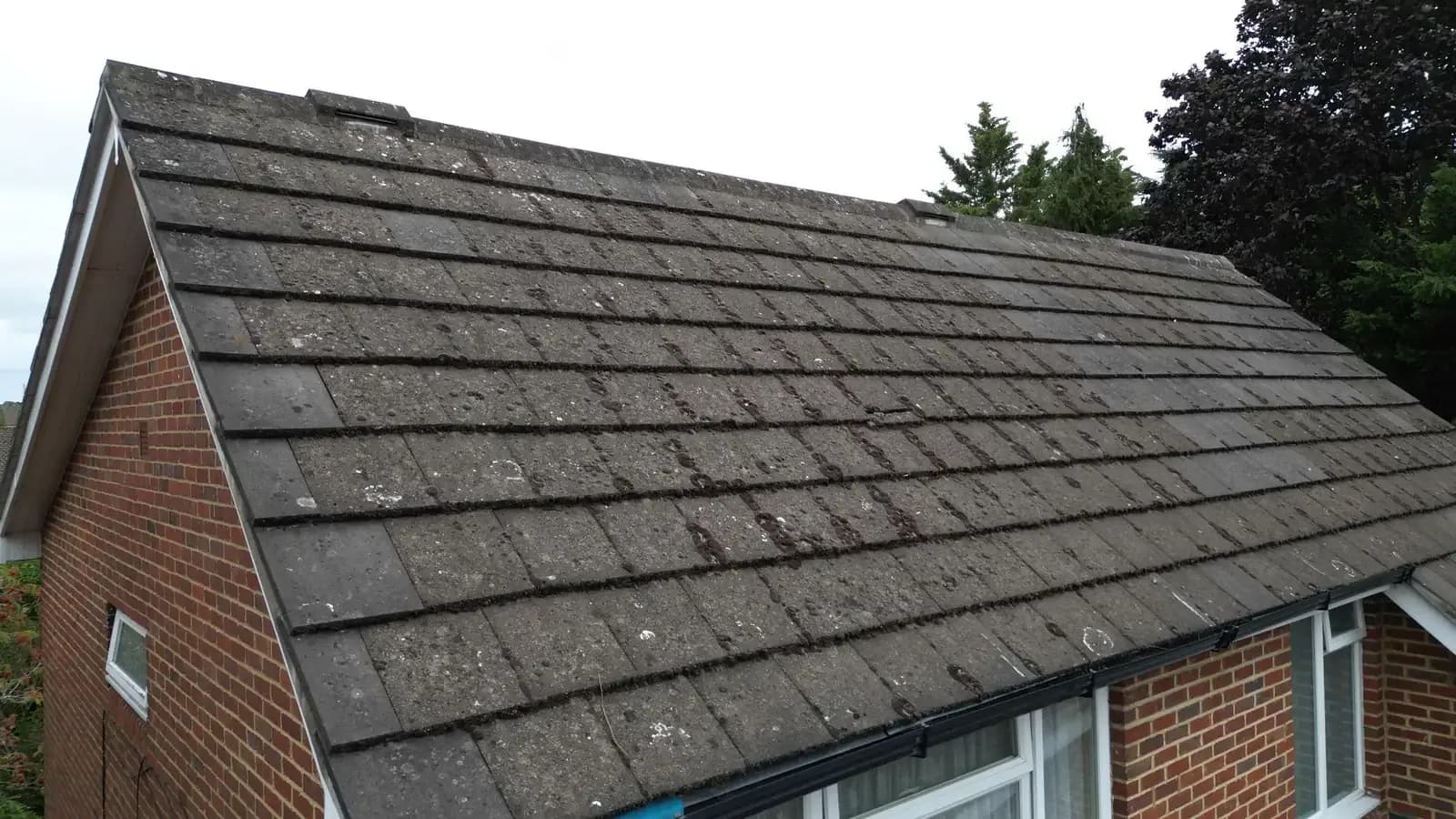
Light roof moss does not automatically cause leaks or damage sound roof tiles. Heavy, established growth can contribute to problems by restricting drainage, holding debris, growing around tile edges or concealing existing defects.
Most roof leaks begin with a fault such as a cracked tile, failed flashing, damaged underlay or blocked valley. Moss can worsen those conditions, but moss is rarely the only cause.
The right response depends on how much moss is present, where it is growing and what condition the roof is in. Some roofs only need monitoring. Others need careful moss removal, drainage clearance or repair by a qualified roofer.
Does Roof Moss Directly Cause Leaks?
Roof moss rarely creates a leak through a sound, correctly installed roof on its own. The greater risk develops when thick growth interferes with drainage or takes hold around an existing weakness.
Pitched roofs manage rain through overlapping tiles, sufficient roof pitch and clear drainage routes. Water needs to move down the covering and into the gutter without obstruction.
Scattered moss on the face of a tile does not normally defeat that system. Dense growth in tile overlaps, valleys, gutters or around roof penetrations deserves more attention.
| Roof condition | Likely significance | Appropriate response |
|---|---|---|
| Light, scattered moss on sound tiles | Usually low risk | Monitor the roof and keep drainage clear |
| Heavy moss around overlaps or valleys | Possible indirect risk | Arrange a proper roof assessment |
| Moss beside cracked, slipped or missing tiles | Existing defect may admit water | Ask a roofer to diagnose and repair the defect |
| Loose moss filling the gutters | Drainage problem | Clear the roof debris and gutter system |
| Internal damp or active dripping | Leak already exists | Investigate the roof without delay |
Moss should therefore be treated as one part of the roof's condition, not automatic proof of failure.
How Can Roof Moss Contribute to a Leak?
Heavy roof moss can contribute to water ingress through several indirect routes. The strongest links involve restricted drainage, vulnerable tile overlaps and concealed defects.
Moss can restrict rainwater runoff
Thick moss creates an uneven surface across the tiles. Loose growth, leaves and other debris can gather around those areas.
The collection can slow water moving down the roof, particularly on shallow pitches and complicated roof sections. Roof valleys, abutments, dormers and areas behind chimneys require clear drainage.
Slower runoff does not guarantee a leak. However, the roof covering remains wet for longer and existing weaknesses face greater exposure.
Moss can collect around tile overlaps
Roof tiles rely on their layout and overlaps to control rainwater. Established moss can grow along the edges and in the channels between certain tile profiles.
A small amount on the exposed face creates less concern. Thick growth packed beneath an edge or between interlocking sections needs closer inspection.
Moss does not possess strong roots capable of drilling through tiles. Moss uses small anchoring structures called rhizoids to attach to the surface.
However, bulky growth can occupy existing spaces and collect moisture or debris. Water driven by strong wind can then reach areas that normally remain better protected.
Fallen moss can block gutters and outlets
This is one of the clearest practical problems associated with roof moss. Clumps break away during dry weather, wind, heavy rain or bird activity.
The material can fill gutters, outlets and downpipes. Water then backs up or flows over the gutter edge instead of reaching the drainage system.
Overflowing water can soak fascia boards, mark external walls and collect around the building. Blocked gutters do not usually create a leak through the middle of a sound roof, but they can cause separate damp and drainage problems.
If moss has reached the guttering, a complete service should address both surfaces. Chiltern Surface Co's professional gutter cleaning service clears accumulated moss, leaves and debris from the rainwater system.
Moss can hide an existing defect
Dense growth can conceal cracked tiles, slipped slates, damaged pointing and previous repairs. The homeowner may only discover the defect after the moss has been removed.
The moss has not necessarily caused the damage. The growth may simply have made the problem difficult to see.
This distinction matters when diagnosing a leak. Removing the moss can improve visibility, but a roofing contractor must still identify and repair the actual fault.
Can Roof Moss Damage Roof Tiles?
Light moss growth does not normally damage sound clay, concrete or slate tiles. Heavy growth can contribute to deterioration where tiles are already porous, weathered, cracked or poorly positioned.
The effect varies because roof coverings have different materials, profiles and ages. A firm claim about every moss-covered roof would ignore those differences.
Concrete roof tiles
Concrete tiles naturally weather and become rougher over time. A textured surface holds dust and organic material, which gives moss an easier place to establish.
Moss can keep local areas damp for longer. However, moisture on the surface does not automatically mean that a sound concrete tile has failed.
Older tiles may already contain worn coatings, surface erosion or small cracks. Heavy moss can conceal those changes and make their condition harder to assess.
Aggressive cleaning presents a separate risk. Excessive pressure can remove weathered surface material and leave visible cleaning lines.
Clay roof tiles
Clay roof tiles can remain serviceable for a very long time, but their condition varies considerably. Handmade clay, machine-made clay, plain tiles and pantiles do not respond identically.
Heavy moss around overlaps can interfere with water movement. Weathered or damaged clay tiles also require careful handling because foot traffic and strong cleaning can crack them.
Freeze-thaw deterioration can affect porous, saturated materials during cold weather. Moss may keep a vulnerable area wetter, but the outcome depends on the tile's porosity and existing condition.
Moss on clay does not automatically justify cleaning. A surface assessment should consider whether removal offers more benefit than risk.
Natural slate
Natural slate is dense and durable, but individual slates can become fragile through age, previous damage or failing fixings.
Moss commonly grows around slate edges and in areas where organic material has accumulated. Heavy growth can hide cracked, slipped or missing slates.
The greatest danger can come from careless removal. Walking directly across old slate or using unsuitable pressure can break sound pieces and dislodge vulnerable ones.
Cleaning should use controlled access and a method suited to the roof. Slate should never be treated as if it were concrete paving.
Can Moss Make Roof Tiles Crack During Winter?
Moss does not automatically crack roof tiles during frost. Freeze-thaw damage becomes more plausible when a tile already absorbs water through weathering, deterioration or an existing crack.
Water expands when it freezes. Repeated freezing and thawing can place stress on porous or damaged materials.
Moss can keep an area damp and reduce drying between periods of rain. That local moisture retention may contribute to deterioration in vulnerable tiles.
However, the presence of moss does not prove that frost damage will occur. Sound, suitable roof tiles are manufactured for external weather exposure.
The more useful question is whether heavy growth appears alongside weathered tiles, persistent shade, poor runoff or blocked drainage.
How Much Moss Is Too Much?
Moss needs attention when it obstructs drainage, covers large areas, collects around tile edges or repeatedly falls into gutters. Colour alone does not determine severity.
A thin green covering can appear dramatic from the ground without creating a functional problem. Dense cushions of moss have greater potential to hold debris and disturb runoff.
When monitoring may be enough
Monitoring is usually reasonable when the roof has scattered patches, clear gutters and no visible defects. The loft should also show no signs of water ingress.
Take photographs from a safe ground-level position. Comparing images every 6-12 months can reveal whether the growth is stable or spreading.
Do not climb onto the roof to inspect moss closely. Binoculars, camera zoom or a professional drone inspection provides a safer view.
When the roof needs assessment
Arrange an assessment when moss forms dense ridges along tile overlaps or fills roof valleys. Regular deposits in gutters and on paths also suggest established growth.
A closer look also makes sense when one roof area remains noticeably wetter than the surrounding surface.
Moss around chimneys, roof windows, solar panels and abutments requires care because those areas contain additional joints and drainage details.
When you need a roofer
Contact a qualified roofer when you see slipped or missing tiles, damaged leadwork, failing ridge details or sagging sections.
Internal symptoms also need roofing diagnosis. Damp insulation, stained rafters, water marks and active dripping point to water ingress rather than a simple cleaning issue.
A cleaning contractor can remove suitable contamination. A roofer should investigate and repair failures in the roof covering or structure.
Is Moss the Real Cause of Your Roof Leak?
A visible patch of moss and a nearby leak do not automatically share the same cause. Water can travel along underlay, battens and timbers before becoming visible indoors.
The damp patch inside the property may appear some distance from the entry point. Correct diagnosis therefore requires more than looking directly above the stain.
Common causes include cracked or slipped tiles, failed flashing, defective valleys, damaged underlay, poorly sealed roof windows and blocked drainage. Condensation can also wet timbers and insulation without rain entering through the covering.
A roofer should inspect the roof when an active leak exists. Removing moss without diagnosing the defect can delay the repair while water continues entering the building.
What Does UK Roofing Guidance Say?
UK guidance does not support the claim that every moss-covered roof faces imminent damage.
The National Federation of Roofing Contractors states that moss on roof tiles is rarely a problem in most circumstances. Removal becomes more relevant when moss blocks gutters, outlets or other drainage points.
The organisation also warns that aggressive removal methods can damage a roof. High-pressure washing and unnecessary foot traffic can crack or break tiles.
That guidance supports a proportionate approach: leave harmless growth alone, monitor developing moss and address heavy accumulation where it affects drainage or conceals roof condition.
Can Removing Moss Cause More Damage Than Leaving It?
Yes, unsuitable moss removal can damage a roof that was not previously leaking. Excessive pressure, careless scraping and uncontrolled foot traffic create avoidable risks.
High-pressure washing
A concentrated jet can strip coatings from concrete tiles, mark weathered clay and dislodge vulnerable slates. Water directed upwards can also enter beneath tile laps.
The immediate result may look clean, but a bright surface does not prove that the roof has been treated safely.
Some sound roofs can accept carefully controlled, low-pressure cleaning. That decision should follow inspection rather than assumption.
Foot traffic and scraping
Roof tiles carry weather loads differently from concentrated foot pressure. Poorly positioned steps can crack clay tiles, break slate or disturb interlocking units.
Manual removal provides control when suitable tools follow the tile profile. Careless scraping can still chip edges or remove surface material.
Professional access equipment reduces unnecessary contact with the surface. Scaffold towers, roof ladders and mobile platforms suit different properties.
Chemical treatment
Biological treatments can address remaining growth after bulk moss removal. The operative must select, dilute and apply the product correctly.
Runoff needs control around gutters, plants, lawns, windows, metals and neighbouring properties. Chiltern Surface Co explains the available options in its guide to removing roof moss safely.
How Should Moss Be Removed From Roof Tiles?
The safest process begins with an inspection and uses the least aggressive effective method. Roof material, condition, pitch, access and moss density should guide the work.
Manual moss removal
Manual removal targets larger deposits using tools matched to the tile profile. The operative should work methodically without forcing tools beneath tiles.
Removed moss must also be collected from gutters, lower roofs and surrounding surfaces. Small biological traces can remain after the visible growth has gone.
Controlled low-pressure cleaning
Controlled cleaning can suit some sound tile surfaces. The operative adjusts pressure, flow, angle and working distance for the roof.
Water should follow the natural downward direction of drainage. Spraying upwards against overlaps increases the risk of water ingress.
Soft washing and biological treatment
Soft washing uses low-pressure application with a treatment selected for the contamination and surface. The process targets biological growth rather than blasting it away.
Chiltern EverGuard™ Treatment can help reduce biological regrowth after suitable preparation. Its typical protection period is 12-24 months, depending on the roof, environment, weather and maintenance.
No treatment prevents moss permanently. Shade, nearby trees and slow-drying roof slopes continue to influence regrowth.
Should You Remove Roof Moss Yourself?
Ground-level monitoring is reasonable, but homeowners should not climb onto a roof to remove moss. Wet biological growth makes an already hazardous surface more slippery.
A domestic pressure washer used from a ladder creates additional danger. Recoil, unstable footing and poor control can injure the user and damage the roof.
Safe DIY maintenance can include photographing the roof from the ground, watching gutter performance during rain and checking the loft after heavy weather.
Professional help becomes sensible when the work requires roof access, specialist treatment or judgement about fragile materials.
When Does Roof Moss Need Prompt Attention?
Moss rarely creates an emergency by appearance alone. Urgency depends on drainage, visible defects and evidence of water ingress.
Arrange prompt attention when water enters the loft, insulation feels wet, gutters overflow, a valley is packed with moss, tiles are broken or slipped, or loose growth repeatedly blocks outlets.
A roofer should address leaks or damaged coverings first. Cleaning can follow once the roof is stable and the correct method has been agreed.
How Can You Reduce Future Moss Growth?
Moss thrives where surfaces stay damp and collect organic material. You cannot remove every airborne spore, but you can reduce favourable conditions.
Trim overhanging branches where sensible and legally permitted. More daylight and airflow can help roof slopes dry faster.
Keep gutters, outlets and valleys free from leaves and fallen moss. Clear drainage does more for roof performance than maintaining a completely spotless tile surface.
After appropriate cleaning, Chiltern EverGuard™ Treatment can help reduce biological regrowth for approximately 12-24 months. Environmental conditions still determine how quickly moss returns.
Avoid unnecessary annual cleaning. Repeated aggressive work can create more surface wear than light biological growth.
Treat the Roof's Condition, Not Just the Moss
Roof moss can contribute to leaks or tile deterioration, but the relationship is rarely simple. Light growth is usually a maintenance or appearance issue, while heavy growth becomes more relevant around drainage routes, overlaps and existing defects.
The best response starts with the roof itself. Material, age, pitch, condition, moss density and access all affect whether the roof should be monitored, cleaned or repaired.
Chiltern Surface Co assesses those factors before recommending any treatment. Where cleaning is appropriate, the method follows the surface rather than a standard pressure setting.
If you are concerned about heavy moss, blocked drainage or concealed tile damage, explore our professional roof cleaning service and arrange a Free Site Assessment for clear, property-specific advice.
Frequently asked questions
Can a small amount of roof moss cause a leak?
No, not usually. Light moss on sound tiles rarely causes water ingress. Check the roof for defects when a leak already exists.
Can moss lift roof tiles?
Heavy growth can collect around tile edges and existing gaps. However, slipped tiles often result from failed fixings, breakage or previous movement.
Does moss make roof tiles porous?
Moss does not automatically make sound tiles porous. Existing weathering and material condition influence water absorption more directly.
Can roof moss block gutters?
Yes. Loose moss commonly falls into gutters and outlets, where it can restrict drainage and cause overflow.
Will removing moss stop an existing roof leak?
No. Moss removal can expose the roof for inspection, but a roofer must identify and repair the actual entry point.