
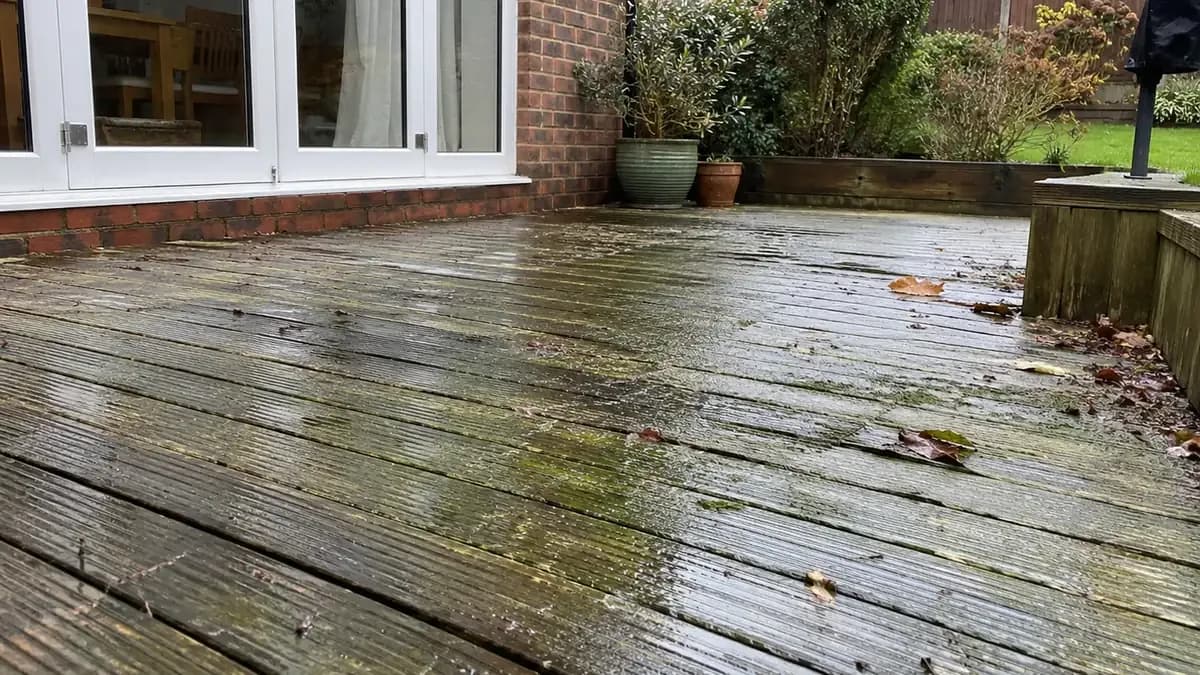
You can clean a deck with a pressure washer, but only when the decking material and condition make pressure washing appropriate. Begin with the lowest effective pressure, use a wide fan spray, keep the nozzle moving and work along the length of each board. A suitable decking cleaner should loosen the contamination first so the pressure washer can rinse it away without unnecessarily stripping or roughening the surface.
The mistake many homeowners make is treating decking like a concrete patio. Timber is softer, more absorbent and far easier to mark. Composite decking also varies significantly between manufacturers. A method that cleans one deck successfully may dull, score or discolour another.
The safest sequence is always:
Identify the surface → assess its condition → loosen the contamination → test the method → clean with controlled pressure → rinse → allow it to dry → inspect the result.
This guide explains how to clean a deck with a pressure washer without leaving visible stripes, raised wood fibres or unnecessary surface damage.
Can You Pressure Wash Decking Safely?
Yes, pressure washing can be suitable for some timber and composite decking. However, the machine should support the cleaning process rather than provide all the cleaning force.
A pressure washer removes contamination through concentrated water pressure. If dirt, algae and old organic deposits have not been loosened first, it is tempting to move the nozzle closer or remain over one area for longer. At that point, the jet may begin removing part of the timber surface or existing finish along with the dirt.
This is why professional deck cleaning is not simply a matter of selecting a powerful machine. The cleaner, dwell time, agitation, nozzle, distance and rinsing technique all work together.
The correct method depends on the material in front of you.
When pressure washing may be appropriate
Controlled pressure washing may be reasonable when the deck is structurally sound, the boards are not badly weathered and the manufacturer allows the method. It can be useful for removing loosened surface dirt, algae and general organic contamination from suitable decking.
When a gentler method may be better
Manual cleaning may be more appropriate for soft, splintered or heavily weathered timber. It may also be preferable when the existing stain or oil needs to remain intact, when water could be forced against the building, or when a composite decking manufacturer advises against pressure washing.
A bucket, appropriate cleaner, suitable brush and garden hose may take longer, but they provide greater control over a vulnerable surface.
First, Identify What Your Deck Is Made From
Before choosing a nozzle or setting, establish whether the deck is softwood, hardwood or composite. If the decking has been painted, stained, sealed or oiled, identify the existing finish as well.
This matters because the same water pressure can have very different effects on different materials.
Pressure-treated softwood decking
Pine, spruce and other softwoods are widely used for garden decking in the UK. They are practical materials, but their surfaces can become increasingly vulnerable as they weather.
Excessive pressure may open the grain, tear soft fibres or produce a rough, furry finish. Damage often appears first around board ends, knots, screws and existing cracks.
If the timber already feels dry, uneven or splintered, do not assume that pressure washing will restore it. A suitable wood cleaner and controlled brushing may be safer.
Hardwood decking
Dense hardwood generally tolerates wear better than softwood, but it is not immune to pressure-washing damage.
A concentrated jet can alter the surface texture, strip oil unevenly or create light and dark bands across the boards. Hardwood should still be tested carefully, particularly if its previous finish is unknown.
Composite decking
The term “composite decking” covers many different products. Some have a protective cap or embossed surface, while older products may behave differently from newer boards.
Certain manufacturers allow gentle pressure washing within stated limits. Others recommend warm soapy water and a soft brush or prohibit pressure washing on specific product ranges.
Always check the current care instructions for the exact product. Using general advice for another brand may affect the appearance of the boards and could invalidate parts of the warranty.
If you cannot identify the manufacturer, start with the least aggressive reasonable method and test a hidden area before considering pressure.
Painted, stained or oiled decking
A pressure washer may remove a weak coating before it removes embedded contamination. The result can be a patchwork of bare timber and remaining finish.
If the whole deck is being stripped and refinished, coating removal may be part of the planned restoration. If you only want a maintenance clean, however, disturbing the coating can turn a straightforward job into a much larger one.
Allow your test patch to dry completely before deciding whether the existing finish has remained stable.
Inspect the Deck Before Cleaning
A dirty deck is not necessarily a sound deck. Moss, algae and dark weathering can hide cracking, decay and previous cleaning damage.
Walk over the surface in daylight and look closely at the board edges and fixings. Check for movement underfoot, raised screws, loose boards, splinters and timber that feels soft. Examine the area where the decking meets the building and make sure water has somewhere safe to drain.
Pressure washing will not repair weakened wood. In some cases, it can expose or worsen loose fibres and damaged areas that were previously difficult to see.
Minor maintenance, such as tightening an appropriate fixing, may be possible before cleaning. Rotten, unstable or structurally weakened boards should be assessed and repaired rather than cleaned as though they were merely dirty.
Why Does Decking Become Green and Slippery?
Green decking is usually affected by biological growth. Algae and fine mosses develop most readily where moisture, shade and organic debris remain on the surface.
Decking beneath trees often collects pollen, fallen leaves and soil. Large plant pots and outdoor furniture can trap moisture beneath them. Blocked gaps between the boards slow drainage, while dense planting can reduce both sunlight and airflow.
These conditions allow a thin biological film to develop. The deck may look only slightly discoloured when dry but become noticeably slippery after rain.
Pressure washing can remove the visible layer, yet cleaning alone does not change the environment. If damp debris continues to collect, the growth will eventually return. Maintenance therefore needs to address both the contamination and the conditions encouraging it.
What Do You Need Before Pressure Washing a Deck?
You do not need an excessive collection of equipment, but each item should suit the surface being cleaned.
Prepare an adjustable pressure washer with a wide fan nozzle, a broom, a non-metallic brush, a garden hose and a cleaner approved for the decking material. You will also need suitable gloves, protective eyewear and footwear with good grip.
Avoid selecting a cleaner simply because it promises the fastest or strongest result. Timber, composite material, coatings, nearby metals and garden plants may respond differently to the same product.
Follow the cleaning-product instructions for dilution, application, dwell time and rinsing. Never mix cleaning chemicals, and do not increase the strength because the first test appears slow.
How to Clean a Deck With a Pressure Washer Step by Step
The actual washing should be the final part of a considered process, not the first.
1. Choose suitable conditions
Select a calm, mild day with enough dry weather available after cleaning.
Intense sunlight can cause a cleaning solution to dry before it has worked evenly. Wind may carry spray towards windows, cars, neighbouring surfaces and planting. If a new oil or stain will be applied later, the timber will also need time to dry to the finish manufacturer’s requirements.
2. Clear the whole deck
Remove furniture, rugs, barbecues, toys, planters and decorative items. Cleaning around them produces obvious outlines and prevents you from seeing the true condition of the boards.
Take note of darker areas beneath pots and furniture. These marks may be caused by trapped moisture, metal staining, tannins or biological growth and may need different treatment.
3. Protect the property
Close nearby doors and windows. Identify electrical fittings, air vents, painted walls, delicate glazing and other places where pressurised water should not be directed.
Think about drainage before applying any cleaner. Water should not be forced beneath a threshold, behind cladding or towards an electrical installation. Protect nearby plants in accordance with the cleaning product’s instructions and keep children and pets away from the working area.
4. Sweep and clear the gaps
Sweep the deck thoroughly while it is dry. Remove grit, leaves, twigs and loose growth from the boards and surrounding edges.
Clear debris from the gaps without damaging the timber. Open gaps allow dirty water to leave the surface rather than collecting around the boards.
This preparation may appear basic, but it makes the wet-cleaning stage more controlled and reduces the amount of force required.
5. Test the equipment away from the decking
Connect the machine and check that the hose, fittings and trigger are secure. Select a broad fan pattern and start with the lowest practical output.
Do not use a turbo, rotary or concentrated pencil jet on timber decking. These nozzles direct too much force onto a small area and can create damage quickly.
A patio surface cleaner should not automatically be used on wood either. Although dedicated decking attachments exist, an accessory intended for stone or concrete may leave circular marks or roughen timber.
6. Carry out a proper test patch
Choose a discreet area, ideally somewhere normally concealed by furniture.
Start with the nozzle farther from the boards than you expect to need. Pass the fan spray smoothly over the test section without pausing. If contamination remains, do not immediately move the lance closer.
First, allow the area to dry enough for inspection. Look for a furry texture, pale bands, small grooves, loss of coating or changes around knots and fixings. On composite decking, check for dulling, scratching or alteration of the embossed finish.
If the surface has changed, reduce the cleaning force by lowering the pressure, increasing the distance or choosing a gentler method.
7. Apply an appropriate deck cleaner
A suitable cleaner should loosen organic deposits before rinsing. This allows you to rely less on mechanical force.
Apply the product evenly to a manageable section and leave it for the stated dwell time. Do not allow it to dry unless the instructions explicitly say that it may.
Agitate stubborn areas with an appropriate brush. On timber, work with the grain where practical. On composite boards, use a brush that will not scratch the protective surface.
If the solution begins drying unevenly, work in smaller sections rather than trying to coat the entire deck at once.
8. Begin rinsing with controlled pressure
Hold the lance securely and start the spray away from the visible decking. Introduce the fan smoothly while maintaining a consistent angle and distance.
The ideal distance cannot be reduced to one universal measurement. A small domestic machine with a broad fan behaves differently from a high-output professional unit. The condition of the deck also changes what it can safely tolerate.
Begin conservatively. If more cleaning action is genuinely needed, make gradual adjustments and recheck the surface.
9. Follow the length of the boards
Clean in the direction of the timber grain and complete one board at a time where practical.
Use long, smooth passes with a slight overlap. Maintain the same walking speed, nozzle angle and working distance. This helps prevent alternate light and dark sections.
Avoid starting or stopping the jet in the middle of a board. Bring the spray onto the surface smoothly and feather it away at the end of each pass. Irregular arcs and short movements are far more likely to remain visible once the deck dries.
10. Reduce force around vulnerable details
Board ends, knots, cracks, raised fixings and splintered edges deserve particular care.
Do not direct the spray into open joints or beneath loose fibres. Reduce the pressure reaching steps, railings and the point where the deck meets the house. Water driven into gaps may travel farther than expected and affect materials beneath or beside the deck.
11. Do not chase stains with the nozzle
If one mark remains after a controlled pass, stop and identify it.
Grease, rust, tannin staining, resin, old paint and deeply embedded organic contamination do not all respond to the same process. Holding the nozzle closer may remove sound surface material before it removes the stain.
A compatible stain treatment or planned refinishing process may be required. Good restoration sometimes means accepting that the condition of the material limits the result.
12. Rinse thoroughly and allow the deck to dry
Rinse away loosened contamination and all cleaner residue. Work towards the natural drainage direction and check that debris has not collected between the boards.
Dirty water left to dry may leave a film, particularly on textured composite decking. Timber should also be left undisturbed until it has dried properly.
Do not judge the finish while the boards are wet. Water temporarily darkens timber and can hide streaks, raised fibres and areas of remaining coating.
What Pressure Should You Use on Decking?
There is no single pressure setting that is safe for every deck.
Online guides often offer one number, but pressure at the machine is only part of the equation. The nozzle angle, water flow, working distance and speed of movement all affect the force reaching the surface.
More importantly, a setting that is acceptable for sound hardwood may damage weathered softwood. Composite manufacturers may also impose their own limits.
The safest rule is to use the lowest pressure that produces an even result after the contamination has been loosened. Start with a wide fan and a generous distance. Only make gradual adjustments after inspecting the test patch.
If the deck will not clean unless the nozzle is held very close, the problem is probably not a lack of pressure. The contamination may need a more suitable treatment, longer dwell time or careful agitation.
Why Do Pressure Washer Lines Appear?
Pressure washer lines are usually caused by inconsistency.
Moving the nozzle closer increases the impact. Slowing down strips one area more aggressively. Changing the angle alters the shape and force of the spray. Starting or releasing the trigger over a board can leave a light spot or curved mark.
Uneven results also appear when only visibly dirty patches are cleaned. Wet timber can make those differences difficult to see until several hours later.
To avoid lines, clean complete boards using controlled overlapping passes. Keep the nozzle moving and allow cleaning chemistry—not concentrated water pressure—to loosen stubborn deposits.
What If the Wood Looks Furry After Pressure Washing?
A rough or furry appearance usually means that the jet has raised or torn the surface fibres.
Stop cleaning and allow the timber to dry. Continuing with the same method will normally increase the affected area.
Lightly raised fibres may sometimes be improved through careful sanding before refinishing. More severe grooves or widespread roughness may require the whole visible section to be sanded so the appearance remains consistent.
Do not sand composite decking unless the manufacturer expressly allows it. Sanding can permanently change the colour and texture of the surface.
If the damage covers a substantial area, seek advice before carrying out further washing or sanding. Correcting aggressive pressure washing can involve more work than the original cleaning task.
Can You Pressure Wash an Old Deck?
Possibly, but the condition must be assessed carefully.
Older timber often develops small surface cracks through repeated wetting and drying. It may also have open grain, loose fibres, worn coatings or earlier pressure-washing marks. These conditions increase the risk of a rough or uneven result.
A sound older deck may tolerate controlled cleaning after a successful test. A fragile one may respond better to a specialist cleaner, manual agitation and gentle rinsing.
Cleaning can improve appearance where the condition allows, but it cannot rebuild eroded fibres, repair decay or strengthen unsound boards.
Can You Pressure Wash Composite Decking?
You should pressure wash composite decking only when the manufacturer permits it.
Check the exact brand and product range rather than relying on general advice for composite boards. Confirm any stated pressure limit, nozzle requirement, working distance and approved cleaner.
Where gentle pressure washing is allowed, clean methodically and rinse each section thoroughly. Residue and dirty water can settle into the textured pattern and leave a visible film after drying.
If the manufacturer cannot be identified, warm soapy water and a soft brush are a more cautious starting point. Composite decking is often described as low maintenance, but every outdoor surface still needs some maintenance. Dirt, pollen, food residue and damp leaves can still support staining and biological growth.
Is Pressure Washing Better Than Manual Cleaning?
Neither method is automatically better. The most appropriate choice depends on the deck.
Pressure washing can make rinsing and lifting loosened contamination more efficient on a suitable, sound surface. Manual cleaning provides greater control and may protect vulnerable timber or coatings.
For a small deck with light dirt, a suitable cleaner, brush and garden hose may be all that is required. Pressure becomes more useful when the area is larger or contamination is established, provided the boards can tolerate it.
The best method is the one that achieves a meaningful improvement without creating avoidable damage.
Should You Sand, Oil or Stain the Deck Afterwards?
Not every cleaned deck needs immediate sanding or refinishing. The decision should follow the dry inspection.
Sanding may be appropriate where timber fibres have lifted, minor splinters are present or a more even surface is needed before applying a new finish. The deck should be fully dry, and sanding must be carried out evenly rather than only over random visible patches.
Before applying oil, stain or another coating, check that the product is suitable for the timber and compatible with any previous finish. Follow the manufacturer’s preparation and moisture requirements. A deck that feels dry on the surface may still contain too much moisture for successful coating.
Test the finish in a discreet area. Transparent and semi-transparent products may reveal variations that an opaque coating would conceal.
Oils and coatings can improve the appearance and help protect timber from weathering, but they do not make the deck permanent or eliminate future maintenance.
How Often Should You Clean Decking?
Decking should be maintained according to its condition and environment rather than an inflexible calendar.
Regular sweeping prevents damp leaves, soil and pollen from remaining on the boards. Move pots and furniture occasionally so trapped moisture can evaporate, and keep the gaps clear to support drainage.
A more thorough clean is useful when dirt and biological growth begin to accumulate. Decking beneath trees or in persistent shade may need attention more often than a surface with good sunlight and airflow.
Frequent aggressive pressure washing is not a substitute for routine maintenance. Light, regular care usually reduces the need for intensive cleaning.
Is DIY Deck Cleaning Reasonable?
Yes. DIY cleaning is perfectly reasonable when the decking is sound, the material is known and the manufacturer’s guidance is available.
A homeowner who prepares the area properly, tests the surface and works patiently can often manage routine cleaning successfully. A pressure washer is not automatically dangerous; problems usually arise when the wrong method is used or early warning signs are ignored.
Professional help becomes more valuable when the timber is heavily weathered, the coating is failing or the surface material cannot be identified. It may also be worthwhile where there is extensive biological growth, difficult drainage, restricted access or earlier pressure-washing damage.
At Chiltern Surface Co, the method follows the surface rather than the equipment. The deck is assessed first, and the cleaning process is chosen according to the material, condition and contamination present. Where pressure is appropriate, it is controlled. Where a gentler method makes more sense, that is what should be recommended.
You can read more about our surface-specific approach and our wider exterior cleaning and Surface Restoration services.
Clean the Contamination, Not the Deck Beneath It
Knowing how to clean a deck with a pressure washer is not about finding one powerful setting that removes everything. It is about understanding what the deck is made from, what condition it is in and what type of contamination needs to be removed.
When pressure washing is appropriate, a suitable cleaner should loosen the dirt first. Low, controlled pressure, a wide fan spray and even passes along the boards can then produce a more consistent result with less risk.
When the timber is fragile, the coating needs to be preserved or the composite manufacturer advises against pressure washing, manual cleaning may be the more responsible choice.
If you are uncertain about the material or condition of your decking, Chiltern Surface Co can inspect it and recommend the most appropriate method. We provide careful exterior cleaning and Surface Restoration across Buckinghamshire, Berkshire and Oxfordshire.
Arrange a Free Site Assessment for surface-specific advice and a clear, no-obligation Free Quotation.
Frequently asked questions
What is the safest way to pressure wash a wooden deck?
Begin by checking that the timber is sound and suitable for pressure washing. Apply an appropriate decking cleaner, allow the correct dwell time and agitate it gently where necessary. Rinse using low, controlled pressure, a wide fan and steady passes along complete boards. The nozzle should remain far enough away that the spray removes contamination without roughening the wood.
Should I pressure wash decking with or against the grain?
Work with the grain and along the length of the boards where practical. This creates a more even appearance and makes visible cross-grain marks less likely. Keep every pass smooth and slightly overlapped.
How close should the nozzle be to the deck?
There is no distance that suits every machine and surface. Begin well away from the boards and move closer only in small increments after testing. If moving closer causes a change in texture or colour, increase the distance immediately and reconsider the cleaning method.
Can pressure washing remove decking paint or stain?
Yes. Pressure washing may remove loose, weathered or poorly bonded coatings. It can also strip them unevenly. If you want to preserve the existing finish, test cautiously. If the coating is already failing, the deck may need a complete refinishing process rather than a maintenance wash.
How do I remove green algae from decking?
Clear loose debris and apply a cleaner approved for the decking material and biological contamination present. Allow it to work according to the label, agitate where appropriate and rinse thoroughly. Also address trapped leaves, poor drainage and persistent dampness, as these conditions encourage regrowth.
Can I use a turbo nozzle on decking?
A turbo or rotary nozzle should not be used on timber decking. Its concentrated rotating jet can cut into the wood, raise fibres and leave permanent marks. A broad fan spray provides greater control.
Do I need a special detergent?
Use a cleaner formulated or approved for the particular timber, composite product or coating. A specialist product can loosen contamination so less pressure is required. Do not mix cleaners or increase their concentration beyond the manufacturer’s instructions.
How long should a deck dry before oiling or staining?
Drying depends on rainfall, temperature, humidity, shade, airflow and the amount of water absorbed by the timber. Follow the finish manufacturer’s moisture requirements rather than relying only on a fixed waiting period. Applying a finish before the boards are sufficiently dry can cause poor absorption, uneven colour or early coating failure.
Can pressure-washing damage composite decking?
Yes. Excessive pressure, an unsuitable nozzle or working too close can mark or dull some composite boards. Certain manufacturers also restrict or prohibit pressure washing on particular products. Check the exact manufacturer’s guidance before starting.
What should I do if pressure washing has damaged my deck?
Stop and allow the surface to dry before assessing it. Lightly raised timber fibres may be improved by careful sanding, while deeper marks may require more extensive refinishing. Do not sand composite boards without manufacturer approval. If damage is widespread or the correct remedy is unclear, arrange a professional assessment.