
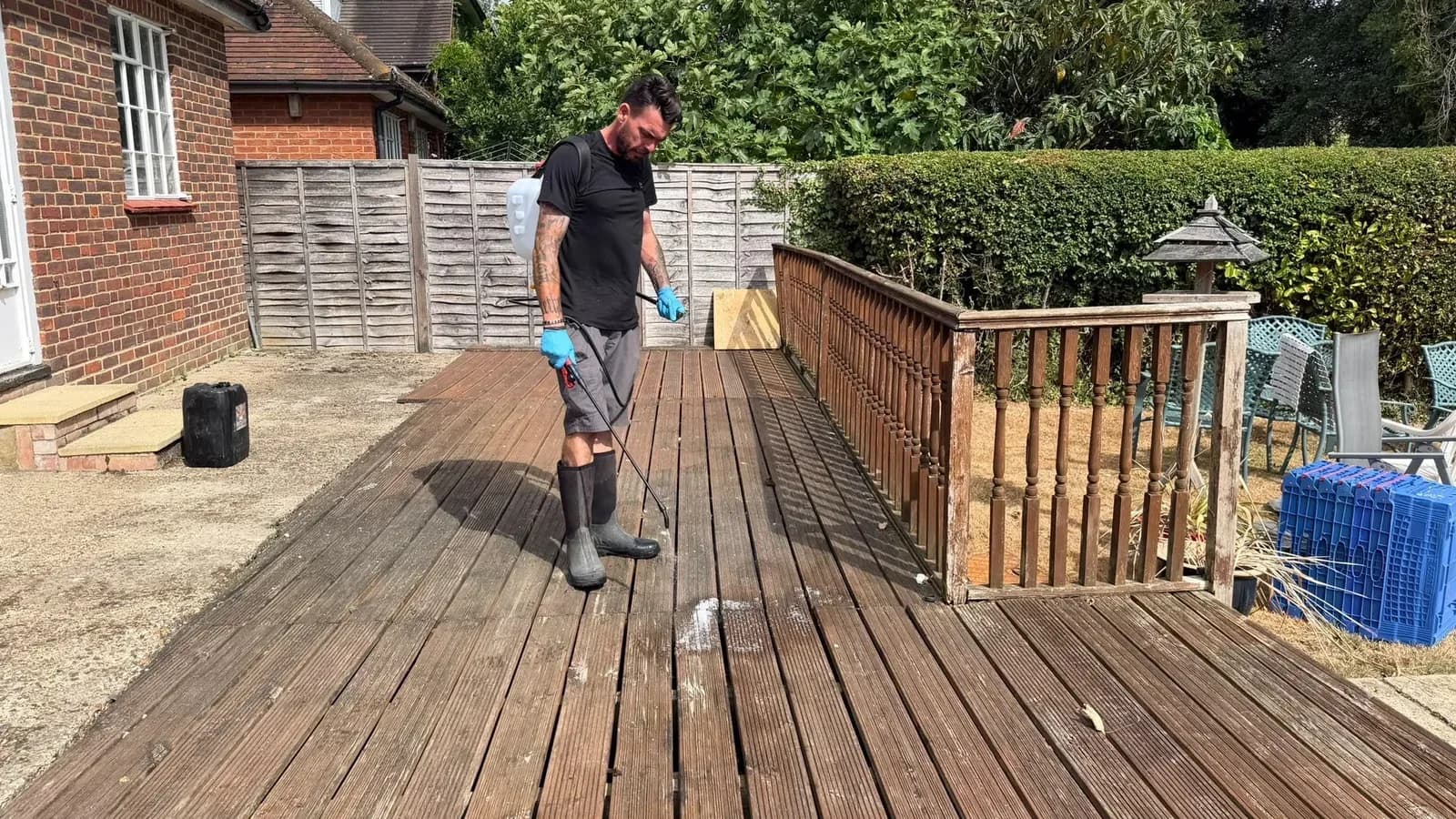
Decking gets slippery in winter because it stays wet for longer. Short days, regular rain, low sun and shaded corners keep boards damp, and that dampness lets a thin film of algae, moss and decomposing leaves build up on the surface. Boards that look fairly clean can still lose grip when wet, and on a cold morning the same deck can carry frost or ice, which is a different hazard altogether.
This guide looks at the winter side of the problem: why decks turn slippery, where the risk is highest, how to tell slippery growth from ice, and when it is worth getting help. If you already know your deck needs a clean, the step-by-step detail is in our separate cleaning guides, linked further down.
Why Does Decking Get Slippery in Winter?
Through the summer, sun and warm air dry a deck quickly after rain. From autumn onwards the boards rarely get the chance. Water sits in the grooves and along board edges, leaves collect against walls and planters, and the parts of the deck that face north or sit under trees may hardly dry at all between showers. Persistent damp is what gives slippery growth its foothold.
A thin film of algae
Algae forms a fine coating that can look green, brown or almost black. On dark composite boards or weathered timber it can be close to invisible, and many people only notice it when their footing goes. It spreads across the walking surface rather than staying in one spot, which is why a whole deck can turn slick after a wet week.
Moss along edges and gaps
Moss prefers the edges of the deck, the gaps between boards and the shaded ground under pots and furniture. It holds water like a sponge, so the boards around it stay wet for longer and the problem spreads outwards. Thick moss in the gaps also slows drainage through the deck.
Wet leaves and grime
A layer of wet leaves is slippery on its own, and as leaves break down they leave a greasy residue that holds moisture against the boards. Leaves also hide whatever is underneath: a patch of algae, a lifted board or a puddle.
Why Is My Decking Slippery Even When It Looks Clean?
Early algae can be thin enough to miss, particularly on darker boards. Old cleaning-product residue can leave its own film, and a worn finish or a very smooth board profile changes how the surface feels underfoot when wet. If a deck feels slick but looks clean, assume there is a film you cannot see and treat the area with the same caution.
Is It Algae or Ice?
The two can feel the same underfoot, but they are separate problems with separate answers. Algae and moss build up over weeks and are worst after rain. Frost and ice form overnight when water on the boards freezes, and they can appear on a deck that was cleaned the day before. A glassy sheen on a cold morning, or a deck that is fine at midday and treacherous at dawn, points to ice rather than growth.
Cleaning removes slippery growth and reduces that part of the risk. It does nothing to stop frost or freezing rain. On an icy deck, the safest step is to stay off it until it thaws, and to use winter precautions that suit the boards rather than reaching for whatever is in the shed.
Where Is the Slip Risk Highest on a Deck?
Slips on decking tend to happen in the same few places, and they are rarely in the middle of the boards.
- The step down from the back door, where people move from a dry floor to a wet board without thinking.
- Decking steps, where a slip becomes a fall and a change of direction puts weight on one foot.
- The route across the deck to the garden, the bins or a gate, used every day in all weathers.
- Shaded corners, boards under pots and planters, and areas beside walls that rarely dry.
- The edge where the deck meets a path or patio, which often collects run-off and leaves.
Start with these areas when you check the deck, and give them attention before the rest of the surface. If someone in the household is older, uses a walking aid or carries things down the steps, these routes matter even more.
Decking steps and handrails
Check that treads are secure, that nosings and fixings have not lifted and that any handrail is firm. Doormats on decking steps can curl, slide or hold water, so they may add a trip hazard rather than remove a slip hazard. Good lighting on steps used after dark is worth as much as a clean surface.
Does Timber or Composite Decking Get More Slippery in Winter?
Both can, for slightly different reasons. Timber absorbs water and weathers over time, and a worn or failing finish can leave the surface rougher in some places and smoother in others. Composite boards do not soak up water in the same way, but algae, grime and leaves still settle on their surface cap. Composite boards are often sold as low-maintenance, and they still need regular cleaning to keep that film down.
Grooved boards are not automatically less slippery. The grooves can trap debris and hold water, while some smooth boards clear more easily. The board design, the condition of the surface and how well the deck drains all matter more than the profile alone. Our guides on cleaning a wood deck and cleaning a composite deck explain how the two materials differ when it comes to cleaning.
What Should You Do When Your Deck Turns Slippery?
Deal with access first. Use another route if you can, keep children and pets off the affected area and let visitors know. If the deck is already hard to walk on, do not try to scrub it while standing on the slippery boards, and never work on it while it is frozen.
When conditions allow, clear leaves and loose debris from a stable position with a soft brush. Look at what is making the area wet: pots sitting directly on the boards, blocked gaps, a leaking downpipe or a flower bed that sheds water onto the deck. Raising planters on feet and redirecting run-off can make a noticeable difference to how quickly the boards dry.
Be wary of quick fixes. Sand, grit or adhesive strips laid across the whole deck can trap moisture, damage finishes and create uneven patches. If a grip product is needed on steps, choose one designed for that decking system and fit it to the manufacturer's instructions. The same caution applies to anti-slip paints and coatings, which may not suit every board.
How to Clean Slippery Decking: Where to Find the Detail
Cleaning is a job in its own right, and the right method depends on whether the boards are timber or composite, painted or bare, sound or worn. Rather than repeat it here, these guides cover the method step by step:
- How to clean algae off a wood deck, for the green film that causes most winter slips.
- How to clean moss off a deck without damaging the surface, for thicker growth along edges and gaps.
- How to clean a deck without a pressure washer, for older or softer timber.
- How to clean a deck with a pressure washer, including when pressure does more harm than good.
Whichever method you choose, the winter rules are the same. Pick a dry, frost-free day with time for the boards to dry afterwards. Do not wash a deck in the late afternoon before a cold night, because water left in the grooves can freeze. Avoid improvised chemical mixtures, and follow the board manufacturer's guidance before using any product.
Can Decking Be Cleaned in Winter?
Often, yes, but timing matters more than the calendar. A mild, dry spell can allow a deck to be assessed and cleaned, while overnight frost, persistent rain or poor drying conditions may mean part of the work has to wait. A responsible contractor will explain what can be done now and what should wait for better weather.
A freshly cleaned deck can still freeze. Removing algae takes away one cause of slips; it does not make the boards safe on an icy morning.
How Can You Keep Decking Safer Through the Winter?
No deck stays free of growth through a damp British winter, but steady upkeep keeps the risk down. Sweep leaves away when the boards are dry enough to walk on, keep the gaps between boards clear so water can drain, and move pots and furniture now and then so the boards beneath can dry. Trimming back overhanging planting lets in light and air, which helps the surface dry between showers.
Check the deck regularly from autumn onwards rather than waiting for a thick green coating. If the same steps or corners turn slippery every winter, that pattern is worth noting: it usually points to shade, drainage or run-off that cleaning alone will not change.
When Should You Get Professional Help?
It is worth calling in help when algae returns quickly after cleaning, the affected area includes steps or the main route into the garden, you are unsure what the boards are made of, or earlier cleaning has left marks or raised the grain. A specialist can assess the boards, the type of growth, the run-off and the planting nearby before choosing a method.
Chiltern Surface Co cleans decking as part of Soft Wash Treatment, using lower-pressure methods matched to timber or composite boards. Where a deck is part of a wider winter problem, such as steps, paths and a patio that all turn slippery, our winter cleaning for slippery paths, steps and patios looks at the whole route together. Every visit starts with an assessment, and cleaning is not carried out immediately before a frost.
Where the boards and the weather suit it, cleaning can be followed by the Chiltern EverGuard™ Treatment to help slow the return of algae and moss. Chiltern EverGuard™ inhibits regrowth, typically for two to three years, depending on the surface and its environment. It helps reduce regrowth; it does not stop ice forming, and the deck will still need regular sweeping and checks.
If your decking or decking steps keep turning slippery, book a free site visit and we will look at the boards, the routes you use and what is keeping them wet.
Final Takeaway
Slippery decking in winter is rarely down to one thing. Shade, rain, leaves, algae and the condition of the boards work together, and frost adds a separate hazard on cold mornings. Focus first on the steps and the routes people use every day, tell growth apart from ice, and choose a cleaning method that suits the boards. Where the problem keeps coming back, a professional assessment can help reduce slip risk without promising to remove every hazard.
Frequently asked questions
What is the green slippery stuff on decking?
It is usually algae, sometimes mixed with moss and decomposing leaves. Algae forms a thin film across the boards, while moss grows in thicker clumps along edges and gaps. Appearance alone does not always identify the growth with certainty.
Will cleaning stop my decking freezing?
No. Cleaning removes slippery growth, but frost and ice form on clean boards too. Stay off an icy deck until it thaws, and avoid washing decking shortly before a cold night.
Does salt help with icy decking?
Do not assume common de-icing products are suitable. Some can affect finishes, fixings, nearby plants or composite boards. Check the decking manufacturer's winter guidance, and keep off the deck while it is unsafe.
Is composite decking slippery when wet?
It can be, especially when a film of algae, grime or leaves has built up on the surface. The board design and the manufacturer's care instructions should guide how it is cleaned.
Does decking need anti-slip paint?
Not necessarily. Coatings change the look of the boards, need their own upkeep and may not suit every product, particularly composite. Ask the manufacturer or a specialist before applying one.
How often should I check decking for algae in winter?
Check the steps, doorways and shaded corners regularly through the wet months, and after heavy leaf fall or a long spell of rain. How often depends on shade, nearby trees, drainage and how much the deck is used.