
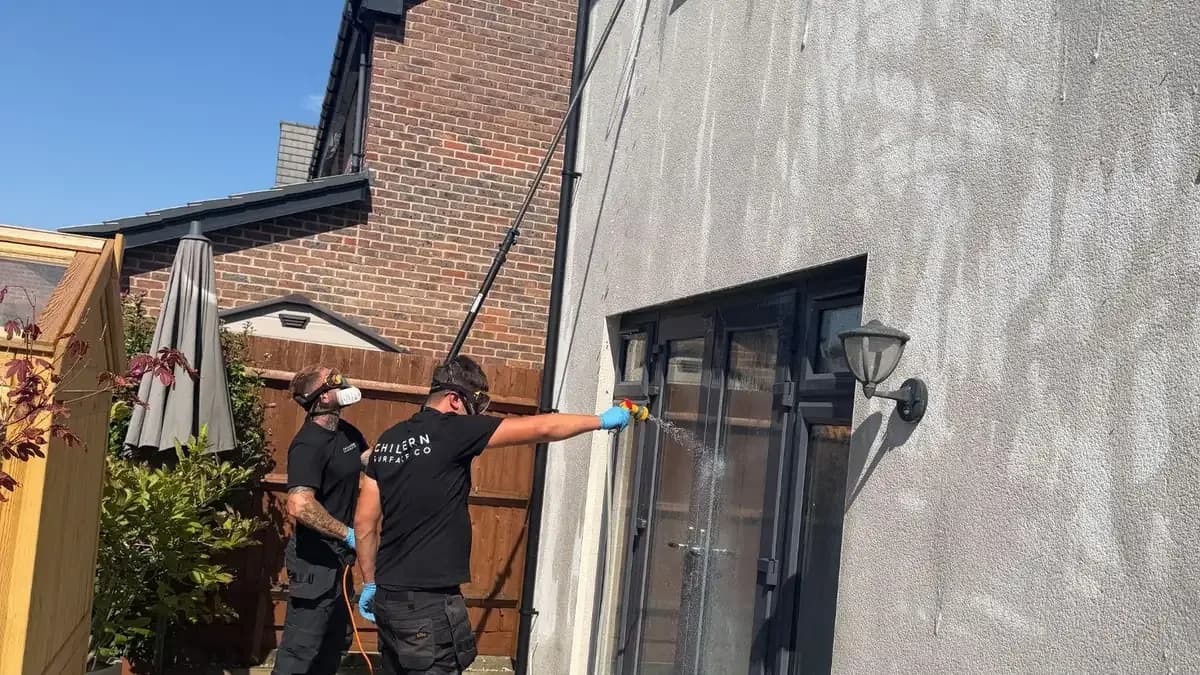
Render cleaning is the careful removal of algae, mould, dirt, atmospheric staining and other contamination from rendered exterior walls. The aim is to restore the appearance of the render without damaging its texture, coating or bond to the wall beneath.
On modern rendered homes, this usually means soft washing or another controlled low-pressure method rather than aggressive jet washing. The cleaning process is chosen around the type of render, its age and condition, and the staining present.
That distinction matters because render is not the same as concrete paving or a driveway. It may be thin, textured, painted, silicone-based, monocouche or part of an external wall insulation system. A method that is perfectly suitable for one hard exterior surface can mark or weaken another.
What Does Render Cleaning Remove?
Rendered walls can collect several different types of contamination, and they do not all respond in the same way.
Green algae
Green staining is one of the most common problems on exterior render. It tends to develop where walls remain damp for longer, particularly on shaded or north-facing elevations and around areas with trees or limited air movement.
Red or pink biological staining
Some rendered walls develop red or pink staining rather than green. This is usually biological growth rather than ordinary dirt, so simply rinsing the wall may brighten it without dealing fully with the cause.
Mould and darker organic marks
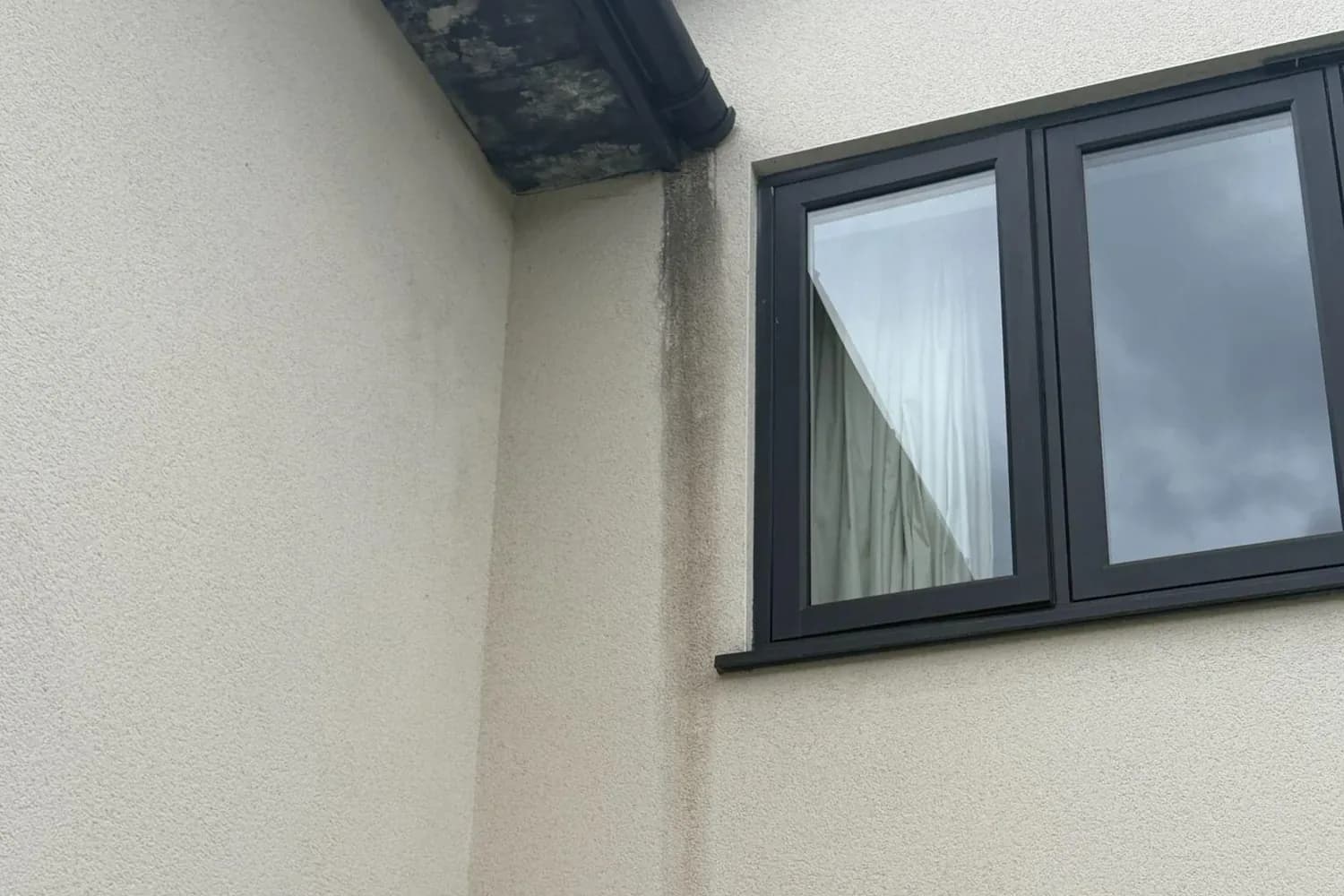
Dark marks can form where moisture and biological growth persist. The stain should be identified before treatment because not every black or grey mark is the same.
Atmospheric dirt and pollution
Fine airborne dirt can settle across textured render and make the whole elevation look dull. Road-facing walls and exposed elevations may show this as general greying rather than obvious patches of algae.
Bird marks, cobwebs and splash staining
Lower walls can pick up soil and rain splash, while corners, window reveals and sheltered areas collect cobwebs, insect deposits and bird marks. These often need light agitation or local attention rather than stronger pressure.
Why Does Render Become Dirty?
Render is exposed to the same weather as the rest of the building, but its texture and location can make biological growth particularly visible.
The main factors are:
- Shade that slows drying after rain.
- North-facing walls with less direct sunlight.
- Nearby trees, hedges and vegetation.
- Rainfall and persistent surface moisture.
- Overflowing gutters or poor drainage above the wall.
- Road traffic and atmospheric contamination.
- Textured finishes that hold moisture and fine debris.
A wall that repeatedly turns green in one area may be telling you something about moisture and exposure. Cleaning can remove the contamination, but it is also worth checking whether a leaking gutter, damaged seal or another maintenance issue is keeping the same patch wetter than the rest.
How Is Render Cleaning Usually Carried Out?
For many modern render systems, the cleaning process relies on low pressure and a suitable treatment rather than water force.
1. The render is assessed first
Before cleaning starts, the wall should be checked for the render type, existing cracks, loose areas, failed paint, damaged seals and signs of water ingress.
If the surface is already defective, cleaning may need to be delayed or reduced until the underlying issue has been addressed.
2. Surrounding areas are protected
Windows, painted details, plants, lawns and nearby surfaces need to be considered before treatment is applied. Good render cleaning includes managing runoff as well as cleaning the wall.
3. A suitable treatment is applied at low pressure
The treatment is selected for the contamination and applied evenly across the affected area. It is then given the correct dwell time so the cleaning action can work without relying on aggressive mechanical force.
4. Stubborn areas may be agitated gently
A soft brush can be used on local marks where appropriate. The purpose is to loosen contamination, not to scrub away the render texture.
5. The wall is rinsed carefully
Once the treatment has done its work, the render is rinsed using controlled water flow suited to the surface. The finish is then checked after drying because wet render can hide remaining staining or colour variation.
This type of low-pressure process is explained further in Chiltern Surface Co's guide to soft washing.
Why Soft Washing Is Often Used on Render
Soft washing is useful because many of the marks seen on render are biological. Instead of trying to blast the visible colour from the wall, the process uses a surface-appropriate treatment and controlled dwell time to deal with the growth.
This reduces the amount of physical force needed on delicate finishes.
Chiltern Surface Co's exterior cleaning services include render and cladding cleaning using surface-specific soft wash methods rather than treating every wall as a pressure-washing job.
Can You Pressure Wash Render?
High-pressure washing is not a sensible default for rendered walls.
Aggressive pressure can mark a textured finish, strip paint, open weathered areas or force water into cracks and weak points. It can also create obvious clean lines where the nozzle has been held closer to one area than another.
The risk is higher when the render is older, already cracked, painted, thin-coated or part of an external wall insulation system.
This does not mean that no pressurised water can ever be used near render. It means the pressure, distance and method need to be controlled around the actual surface rather than chosen for speed.
Different Types of Render Need Different Care
| Render type | Typical cleaning concern | Usual approach |
|---|---|---|
| Silicone / thin coat render | Delicate textured finish, algae staining | Low-pressure soft wash after condition check |
| Monocouche render | Porous textured surface, green or red staining | Treatment-led clean with gentle rinse |
| Painted render | Risk of loose or failing paint | Test first; low pressure and surface-safe treatment |
| Sand and cement render | Age, cracks and previous repairs | Method depends heavily on condition |
| Pebbledash / roughcast | Deep texture traps dirt and growth | Controlled treatment and careful rinsing |
| EWI render system | Thin decorative finish over insulation system | Specialist assessment before cleaning |
What Is K Rend Cleaning?
K Rend is a brand commonly used as a general shorthand for modern coloured render, although not every modern rendered wall is actually K Rend.
The important point is to identify the product or finish before choosing the cleaner. Through-coloured and silicone renders can look robust but still have textured surfaces that are better suited to low-pressure cleaning than aggressive jet washing.
If the render type is uncertain, treat that uncertainty as a reason to be more cautious, not more aggressive.
Render Cleaning Is Not the Same as Repainting
Cleaning removes contamination. Repainting changes or renews the coating.
If a rendered wall looks tired because it is covered in algae, dirt or atmospheric staining, cleaning may restore a significant amount of the original appearance without repainting.
If the problem is faded paint, widespread flaking, cracking, delamination or physical failure, cleaning will not repair it.
A good assessment should distinguish between a dirty finish and a failing finish before recommending work.
Can Render Cleaning Fix Cracks or Damp?
No. Render cleaning is a surface-maintenance process, not a repair.
It cannot repair cracked render, failed sealant, loose sections, defective gutters or moisture entering from another part of the building.
If staining is concentrated beneath a gutter joint, around a window or below a roof detail, the moisture source should be considered before the wall is simply cleaned.
Cleaning first without dealing with an ongoing water problem may mean the same staining returns quickly.
Can You Clean Render Yourself?
Small, low-level areas can sometimes be maintained by a homeowner if the render type is known and in good condition.
DIY cleaning is most reasonable when:
- The affected area can be reached safely from the ground.
- The render is sound, with no loose or cracked sections.
- The stain is light and clearly superficial.
- A cleaner approved for the render type is being used exactly as directed.
- Nearby plants, windows and painted details can be protected.
- A small test area can be checked after drying before the whole wall is treated.
For a more detailed homeowner method, see How to Clean Exterior Render.
When Professional Render Cleaning Makes More Sense
Professional cleaning becomes more useful when the wall is high, heavily stained, difficult to identify or already showing signs of deterioration.
It is worth arranging an assessment when:
- Several elevations are affected.
- The render is K Rend, monocouche, silicone or part of an EWI system and you are unsure of the correct method.
- The wall has heavy green, red or dark biological staining.
- There are cracks, failed paint or repaired areas that need checking first.
- Access would require prolonged ladder work or high-level equipment.
- Plants, glass, neighbouring walls or drainage make runoff difficult to manage.
- Previous cleaning has left marks or uneven colour.
Chiltern Surface Co's assessment-first approach is designed for this situation: identify the surface and its condition first, then use the lowest effective pressure and treatment rather than a one-size-fits-all method.
How Long Do Render Cleaning Results Last?
There is no fixed lifespan for a render clean.
A sunny, exposed wall may stay clean for much longer than a shaded elevation beneath trees. North-facing walls, damp corners and areas affected by repeated gutter overflow will usually show biological growth sooner.
Where appropriate, a maintenance treatment can help inhibit the regrowth of algae, moss and lichen. Chiltern EverGuard™ Treatment typically provides around 12 to 24 months of protection depending on the surface, surrounding environment, weather and ongoing maintenance.
The treatment is not permanent and does not remove the need for maintenance. Its purpose is to slow regrowth and help the surface stay cleaner for longer.
How Often Should Render Be Cleaned?
Render is better maintained by condition than by a rigid timetable.
If the wall remains clear and the finish is sound, there is little benefit in cleaning it simply because a set number of years has passed.
Once green or red staining begins to spread, earlier treatment is usually easier than waiting until the whole elevation is heavily affected.
Regular visual checks are particularly useful on shaded elevations, beneath trees, around gutters and on walls that have developed staining before.
Common Render Cleaning Mistakes
Using maximum pressure because the wall is badly stained
Heavy staining is a reason to improve the diagnosis, not automatically increase the water pressure.
Treating every stain as algae
Rust, mineral marks, dirty runoff and failed paint need different solutions. The treatment should match the cause.
Cleaning over cracked or loose render
Existing defects should be identified first. A clean wall is not a substitute for a sound wall.
Skipping a test area
Colour, porosity and previous coatings can affect the result. A small test area should be allowed to dry before committing to the whole elevation where there is any uncertainty.
Ignoring the cause of repeated damp staining
If a gutter, roof detail or drainage issue is keeping one section wet, the maintenance problem should be addressed as well as the appearance.
Expecting a factory-new finish
Render cleaning can produce a significant improvement where the condition allows, but it cannot reverse fading, cracking, weathering or previous damage.
Frequently asked questions
What is render cleaning?
Render cleaning is the removal of algae, mould, dirt and staining from rendered exterior walls using a method suited to the render type and condition. Modern render is commonly cleaned with low-pressure soft washing rather than aggressive jet washing.
Is render cleaning the same as soft washing?
Soft washing is one of the main methods used for render cleaning, especially where biological growth is present. Render cleaning is the wider service; the exact method can change depending on the surface and stain.
Can K Rend be cleaned?
Yes. K Rend and similar modern coloured renders can be cleaned, but the finish should be identified and checked before treatment. Low-pressure, surface-specific methods are generally more appropriate than aggressive pressure washing.
Can you pressure wash render?
High-pressure jet washing is not a good default for render because it can mark the surface, strip coatings or force water into weak areas. Controlled low-pressure cleaning may be used where appropriate after assessment.
What causes green stains on render?
Green staining is commonly biological growth encouraged by moisture, shade and slow drying. North-facing walls, tree cover and damp areas often show it first.
Does render cleaning remove red stains?
Many red or pink biological stains can be treated, but the cause should be identified first. Not every coloured mark on render is the same type of contamination.
Will render cleaning repair cracks?
No. Cleaning removes contamination but does not repair cracks, failed paint, loose render or water-ingress problems. Defects should be assessed separately.
How often should exterior render be cleaned?
There is no fixed interval. Clean when biological staining or dirt becomes established enough to justify it, and monitor shaded or previously affected elevations more closely. If your render has developed green, red or dark staining, or you are unsure whether the finish can be cleaned safely, arrange a Free Site Assessment with Chiltern Surface Co. We can identify the surface, check its condition and explain whether soft washing, another specialist treatment or no cleaning at all is the right next step. If work is appropriate, we will provide a clear Free Quotation before anything begins. We serve homes across Buckinghamshire, Berkshire and Oxfordshire, with no pressure to book unnecessary work.