
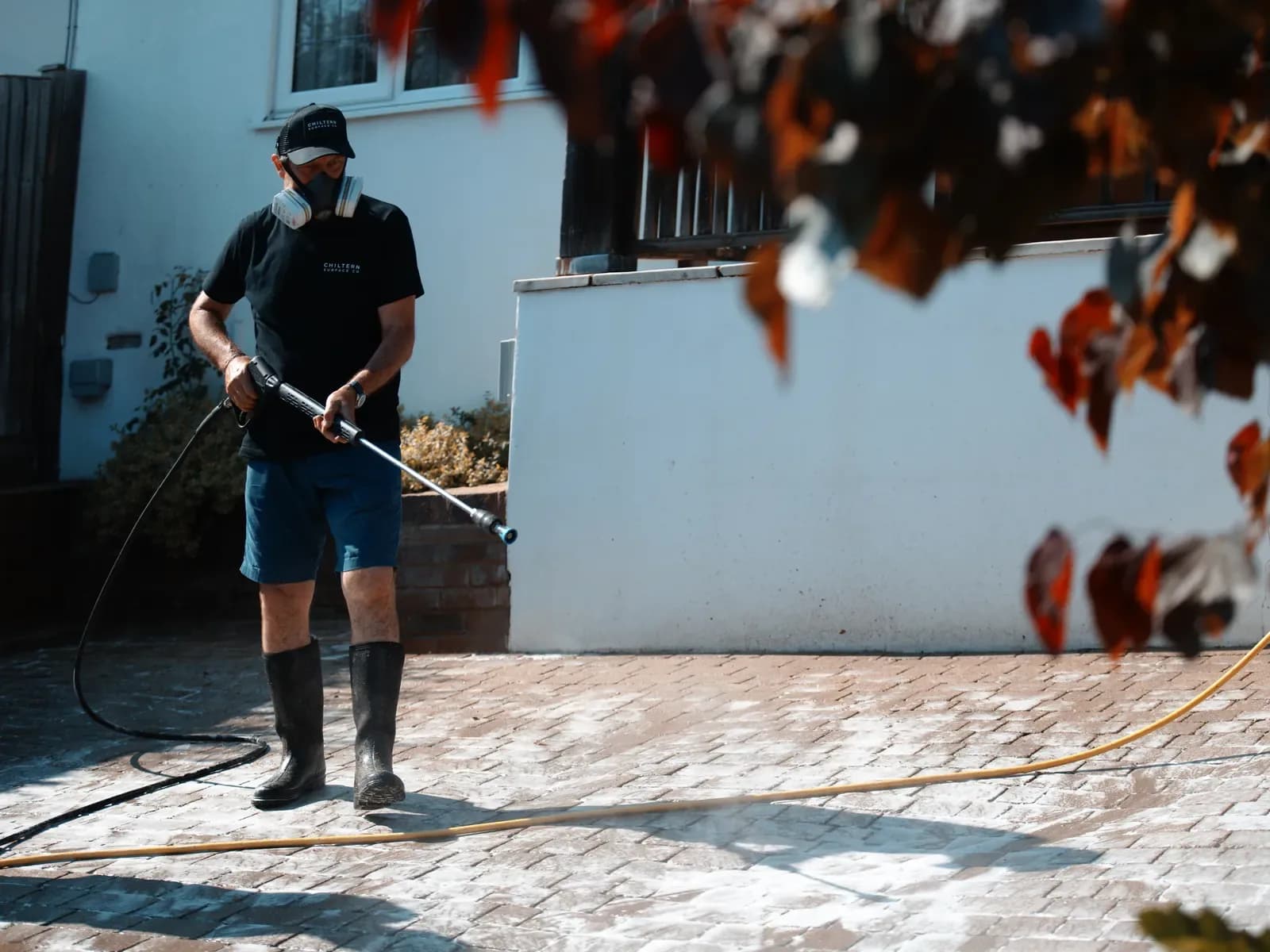
1. H1: How to Clean Exterior Render Safely in 2026
To learn how to clean exterior render, inspect the finish, pre-wet the wall, apply a suitable cleaner, and rinse gently.
Use garden-hose pressure or professional soft washing because forceful jets can erode render and drive water behind the finish.
UK homeowners often call exterior render render, although construction methods vary between properties.
Traditional finishes use cement, lime, and sand. Modern finishes include acrylic render, painted coatings, and insulated render systems.
The correct method removes algae, mould, pollution, and grime without weakening the wall surface.
What Is the Safest Way to Clean Exterior Render?
The safest method uses low pressure, a compatible cleaner, controlled dwell time, and a thorough clean-water rinse. Start with the gentlest method that matches the wall material and contamination. That sequence defines how to clean exterior render safely.
A soft brush and garden hose handle loose soil, cobwebs, pollen, and light traffic film.
A labelled exterior biocide handles organic growth, including algae, mould, mildew, and lichen.
Professional soft washing suits large areas, upper storeys, heavy growth, and delicate modern coatings.
How to Identify the Render or Render Type
To identify the render or render type, check the property records, installer documents, texture, paint layer, and wall build-up. Finish identification determines how to clean exterior render safely.
Traditional cement render feels hard and mineral. Lime render often feels softer and shows a more open, breathable texture.
Painted render shows a separate colour film. Acrylic render often has an even texture and factory-coloured finish.
How to Choose Hand Washing or Soft Washing
To choose hand washing or soft washing, match the method to the wall size, finish strength, staining, height, and access. Access and staining also shape how to clean exterior render.
Choose hand washing for small ground-floor areas with loose dirt, bird marks, cobwebs, or isolated splashes.
How to Spot Damage Before Cleaning
To spot damage before cleaning, inspect cracks, hollow patches, loose paint, bulges, open joints, failed sealant, and damp edges. Surface defects change how to clean exterior render safely.
Mark hairline cracks longer than 12 inches (30cm) and photograph every damaged area before washing.
What Tools and Cleaners Do You Need for Exterior Render?
You need low-pressure equipment, non-abrasive tools, suitable protection, and a cleaner approved for the identified finish. Avoid stiff wire brushes, rotary nozzles, acidic cleaners, and unlabelled chemical mixtures. Suitable equipment controls how to clean exterior render safely.
Prepare every item before wetting the wall. A complete setup prevents rushed movements and uneven dwell times.
How to Gather Low-Pressure Cleaning Tools
To gather low-pressure cleaning tools, prepare a garden hose, adjustable nozzle, pump sprayer, soft brush, sponge, and 2 buckets.
Use a telescopic water-fed pole for accessible upper sections, subject to the pole manufacturer's working-height limit.
How to Select a Render-Safe Cleaner
To select a render-safe cleaner, read the render manufacturer's guidance and choose a water-soluble product for mineral surfaces. Product compatibility governs how to clean exterior render safely.
Use a pH-neutral detergent for dust, light grime, pollen, and general atmospheric soil.
Use a labelled exterior biocide for algae, mould, mildew, and lichen, following the stated dilution and dwell time.
How to Protect People, Plants, Windows, and Drains
To protect people, plants, windows, and drains, create a controlled work zone before opening any cleaner. Runoff planning affects how to clean exterior render responsibly.
Close windows, isolate outdoor sockets, move furniture, cover delicate metals, and protect air vents from direct spray.
How to Clean Exterior Render Step by Step
To clean exterior render step by step, work through inspection, testing, pre-wetting, cleaning, agitation, rinsing, and drying. Divide each elevation into manageable 6-foot (1.8m) sections.
Work on one section at a time. Controlled sections prevent cleaner from drying and reduce visible lap marks.
How to Inspect and Test the Wall
To inspect and test the wall, check the finish in dry daylight and select a hidden 12-inch (30cm) test area. A test patch confirms how to clean exterior render safely.
Apply the chosen cleaner at label strength. Leave the product for the stated time, then rinse with clean water.
Wait until the test area dries completely. Check colour, texture, adhesion, chalking, streaking, and surface softness.
How to Pre-Wet the Render
To pre-wet the render, saturate the wall with clean water from the bottom upwards. Pre-wetting supports how to clean exterior render evenly.
Bottom-up wetting reduces absorption and limits dirty runs across dry porous areas.
How to Apply the Cleaning Solution
To apply the cleaning solution, start at the lowest section and spray an even coat across the pre-wetted surface. Controlled dwell time improves how to clean exterior render.
Bottom-up application reduces streaking on porous render. Keep each section uniformly damp during the labelled dwell period.
How to Agitate Stubborn Marks
To agitate stubborn marks, move a soft brush with light overlapping strokes across the textured finish. Light agitation supports how to clean exterior render safely.
Brush isolated dirt, insect deposits, cobweb anchors, bird marks, and low-level splash staining.
How to Rinse and Check the Finish
To rinse and check the finish, wash from the top down with clean water and garden-hose pressure. Complete rinsing finishes how to clean exterior render correctly.
Rinse until runoff looks clear and the wall feels free from slippery detergent residue.
How to Clean Exterior Render Without a Pressure Washer
To clean exterior render without a pressure washer, use hand washing for small areas. Use pump-sprayer soft washing for larger areas. Garden-hose pressure protects fragile texture and paint.
The no-pressure method gives you better control around windows, vents, lights, decorative bands, and repaired patches.
The no-pressure method also reduces splashback, surface erosion, and forced water entry.
How to Hand-Wash Routine Dirt
To hand-wash routine dirt, mix a labelled pH-neutral exterior detergent with water at the stated ratio.
Pre-wet a 6-foot (1.8m) section, apply detergent, brush lightly, and rinse before moving sideways.
How to Treat Algae and Mould
To treat algae and mould, choose a registered exterior biocide that names render, masonry, or painted facades.
Apply the product through a low-pressure pump sprayer. Follow the label's dilution, coverage, dwell, and rinsing instructions.
How to Clean Upper Storeys Safely
To clean upper storeys safely, keep both feet on a stable platform and keep both hands available for controlled work.
Use ground-fed equipment only within the manufacturer's reach and wind limits.
Hire trained professionals for walls above normal ground reach, restricted access, sloping ground, conservatories, and public footpaths.

Can You Pressure Wash Exterior Render Safely?
Yes, trained professionals can use controlled pressure on suitable sound finishes after testing the wall. DIY high-pressure washing creates unnecessary damage risk. Professional control changes how to clean exterior render with powered equipment.
Professionals often use pressure-washer pumps only to deliver low-pressure solution and rinse water through suitable nozzles.
The cleaning chemistry loosens contamination. Water flow removes residue without relying on concentrated impact.
How High Pressure Damages Render
To understand high-pressure damage, consider the finish's pores, aggregates, paint film, joints, and underlying wall system.
A concentrated jet removes surface grains, creates stripes, opens cracks, strips paint, and drives water through weak details.
How Professionals Control Pressure
To control pressure, professionals select the lowest effective setting, wide fan patterns, suitable flow, and generous working distance.
Professionals test inconspicuous areas, work with downward angles, protect openings, and monitor runoff throughout the clean.
Chiltern Surface follows a surface-specific cleaning approach rather than applying one pressure level to every wall.
How to Recognise Immediate Damage
To recognise immediate damage, watch for fresh pale lines, exposed aggregate, dark wet patches, paint lift, crumbling, or water indoors.
Stop cleaning immediately after any damage sign. Rinse remaining cleaner gently and photograph the affected area.
How to Remove Specific Stains from Exterior Render
Match every stain to a compatible treatment because algae, rust, salts, soot, and paint marks need different chemistry. Test every stain treatment before full use. Stain identification determines how to clean exterior render effectively.
Never combine stain removers. Rinse one product completely before considering another labelled product.
How to Remove Green Algae and Black Mould
To remove green algae and black mould, apply a labelled exterior biocide through low-pressure equipment.
Treat the full affected patch, including a 12-inch (30cm) clean margin around visible growth.
How to Remove Rust and Metal Stains
To remove rust and metal stains, identify the source before treating the orange or brown mark.
Common sources include steel fixings, railings, satellite brackets, overflow pipes, and corroding decorative metalwork.
How to Handle Efflorescence and Mineral Marks
To handle efflorescence and mineral marks, confirm that the white deposit feels dry, powdery, and crystalline.
Trace moisture sources, including defective copings, leaking gutters, cracked render, raised ground, and failed sealant.
How to Remove Traffic Film and Soot
To remove traffic film and soot, use a pH-neutral facade detergent designed for atmospheric grime.
Pre-wet the wall, apply detergent evenly, agitate lightly, and rinse with clean water before drying.
How Does Render Type Change the Cleaning Method?
Render type controls cleaner choice, water pressure, brushing strength, dwell time, and repair requirements. Confirm the system before choosing how to clean exterior render.
A method that suits sound cement render can damage lime render, old paint, acrylic texture, or insulated facade systems.
How to Clean Traditional Cement or Lime Render
To clean traditional cement or lime render, use clean water, mild compatible detergent, soft brushing, and gentle rinsing. Mineral composition shapes how to clean exterior render safely.
Cement render usually tolerates careful brushing better than soft lime render.
How to Clean Painted Render
To clean painted render, test paint adhesion and colour stability before wetting a large area. Paint condition changes how to clean exterior render safely.
Press low-tack tape onto a dry hidden patch. Stop when paint transfers or lifts during gentle removal.
How to Clean Acrylic, EWI, or EIFS Finishes
To clean acrylic, EWI, or EIFS finishes, follow the system manufacturer's written maintenance instructions. System guidance controls how to clean exterior render safely.
Use low-pressure application, non-abrasive tools, controlled dwell times, and careful rinsing around joints and penetrations.
How Often Should You Clean Exterior Render in the UK?
Inspect exterior render every 6 months and schedule cleaning when growth or grime becomes visible. Most sound walls need a full clean every 1 to 3 years. Local exposure influences how to clean exterior render and when.
North-facing elevations, shaded courtyards, coastal sites, wooded plots, and roadside walls often need closer monitoring.
Frequent gentle maintenance causes less risk than rare aggressive cleaning.
How to Set a Practical Cleaning Schedule
To set a practical cleaning schedule, inspect the wall during spring and autumn property checks.
Record algae, mould, cracks, water tracks, rust, paint failure, and gutter defects with dated photographs.
How to Reduce Algae and Mould Regrowth
To reduce algae and mould regrowth, remove persistent moisture and improve airflow around the facade.
Clear gutters, repair downpipes, redirect overflowing water, and keep soil below the damp-proof course.
How to Choose the Best Cleaning Season
To choose the best cleaning season, select a mild dry day. Avoid frost, strong wind, heavy rain, and direct hot sun.
Follow the cleaner label's temperature range. Many treatments stop working properly below the stated minimum temperature.
When Should You Hire a Professional Render Cleaner?
Hire a professional when height, damage, uncertain materials, heavy growth, public access, or runoff makes DIY cleaning unsafe. Professional assessment protects the finish and surrounding property. Risk level decides how to clean exterior render safely.
Ask for proof of insurance, method details, chemical information, plant protection, access planning, and a written quotation.
How Height and Access Change the Risk
To assess height and access, check ground stability, slopes, extensions, conservatories, narrow passages, traffic, and overhead cables.
Ground-level washing still creates slip hazards around hoses, runoff, tools, and wet paving.
How Damage and Heavy Growth Change the Job
To assess damage and heavy growth, look for crumbling texture, open cracks, bulges, damp interiors, detached paint, and thick lichen.
Heavy growth often hides defects. Professional cleaning starts with testing and uses repeat low-strength treatment instead of aggressive force.
How Commercial Buildings Need Planned Care
To plan commercial care, coordinate access, signage, pedestrians, tenants, opening hours, vehicles, drainage, and chemical controls.
Schools, clinics, offices, hotels, retail units, and apartment blocks need documented methods and controlled exclusion zones.
Chiltern Surface explains how commercial exterior cleaning supports appearance, surface protection, safety, and planned maintenance.
Quick-Reference Exterior Render Cleaning Table
Use the table to plan tasks, timing, methods, and difficulty before starting the work. Product labels control final dwell and drying times. The table condenses how to clean exterior render safely.
| Task | Timing | Method | Difficulty |
|---|---|---|---|
| Inspect wall | 10-20 minutes | Dry visual check and tap test | Easy |
| Protect surroundings | 15-30 minutes | Cover, isolate, pre-water, divert runoff | Moderate |
| Test cleaner | Label time plus drying | 12-inch (30cm) hidden patch | Easy |
| Pre-wet wall | 5-10 minutes | Bottom-up garden-hose spray | Easy |
| Apply cleaner | Label dwell time | Low-pressure pump sprayer | Moderate |
| Agitate marks | 5-15 minutes | Soft brush with light strokes | Moderate |
| Rinse wall | 10-30 minutes | Top-down clean-water rinse | Moderate |
How to Keep Exterior Render Clean After Washing
To keep exterior render clean after washing, control moisture, repair defects, trim vegetation, and inspect the facade every 6 months. Gentle early treatment prevents heavy buildup.
Clean gutters and downpipes before overflow marks reach the wall. Repair leaking joints and defective sills promptly.
Keep plants away from the finish and remove bird marks, cobwebs, and splash soil during routine garden maintenance.
Photograph each elevation after cleaning. Reference photographs make new staining, cracks, and colour changes easier to identify.
For safe assessment and professional soft wash treatments, contact Chiltern Surface Co and request a free site visit.
Frequently asked questions
Can You Use Bleach to Clean Exterior Render?
Yes. Use only a labelled exterior product containing sodium hypochlorite when the product names the wall finish. Follow every label instruction.
Can You Pressure Wash Exterior Render?
Yes. Trained professionals can use controlled low pressure on sound tested finishes. DIY users should choose garden-hose pressure instead.
Can You Use Vinegar on Exterior Render?
No. Vinegar contains acid, and acid can etch mineral render, alter pigments, and damage some coatings.
Should You Clean Exterior Render Before Painting?
Yes. Remove dirt, algae, chalking, salts, and loose material before repair, priming, or repainting. Let the wall dry fully.
Can You Clean EWI Like Traditional Render?
No. Exterior Wall Insulation uses a thin layered finish. Follow the system manufacturer's guidance or hire an approved contractor.