
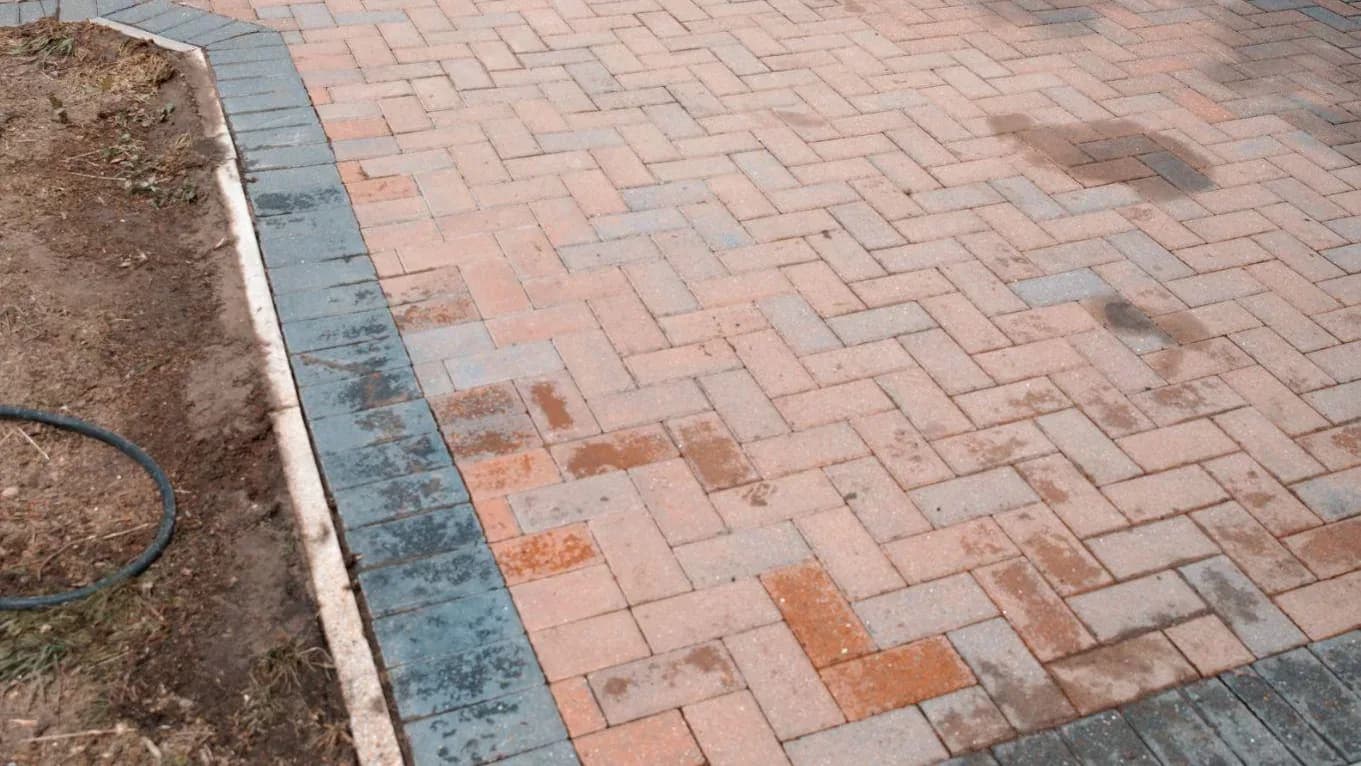
Efflorescence on paving is a white, grey or chalky mineral deposit left when moisture carries soluble salts to the surface and then evaporates. It is common on new concrete blocks and slabs, usually affects appearance rather than strength, and often fades as the available salts and construction moisture reduce.
The important question is not simply how to remove the white marks. You first need to confirm that the deposit is efflorescence, understand why moisture is moving through the paving and decide whether treatment is necessary. Cleaning the visible salts without addressing continuing moisture can produce only a temporary result.
What Does Efflorescence Look Like on Paving?
Efflorescence normally appears as a pale powder, cloudy bloom or irregular white-grey haze. The deposit can affect individual blocks, follow slab edges or spread across a wider area. Heavy deposits can form a firmer crust instead of loose powder.
A useful clue is the wet-and-dry change. Efflorescence often becomes less visible when rain darkens the paving, then returns as the surface dries. Water temporarily masks the colour difference; evaporation reveals the mineral crystals again.
Appearance alone does not prove the diagnosis. Cement haze, jointing-compound residue, limescale and acid damage can all create pale marks. Check when the marks appeared, whether the surface feels powdery and whether the pattern follows moisture movement.
Why Does Efflorescence Form on Paving?
Efflorescence needs 3 things: soluble salts, water and a route to the surface. Remove any one of those conditions and fresh deposits cannot continue forming.
Soluble salts are present in the paving system
Concrete blocks, bedding mortar, jointing products and some natural stones contain mineral compounds. Water dissolves a small proportion of those salts. Calcium compounds are common in cement-based paving, although sulphates, chlorides and other salts can also contribute.
Moisture moves through pores and joints
Rain, construction water, irrigation, poor falls or moisture rising from the bedding can enter the paving system. Porous blocks and slabs allow dissolved minerals to travel through capillary pathways. The route can begin within the unit, the mortar bed or a neighbouring material.
Evaporation leaves the salts behind
Water reaching the exposed face evaporates into the air. Dissolved minerals cannot evaporate, so they crystallise on or close to the surface. Repeated wetting and drying can create several generations of white deposits.
Is Efflorescence Harmful to Paving?
Ordinary efflorescence on new concrete paving is usually cosmetic. The white bloom does not automatically mean that the blocks are weak, incorrectly manufactured or badly installed. Many deposits weather naturally without affecting the paving’s use.
Persistent or localised efflorescence still deserves investigation because the deposit records moisture movement. A patch fed by a leaking downpipe, failed joint, raised flower bed or poor drainage will continue until the water source changes. The salts are the visible symptom, not always the underlying problem.
Look beyond appearance when the paving also shows movement, crumbling, open joints, standing water or frost damage. Those symptoms require assessment of the installation rather than repeated surface cleaning.
Why Is Efflorescence Common on New Block Paving?
New concrete products contain residual construction moisture and mineral compounds from cement hydration. Early exposure to rain and drying can carry salts towards the surface, making efflorescence particularly noticeable during the first months after installation.
The effect can appear uneven because individual blocks dry at different rates. Shade, airflow, sub-base moisture, packaging and manufacturing batches all influence the pattern. Random white patches do not by themselves prove poor workmanship.
Efflorescence can also become more visible after cleaning. Washing wets the blocks, mobilises salts and then leaves them at the surface during drying. That sequence explains why some homeowners think pressure washing has created a new stain.
How to Tell Efflorescence From Other White Marks
Correct identification prevents unnecessary acid treatment, damaged surfaces and premature sealing. Use the deposit’s texture, position and history rather than relying on colour alone.
| Possible cause | Typical appearance | Useful clue | First response |
|---|---|---|---|
| Efflorescence | White powder, bloom or pale haze | Fades when wet and returns during drying | Dry brush and monitor |
| Cement or grout haze | Continuous dull film near recent pointing | Closely follows installation residue | Check jointing product guidance |
| Polymeric compound haze | Patchy film beside sanded joints | Appears after wet activation of jointing sand | Consult product manufacturer |
| Limescale | Hard pale rings or drip patterns | Follows irrigation or repeated hard-water flow | Correct the water source |
| Acid damage | Pale, dull or etched surface | Does not brush away and may feel rough | Stop chemical treatment |
Cement and grout haze
Cement haze usually follows recent pointing or grouting and creates a thin, dull film. Unlike loose efflorescence, the residue can remain firmly bonded when dry. Removal should follow the paving and jointing manufacturers’ guidance because cement removers can also attack limestone, concrete and mortar joints.
Polymeric jointing residue
Polymeric sand or brush-in compound can leave a pale film if fine material remains on the slab face during activation. The pattern often concentrates beside joints or follows washing marks. Treating the film as efflorescence can fail because the residue contains binders, not simply soluble salts.
Limescale and irrigation marks
Hard water can leave calcium-rich deposits where sprinklers, leaking taps or planters repeatedly wet the same area. Rings, arcs and drip trails point towards an external water source. Correcting the spray or leak matters more than repeatedly cleaning the marks.
Bleaching and acid damage
Acid damage changes the surface instead of leaving a removable deposit. The affected paving can look pale, dull or rough even after thorough rinsing. Additional acid cannot dissolve the damage and can extend it.
Does Efflorescence Disappear Naturally?
Many cases become less noticeable through normal weathering. Rain dissolves part of the deposit, traffic loosens crystals and successive wet-dry cycles exhaust accessible salts. The timescale varies from weeks to many months because paving systems hold different amounts of moisture and salt.
Avoid promising a fixed disappearance date. New concrete blocks in an open, well-drained position often clear faster than shaded paving over a wet bed. Recurring deposits beside one wall or drainage point can remain until the moisture route is corrected.
Waiting is often the least damaging first response when the paving is new, sound and only lightly affected. Photograph the same dry area every 4 weeks to judge the trend accurately rather than comparing one wet day with another dry day.
How to Remove Efflorescence From Paving Safely
To remove efflorescence from paving safely, start dry, use the least aggressive method and match any cleaner to the surface. Do not seal or apply strong acid simply because the paving looks white.
Start with dry brushing
Choose a dry day and allow the paving to dry fully. Sweep the deposit with a clean, stiff nylon brush, then collect the powder rather than washing it into nearby joints. Dry removal avoids dissolving the salts and drawing part of the solution back into the paving.
Identify the paving material
Confirm whether the surface is concrete block, clay, sandstone, limestone, porcelain or another material. Acid sensitivity varies sharply. Limestone and cement-based products can react with acids, while some dense porcelain surfaces tolerate products that would alter natural stone.
Test a compatible efflorescence remover
Use a purpose-made product only when its manufacturer approves the exact surface. Test a small inconspicuous area at the stated dilution and dwell time. Rinse fully, allow the patch to dry and check colour, texture and sheen before treating a larger section.
Rinse carefully and reassess when dry
Use controlled water flow and protect plants, metals, ponds and drainage. Avoid saturating the bedding or newly completed joints. Judge the result only after complete drying because wet paving hides the white contrast.
Will Pressure Washing Remove Efflorescence?
Pressure washing can dislodge loose surface deposits, but it does not stop salts travelling through wet paving. Heavy washing can introduce more water, remove jointing sand or expose aggregate before the underlying moisture cycle has finished.
Use pressure only when the paving and jointing can tolerate it, and treat pressure as one part of a controlled method. Chiltern Surface Co explains this principle in our cleaning approach: the surface, condition and contamination decide the treatment, not the machine.
A narrow nozzle held close to the surface can create permanently lighter tracks that resemble cleaned areas. Once the surface texture changes, further washing usually increases the contrast.
Can You Use Vinegar or Brick Acid on Efflorescence?
Do not treat vinegar or brick acid as universal remedies. Both are acidic, and acid can etch limestone, alter dark natural stone, attack concrete products and weaken cementitious joints.
A cleaner that removes white salts from clay brick can damage adjacent slabs or metal edging. Product strength, surface composition, dwell time and rinsing all matter. Follow written compatibility guidance rather than an online dilution copied from another surface.
Marshalls advises testing a small, inconspicuous area before broader cleaning and explains that efflorescence is generally a naturally occurring deposit. Its efflorescence treatment guide provides useful manufacturer-level background.
Should You Seal Paving With Efflorescence?
Do not seal active efflorescence without checking the paving and sealer manufacturers’ requirements. A sealer does not remove existing salts, and some film-forming products can trap moisture or make later treatment more difficult.
Wait until the paving has dried, the deposit has stabilised and any required cleaning has been completed. Some paving products require a defined period before sealing. The correct interval depends on the block, installation, weather and chosen sealer, so use the actual manufacturer’s specification.
Sealing can reduce liquid water entry on suitable surfaces, but no sealer guarantees permanent prevention. Moisture can still reach paving from below, from open joints or from adjacent ground. Breathability and drainage remain important.
Why Does Efflorescence Keep Returning?
Efflorescence returns because fresh moisture continues dissolving and transporting salts. Reappearance after cleaning does not necessarily mean that the cleaning failed; the treatment removed one deposit while the paving produced another.
Check for standing water, incorrect falls, leaking gutters, dripping taps, irrigation overspray and saturated planting beds. Also inspect open joints and areas where the paving meets walls or raised ground. A repeated band or isolated patch often reveals the moisture route.
If the whole installation is new, time and drying can be the main solution. If an established patio suddenly develops concentrated deposits, investigate what changed before applying another cleaner.
When Does Professional Treatment Make Sense?
Professional assessment makes sense when deposits are widespread, firmly crusted or repeatedly returning. It is also sensible for limestone, valuable natural stone, sealed paving or surfaces already exposed to acid.
A specialist should distinguish efflorescence from cement haze, limescale, polymeric residue and surface damage. The realistic outcome can range from simple dry removal to moisture correction, controlled chemical treatment or restoration of a wider paved area.
For patios with several problems, Chiltern Surface Co’s guide to restore your patio explains how cleaning, joints, repairs and protection fit together rather than competing with each other.
How to Reduce Future Efflorescence
You cannot remove all naturally occurring salts from every paving system, but you can reduce the conditions that transport them. Maintain clear drainage, correct persistent leaks and avoid repeatedly saturating the surface during cleaning.
Keep joints in sound condition and prevent soil or mulch from holding water against slab edges. Direct sprinklers away from paving, clean gutters and check that downpipes discharge correctly. Use compatible breathable protection only after the paving has stabilised and dried.
For block-paved areas, joint condition matters after cleaning. Chiltern Surface Co’s block paving cleaning guide explains why re-sanding and surface care should form part of the same maintenance plan.
Understand the White Marks Before Treating Them
Efflorescence is usually a visible record of moisture carrying salts through paving, not a sign that the surface needs immediate aggressive cleaning. Confirm the deposit, monitor new paving and correct persistent water sources before choosing treatment.
If the marks keep returning or the paving material is uncertain, arrange a Free Site Assessment with Chiltern Surface Co. We will inspect the surface, explain the likely cause and provide a clear Free Quotation for any appropriate treatment.
Frequently asked questions
Is efflorescence a sign of faulty paving?
No, not usually. Efflorescence is common in cement-based products and often reflects normal moisture and salt movement. Persistent local deposits can still indicate drainage or water-entry problems.
Why does efflorescence disappear when paving is wet?
Water darkens the surface and temporarily dissolves or masks the pale crystals. The salts become visible again when the water evaporates and leaves mineral residue behind.
How long does efflorescence last on block paving?
No fixed period applies. Light deposits can fade within weeks, while repeated blooms can continue for months where the paving retains construction moisture or receives regular water.
Can efflorescence come back after cleaning?
Yes. Cleaning removes the visible deposit but does not always remove the salts or moisture route. Fresh deposits can form during later drying cycles.
Is efflorescence the same as mould?
No. Efflorescence is a mineral deposit, while mould and algae are biological growth. The correct cleaning chemistry differs, so confirm the contamination before treatment.