Drone cleaning
Bucks · Oxon · Berks · Herts · SurreyBuckinghamshire · Oxfordshire · Berkshire · Hertfordshire · Surrey
Drone cleaning for commercial buildings
High façades, cladding and roofs cleaned from the ground. No scaffold, no lift and no one working at height. We're bringing drone cleaning to Buckinghamshire, Oxfordshire, Berkshire, Hertfordshire and Surrey. Book a free demonstration on your own building.
We aim to reply to every survey request within one hour, 8am to 6pm, Monday to Saturday.
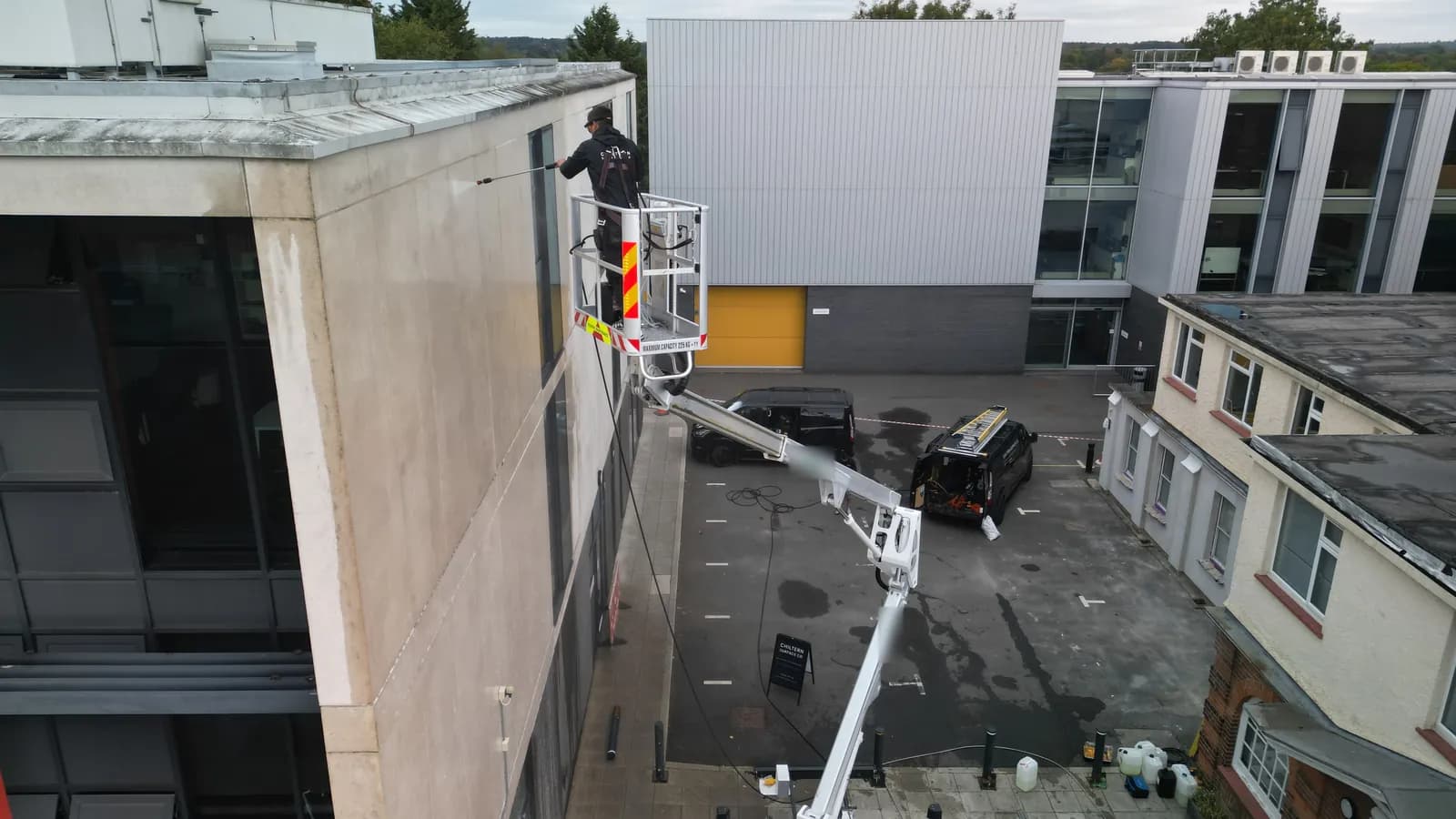
On sitePhotographed by drone: soft washing the render below the roof edge from the platform basket.
- Free survey
- within five working days
- Reply within one hour
- we aim to, 8am to 6pm, Monday to Saturday
- 5-star rating
- on Google
- DBS-checked
- IPAF-accredited Chiltern Surface Co technicians
- £5m
- public liability insurance
Why drones
Why drones
We stay at the cutting edge of exterior cleaning technology, so our clients get the best value. Right now, that means drone cleaning.
- Safer
- Nobody works at height. The pilot and the crew stay on the ground, and the area below is coned off. There's no scaffold to climb and no basket to work from.
- Quicker
- Nothing to erect or strike. There's no scaffold to put up or take down, and no lift to set up and move along each elevation. Jobs that would take days with access equipment can often be done in less time on site, with less disruption to the building.
- More cost-effective
- On many buildings the biggest cost isn't the cleaning but the access: scaffold hire, lift hire, or a rope team. Take that out and the price often comes down. We'll show you both options at the survey, priced side by side, so you can see for yourself.
Access compared
Drone, powered access or scaffold?
The right way to reach a building depends on its height, its surfaces and how the site is used. We'll recommend one at the survey and explain why.
Drone
- Set-up
- Minimal: the drone and its crew arrive and start once the area below is closed off
- Disruption
- Low: a moving exclusion zone on the ground, and nothing fixed to the building
- Time on site
- Usually the shortest
- Working at height
- Nobody works at height
- Best for
- Tall façades, cladding and roofs you can't walk on, with open access below
- Less suited to
- Wind and rain, restricted airspace, busy public areas that can't be closed
Powered access
- Set-up
- A lift is delivered and positioned at each elevation
- Disruption
- Moderate: the lift and its outriggers take up space at the base
- Time on site
- Moderate
- Working at height
- A technician works from the platform
- Best for
- Detail work, hand methods, gutters and fascias, and buildings in restricted airspace
- Less suited to
- Tight courtyards, soft ground and very tall elevations
Scaffold
- Set-up
- Erected before work starts and taken down afterwards
- Disruption
- Highest: the structure stays in place for the whole job
- Time on site
- Usually the longest, including erecting and striking
- Working at height
- Technicians work from the scaffold
- Best for
- Long, complex jobs that also involve repairs or other trades
- Less suited to
- Short cleaning-only jobs, where it rarely makes sense on cost
We price the options side by side at the survey, so you can see which is better value for your building.
Where it fits
What it suits
Tall façades, render and cladding that would otherwise need scaffold or powered access
Roofs you can't safely walk on. Cleaning from above means no one on the roof at all
High fascias, soffits and parapets
Sites where a lift can't get in: tight courtyards, soft ground, or no room for outriggers
Limits
When we'd use something else
We'll tell you at the survey if a drone isn't the right tool. That includes:
Wind and rain
Drones need calm weather. Visits are rescheduled at no cost.
Restricted airspace
There are flight restriction zones around airfields across our area. We check every site before quoting.
Busy public areas that can't be closed off underneath.
Detail work and listed buildings, where test areas and hand methods come first.
Asbestos-cement roofs
These are never pressure-washed, by drone or any other way.
On the day
What happens on the day
- 01
Survey
We photograph the building by drone and check the airspace, access and drainage.
- 02
Flight plan and RAMS
The flight area, the exclusion zone below and the wash-water plan are agreed with your site contact.
- 03
Cleaning
The drone works one elevation at a time, with the exclusion zone moving with it.
- 04
Report
Before-and-after drone photos of every elevation, taken from the same positions.
Rules
Rules and insurance
Commercial drone cleaning in the UK needs an operational authorisation from the Civil Aviation Authority, a qualified remote pilot and insurance that covers drone operations. All three will be in place before we fly on any client's site.
Demonstration
Book a demonstration
See it on your own building before you commit to anything. We'll bring the drone, clean a test area and show you the result.
See it on your building
Book a 15-minute call to arrange a free drone cleaning demonstration on your site. We'll check the airspace and access, then agree a date.
Office01628 232 450- Office
- 01628 232 450
- Mobile
- 07308 755 755WhatsApp
We aim to reply to every survey request within one hour, 8am to 6pm, Monday to Saturday.
Safety and site control
Planned before we arrive
- Roofs
- We identify the roof covering before any work is proposed and request the asbestos register. Asbestos-cement and fragile roofs are never pressure-washed or walked on.
- Wash water
- We plan wash-water control and drain protection for every site.
- Listed and conservation buildings
- We use test areas and low-pressure methods on listed and conservation-area buildings.
Questions
Drone cleaning FAQs
Is it really more cost-effective?
Often, because it takes out scaffold or lift hire. Not always: on low buildings, a pole or a lift can still be the better value. The survey prices both options.
Is it safe near our staff and visitors?
The area below is closed off while the drone works, and we plan the timing around how your site is used.
What about the water and chemicals?
The same wash-water control and drain protection we use on every job.
Related