
Hard surfaces
Buckinghamshire · Oxfordshire · Berkshire
Commercial Pressure Washing for External Hard Surfaces
Professional cleaning for commercial paving, concrete, forecourts, courtyards and communal areas across Buckinghamshire, Oxfordshire and Berkshire.
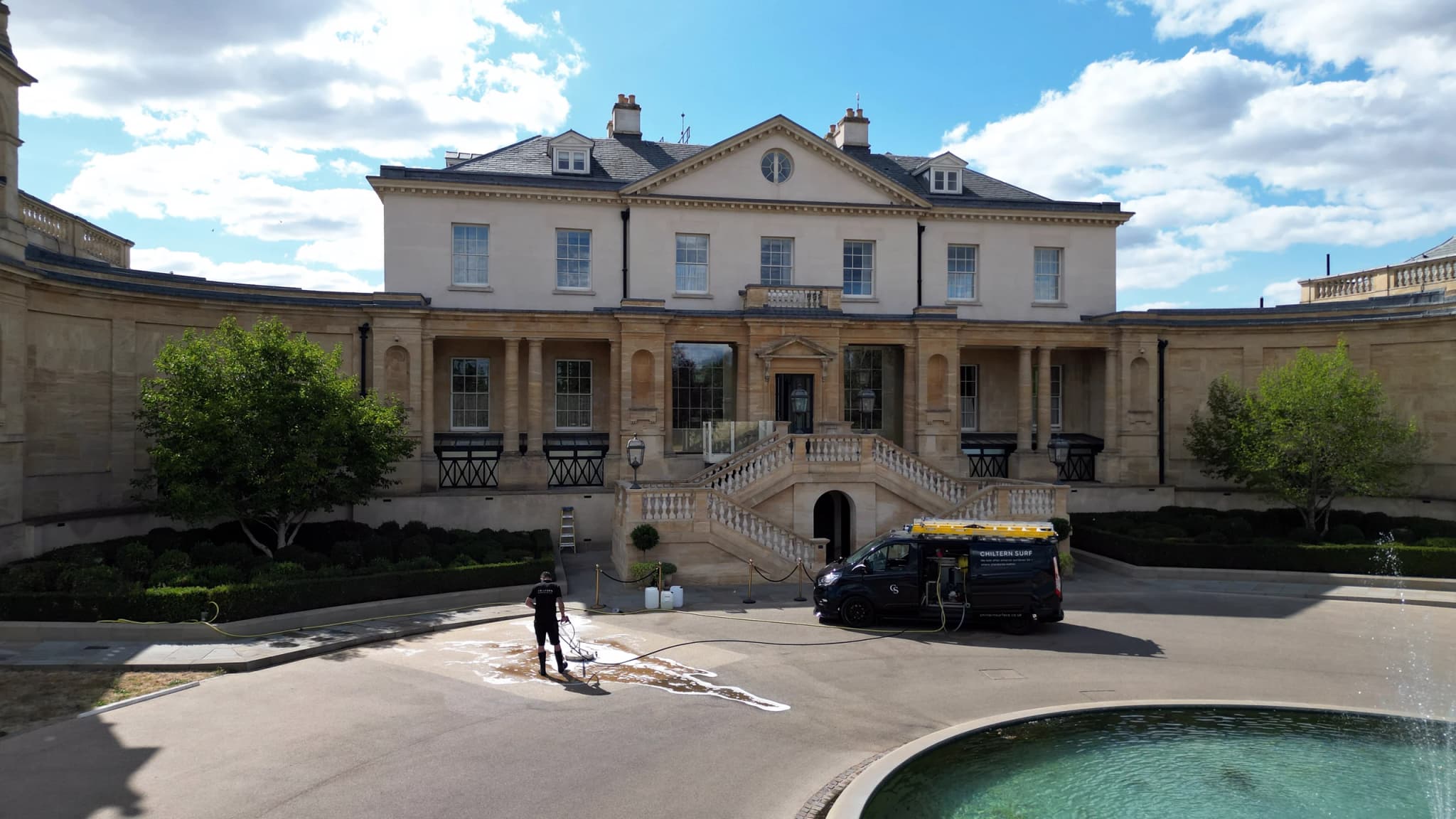
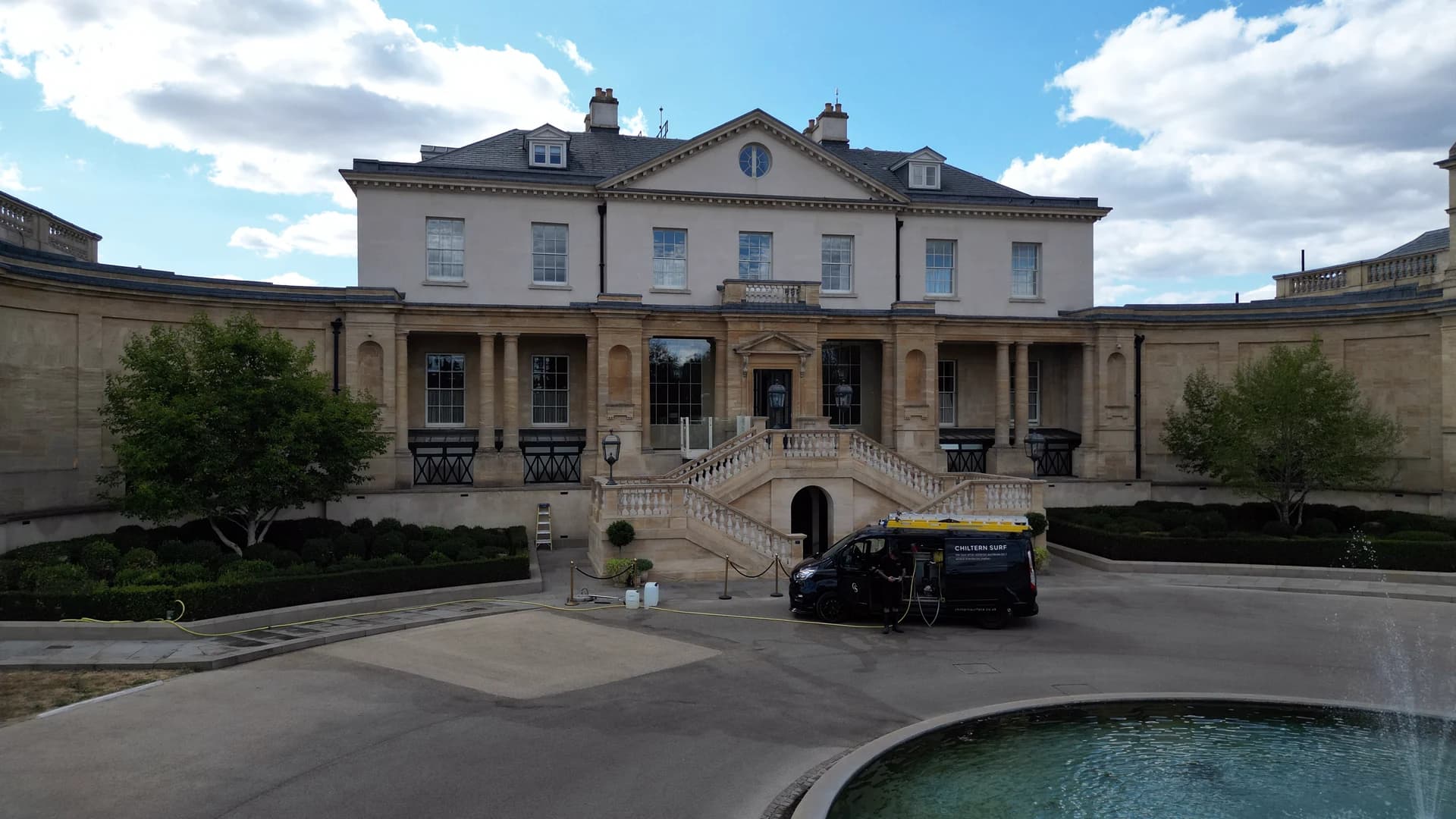
On siteWorks: surface cleaner on a foamed patch of paving behind a stanchion cordon
- IPAF
- Accredited operators on every lift
- £10m
- Public liability insurance
- RAMS
- Site-specific, issued before we mobilise
- 5 days
- From request to survey
Photographic record
From mobilisation to the completion report
- Office
- 01628 232 450
- Mobile / WhatsApp
- 07308 755 755WhatsApp
The problem
What build-up does to commercial hard surfaces
Entrances, approaches, paths and courtyards are heavily used external areas on a commercial site. Forecourts take repeated vehicle and pedestrian traffic while creating the first impression of the property, and the areas that most need cleaning are usually the ones that must stay in use.
Sites add their own constraints, such as tenants and several buildings on business parks, deliveries and continuous trading in retail, and occupied buildings at schools and colleges. The sector pages cover each one.
- Build-up
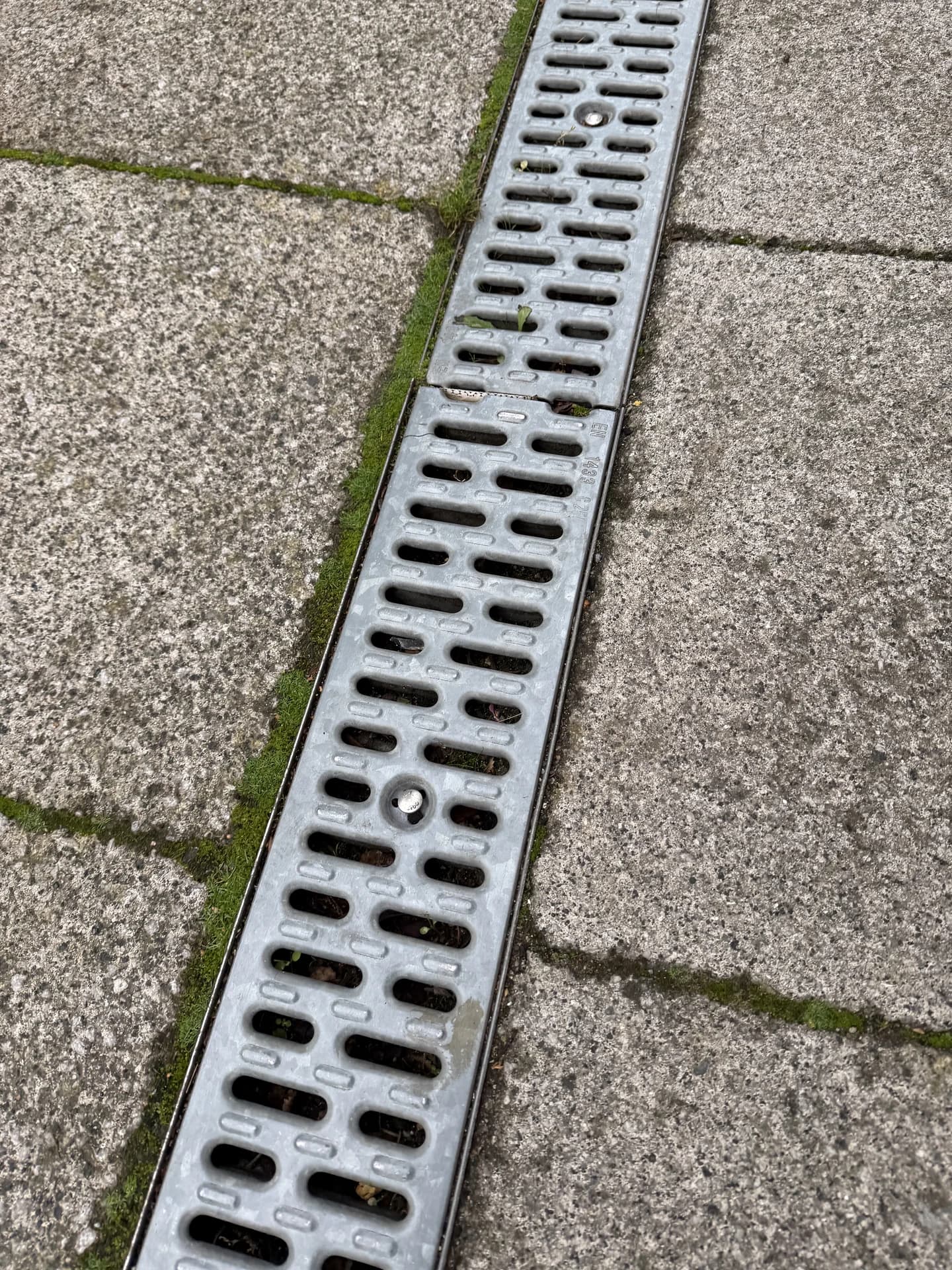
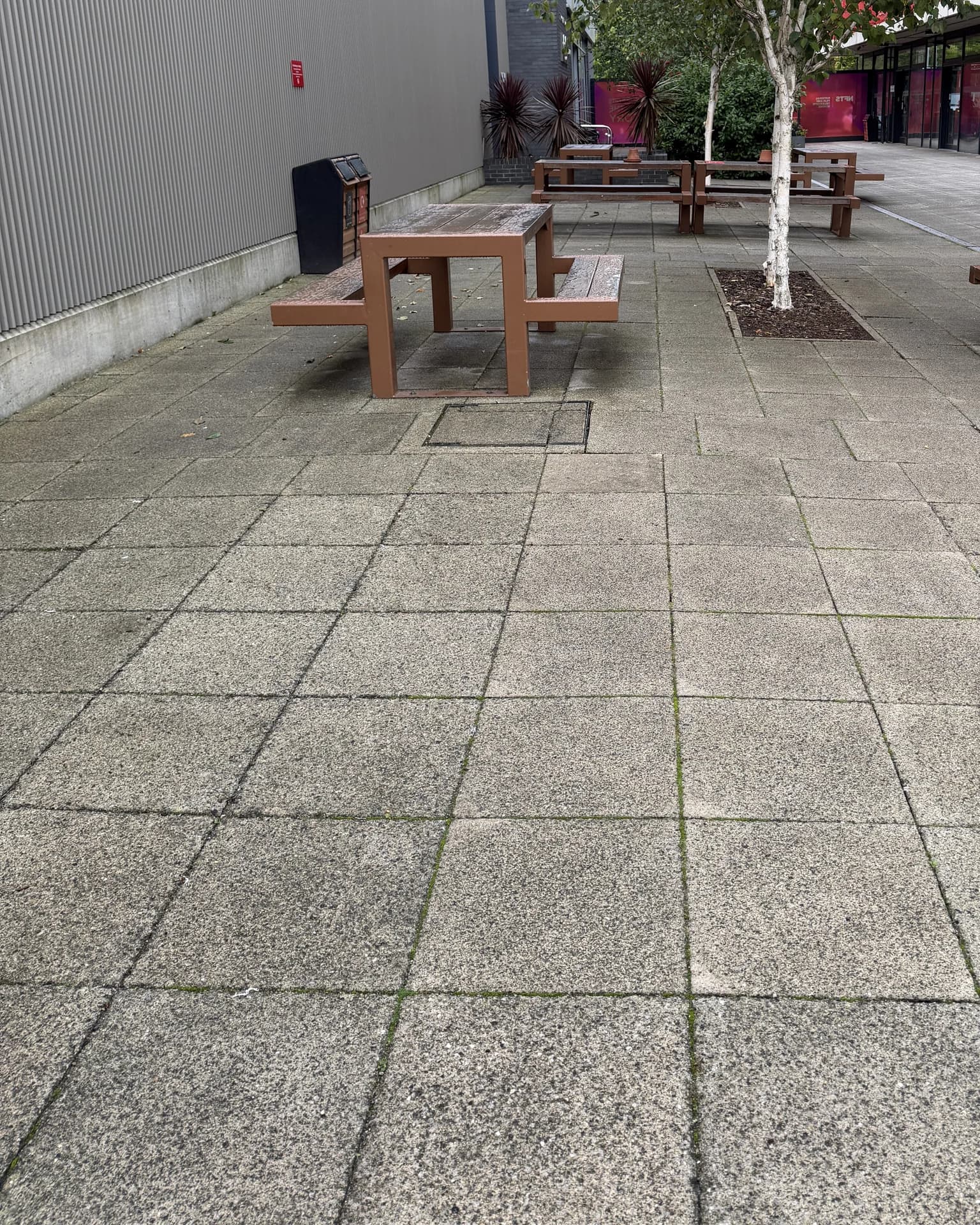
- Concrete holds vehicle residue, atmospheric dirt and organic growth within its textured surface. Block paving carries surface grime, algae, moss and loose weed growth, and pressure cleaning can disturb its jointing sand.
- Mixed contamination
- Not every mark has the same cause: algae and moss behave differently from oil, rust, chewing gum, paint, cement residue or deeply absorbed staining.
- Absorbed staining
- Oil, fuel and other staining can penetrate porous surfaces. Treatment may improve it, but complete removal cannot be assumed: where it cannot be guaranteed, we say so before works begin and set out the expected improvement.
- Hidden condition
- Existing wear, failed joints, cracks, loose pointing or surface erosion can become more visible after cleaning. These are condition issues rather than dirt, and may need repair.
- Recurring build-up
- Busy entrances, shaded paths and vehicle areas build up again after cleaning, so they are often better served by planned preventative maintenance (PPM) than by a one-off clean. A one-off clean suits a site before an opening, inspection, handover or event.
What we do
Specification of works
Hard surfaces can be cleaned as individual areas or coordinated across a wider property under one specification of works.
| Areas | Concrete, block paving, paving slabs and suitable natural stone at entrances and approaches, forecourts, paths, courtyards, communal spaces, terraces and outdoor seating areas, with suitable steps, ramps and boundary details. Service yards and loading bays are covered under industrial yard and warehouse cleaning; car parks and walkways under car park and walkway cleaning. |
|---|---|
| Method | Pressure washing is one method among several: delicate, damaged, coated or poorly jointed surfaces are cleaned at lower pressure, soft washed or given another process. Where pressure washing suits the surface, Chiltern Surface Co technicians set pressure, water flow, nozzle, working distance and the number of passes for each material, adjust them where the material or condition changes, and pre-treat where the staining needs it. Cement, paint, adhesive and sealant residues may not respond to pressure washing; we test suitability before the specification of works is set. |
| Arisings | Moss and loose weed growth cleared from the surface are removed from site as arisings, with skip provision where required. |
| Before work starts | We review falls, channels, gullies, planting, entrances and adjoining surfaces, and ask you to identify known drainage restrictions, sensitive areas and site rules. Vehicles, furniture and loose items are managed as agreed, and the areas, sequence and any temporary access restrictions are agreed before work begins. |
| Recorded | Failed joints, cracks, loose pointing, settlement and surface erosion that the clean reveals are listed in the completion report's defect schedule. |
| Exclusions | Stain removal, repairs, re-sanding and sealing are included only where the specification of works states them. Internal floors, hazardous residues, hazardous-material handling and specialist remediation are outside the scope. We do not attend spill or pollution incidents: residual oil staining is treated after the event under oil stain and contamination removal. |
- Office
- 01628 232 450
- Mobile / WhatsApp
- 07308 755 755WhatsApp
Included on the project
- Fixed-price proposalspecification of works, programme and exclusions
- Site-specific RAMS issued before mobilisation
- Arisings removed from site
- Completion reportbefore-and-after photography and defect schedule
- £10 million public liability cover
How the work is delivered
Survey it. Specify it. Plan it. Deliver it. Document it. Maintain it.
- 01SurveySite visit, with the condition photographed.
- 02ProposalFixed price, with specification of works, programme and exclusions.
- 03MobilisationRAMS issued; drainage drawings and site rules checked.
- 04WorksZone by zone behind exclusion areas, with arisings removed and wash-water control planned.
- 05Completion reportBefore-and-after photography, a defect schedule and sign-off.
- 06PPMA planned maintenance proposal, so the problem does not come back unnoticed.
- Office
- 01628 232 450
- Mobile / WhatsApp
- 07308 755 755WhatsApp
Safety and site control
Planned before we arrive
- Wash water
- We plan wash-water control and drain protection for every site.
- Schools and care settings
- We work in school holidays and INSET days, or behind exclusion zones away from pupils and residents.
Related
Where hard-surface work connects
Questions
Pressure washing FAQs
Is pressure washing suitable for every external surface?
No. The survey confirms which surfaces can take pressure washing, and the specification of works names another method for any that cannot.
Can you work while the site stays open?
Yes. Works are phased zone by zone behind agreed exclusion areas, so access can be maintained wherever the site conditions allow. Out-of-hours working is available where the site needs it.
Is re-sanding included when block paving is cleaned?
No, unless the specification of works states it. Where the clean removes jointing sand and re-sanding is suitable, it is priced as a separate follow-on stage once the paving has dried sufficiently.
How is the work priced?
At a fixed price, set after the survey from the area, surface types, condition, staining, access, drainage and preparation. There are no day rates and no overrun charges.
How often should commercial hard surfaces be cleaned?
It depends on the material, shade, drainage, footfall, vehicle traffic and the presentation standard the site needs. The completion report ends with a PPM proposal and a suggested review cycle for the site.
What do you need from us before the survey?
The property address, the surface types, the approximate area, known stains, access restrictions, drainage concerns and your preferred timescale. Photographs and site plans are useful where available.
Next step
Request a Site Survey
Tell us about the property, the surfaces that need attention and any known access, staining or drainage concerns. We survey the site, then send a fixed-price proposal with a specification of works, programme and exclusions.
- Office
- 01628 232 450
- Mobile / WhatsApp
- 07308 755 755WhatsApp