
High-level access cleaning
Bucks · Oxon · Berks · Herts · SurreyBuckinghamshire · Oxfordshire · Berkshire · Hertfordshire · Surrey
Commercial High Level Access Cleaning
Façades, cladding and rooflines that cannot be reached from the ground are cleaned from powered access. Commercial high-level access cleaning across Buckinghamshire, Oxfordshire, Berkshire, Hertfordshire and Surrey.
We aim to reply to every survey request within one hour, 8am to 6pm, Monday to Saturday.
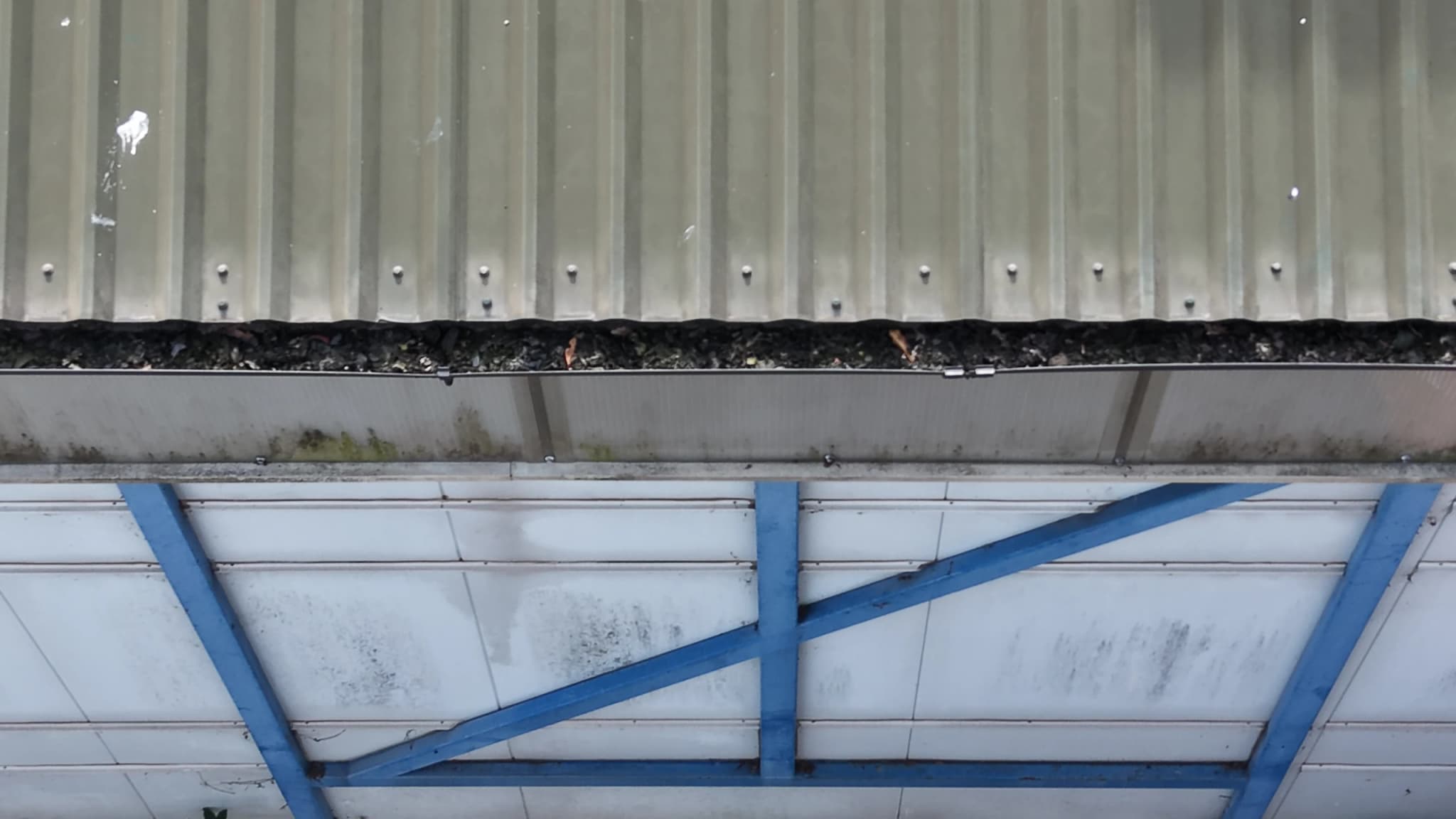
Drone survey: a gutter packed with leaves and debris at a high roof edge
- Free survey
- within five working days
- Reply within one hour
- we aim to, 8am to 6pm, Monday to Saturday
- 5-star rating
- on Google
- DBS-checked
- IPAF-accredited Chiltern Surface Co technicians
- £5m
- public liability insurance
Included on the project
- Powered accessoperated by IPAF-accredited Chiltern Surface Co technicians
- Drone survey of roofs and high-level areaswhere needed
- Site-specific RAMS issued before mobilisation
- Fixed-price proposalspecification of works, programme and exclusions
- Weather rescheduling free of charge
- Completion reportbefore-and-after photography and defect schedule
The problem
The condition above ground level
Upper elevations collect airborne dirt, traffic film, organic growth and weather-related staining in areas that are hard to inspect from the ground. When a surface cannot be reached effectively from ground level, the access method becomes part of the specification of works.
Height is only one consideration. Setbacks, roof overhangs, narrow approaches, ground conditions, parked vehicles, pedestrian routes and the position of the surface all affect what is practical. We plan the access and the treatment as one scope, so the working position suits the method and the finish the surface needs.
- Staining at height
- Run marks, algae, bird fouling and atmospheric contamination collect around joints, ledges and sheltered upper sections of façades and cladding.
- Condition out of sight
- Defects in gutters, fascias, soffits and roofline details can go unnoticed between inspections.
- Operational disruption
- Access equipment, exclusion space and the work sequence affect entrances, parking, deliveries and pedestrian movement unless they are planned in advance.
Access compared
Drone, powered access or scaffold?
The right way to reach a building depends on its height, its surfaces and how the site is used. We'll recommend one at the survey and explain why.
Drone
- Set-up
- Minimal: the drone and its crew arrive and start once the area below is closed off
- Disruption
- Low: a moving exclusion zone on the ground, and nothing fixed to the building
- Time on site
- Usually the shortest
- Working at height
- Nobody works at height
- Best for
- Tall façades, cladding and roofs you can't walk on, with open access below
- Less suited to
- Wind and rain, restricted airspace, busy public areas that can't be closed
Powered access
- Set-up
- A lift is delivered and positioned at each elevation
- Disruption
- Moderate: the lift and its outriggers take up space at the base
- Time on site
- Moderate
- Working at height
- A technician works from the platform
- Best for
- Detail work, hand methods, gutters and fascias, and buildings in restricted airspace
- Less suited to
- Tight courtyards, soft ground and very tall elevations
Scaffold
- Set-up
- Erected before work starts and taken down afterwards
- Disruption
- Highest: the structure stays in place for the whole job
- Time on site
- Usually the longest, including erecting and striking
- Working at height
- Technicians work from the scaffold
- Best for
- Long, complex jobs that also involve repairs or other trades
- Less suited to
- Short cleaning-only jobs, where it rarely makes sense on cost
We price the options side by side at the survey, so you can see which is better value for your building.
Signs your site needs this
- Upper floors dirtier than the ground floor
- Streaks below rooflines, parapets and high windows
- Growth on high render or cladding that can't be reached from the ground
- Dirt on high-level signage and canopies
What sets the price
- Area
- Height and access
- Surface and condition
- Working hours
- Phasing and drainage
The survey is how you get to a fixed price.
What cleaning can't fix
We'll tell you at the survey, and in each report, when the answer isn't cleaning. That includes cracked or failing render, worn-out paving, leaking gutters and joints, and stains that have soaked deep into the surface.
What happens on the day
- The date confirmed a week ahead
- Zones coned off one at a time
- Before-and-after photos of each zone
- The report sent afterwards
Safety and site control
Planned before we arrive
- Roofs
- We identify the roof covering before any work is proposed and request the asbestos register. Asbestos-cement and fragile roofs are never pressure-washed or walked on.
- Wash water
- We plan wash-water control and drain protection for every site.
- Schools and care settings
- We work in school holidays and INSET days, or behind exclusion zones away from pupils and residents.
- Weather
- Our normal lift wind limit is 20 mph. Weather rescheduling is free of charge.
- Office
- 01628 232 450
- Mobile
- 07308 755 755WhatsApp
We aim to reply to every survey request within one hour, 8am to 6pm, Monday to Saturday.
How it works
How it works
- 01
Free site survey
Site visit, with roofs and high-level areas surveyed by drone where airspace permits and the condition photographed. Access planning sets the lift's set-up positions and working height, and the safety controls and the line of rainwater drainage are recorded with them, so the RAMS covers all three. - 02
Fixed-price proposal
What we'll do, when, and what's excluded. No day rates. - 03
Planning
Site-specific RAMS issued. We check the asbestos register, drainage drawings and site rules before we start. - 04
The work
Zone by zone behind barriers. Debris removed and wash water controlled. - 05
Completion report
Completion report: before-and-after photography of every area reached from the lift, the defect schedule for anything found at height, and sign-off. - 06
Planned maintenance
The report records which access method and which cleaning method each area received, and how the sections were phased. An optional PPM schedule then sets the ongoing maintenance and scope for each return visit.
Photographic record
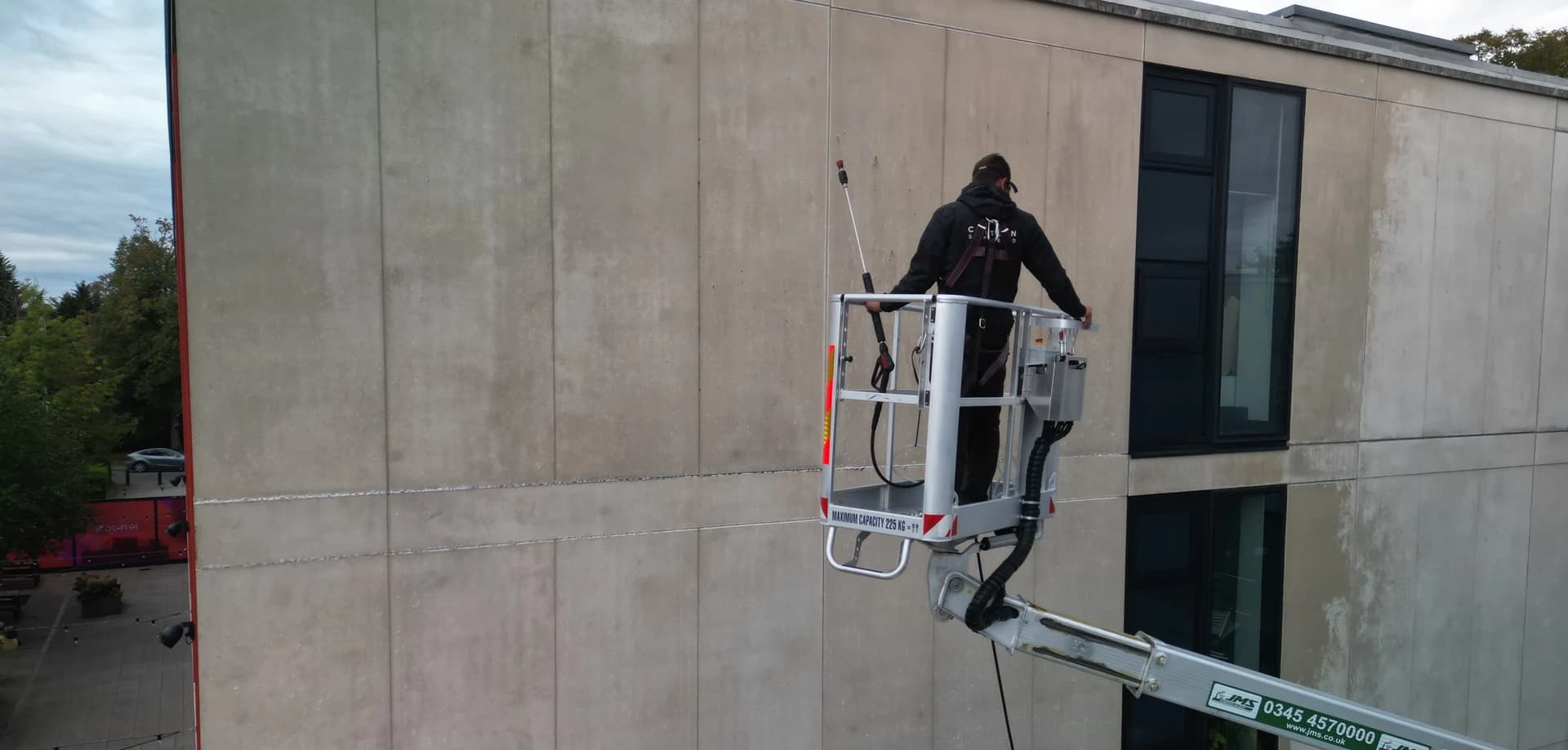
Work at height from powered access
What we do
Scope of the works
Where several high-level areas need the same access, such as façade or cladding sections alongside roofline details, gutters, soffits or signage, we specify them together for the same visit. Each surface and its treatment stays separately defined. A one-off clean suits a handover, rebrand, inspection or lease event. Where shade, nearby trees or persistent organic growth bring the staining back, planned preventative maintenance (PPM) moves the building from reactive cleaning to a known maintenance cycle.
| Areas | Upper-level façades, render and masonry; metal, composite and uPVC cladding, including long warehouse and industrial elevations; high gutters, fascias, soffits and roofline details; canopies, entrance features and architectural elements; external signage and selected high-level fixtures. |
|---|---|
| Method | IPAF-accredited Chiltern Surface Co technicians work from powered access. Render, coated panels and cladding respond differently to pressure, products and dwell time, so the survey sets the treatment: controlled rinsing, soft washing or careful manual agitation, without an unnecessarily aggressive process. We recommend test areas where a finish or previous treatment is uncertain. The surface methods are set out under façade cleaning, render and masonry cleaning and cladding cleaning. |
| Arisings | Where gutter or roofline clearance is in the specification, arisings are removed from site, with skip provision where required. The gutter method is set out under gutter and high-level cleaning. |
| Before work starts | The survey checks the lift's approach and set-up positions: access width, gates, gradients, ground bearing conditions, overhead restrictions, nearby structures and activity around the working area. The chosen set-up positions and exclusion areas are then set out in the site-specific RAMS. We request the site's asbestos register and drainage drawings before roof or gutter work. |
| Recorded | Visible concerns found at height, such as damaged seals, joints or coatings, go into the completion report's defect schedule. |
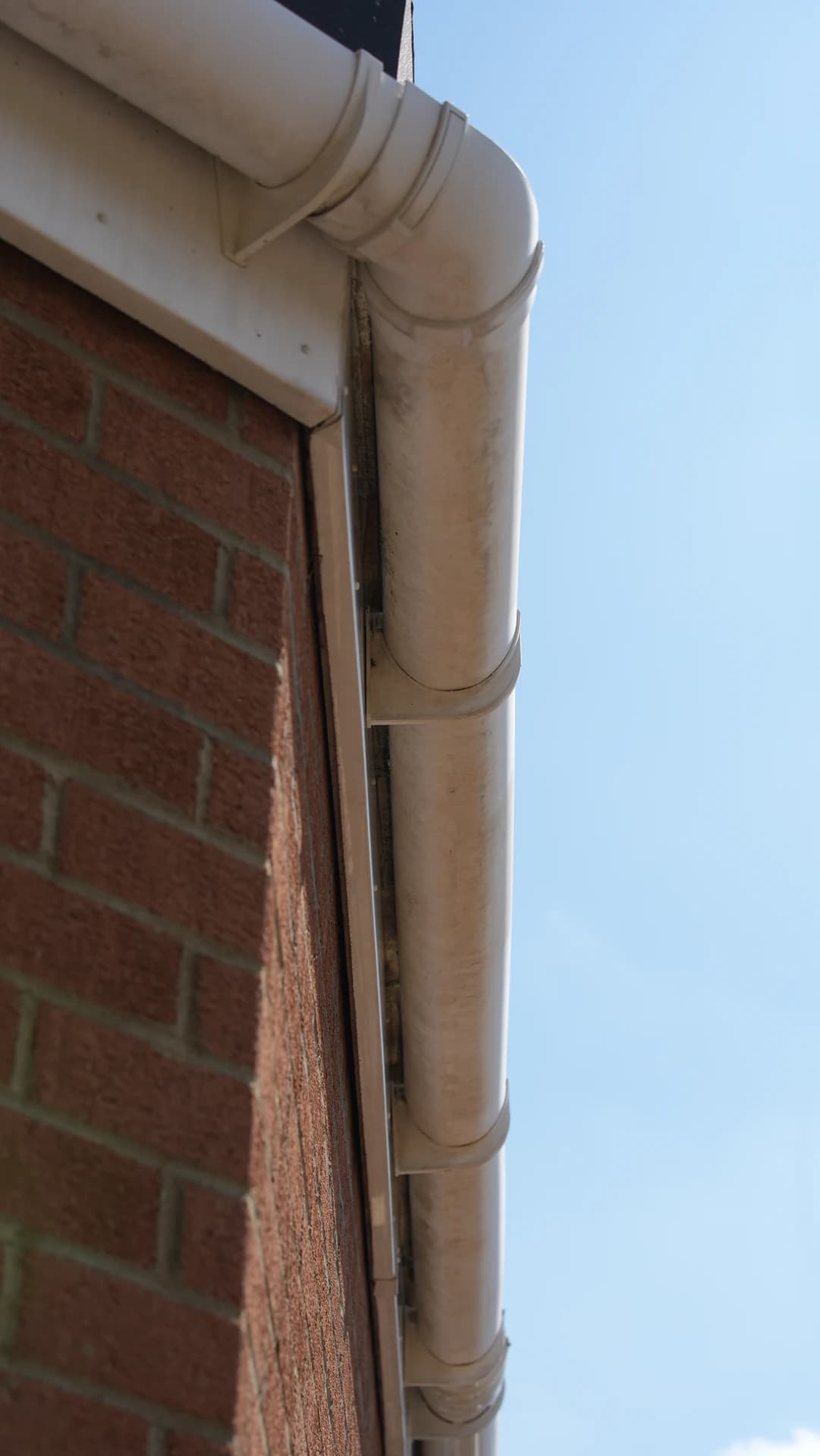
| Gutters and rooflines | Gutter clearing from powered access suits runs that a ground-level gutter vacuum cannot reach. Blocked gutter cleaning is done by hand and by flushing, with downpipe unblocking where an outlet is restricted and the downpipes checked for flow. Fascias and soffits are cleaned from the same platform, and any water overflow staining below the run is noted so the rainwater drainage can be reviewed. The gutter cleaners are Chiltern Surface Co technicians. |
| Exclusions | Cleaning does not repair or recoat the building fabric, and window cleaning and specialist maintenance are not part of the specification of works. Any area the lift cannot reach from the available set-up positions is named in the exclusions. |
Questions
High-level access cleaning FAQs
What is high-level access cleaning?
Exterior cleaning of areas that cannot be reached or treated effectively from the ground, such as upper façades, cladding, rooflines, gutters, canopies and signage. Chiltern Surface Co combines access from powered access with a cleaning method selected for each surface, set out in the specification of works.
Who operates the lift?
Our own IPAF-accredited Chiltern Surface Co technicians. High-level areas are reached from powered access, and the access is set out in the fixed-price proposal, with no day rates and no overrun charges. The lift's position, exclusion zone and set-up points are planned at the survey.
Can the work be planned around an occupied building?
Yes. The survey records entrances, pedestrian routes, vehicle movements, deliveries and the normal use of the site, and on industrial sites the loading areas, yard activity and production access. Chiltern Surface Co phases the works zone by zone behind agreed exclusion areas, so access can be maintained wherever the site conditions allow.
Does weather affect high-level work?
Yes. Wind, heavy rain, low temperatures and poor drying conditions affect lift use, application and rinsing. The lift's normal wind limit is 20 mph, and weather rescheduling is free of charge, so Chiltern Surface Co moves the visit rather than working at height in unsuitable conditions.
What do we receive when the work is complete?
A completion report from Chiltern Surface Co, with before-and-after photography, a defect schedule covering anything found at height, and sign-off. Where the building warrants it, the report ends with a PPM proposal and a suggested review cycle based on the material, exposure, building use and the standard of presentation you need.
What do you need from us before the survey?
The site address, building type, approximate number of storeys, the surfaces that need attention, known access restrictions and any preferred timescale. Photographs, elevations and site plans help. For roof or gutter work, Chiltern Surface Co also asks for the site's asbestos register and drainage drawings.
Next step
Request a Site Survey
Tell us about the building, the surfaces that need attention and any known access constraints. We survey the site and the lift's set-up positions, then send a fixed-price proposal with a specification of works, programme and exclusions.
We aim to reply to every survey request within one hour, 8am to 6pm, Monday to Saturday.
- Office
- 01628 232 450
- Mobile
- 07308 755 755WhatsApp
Related